
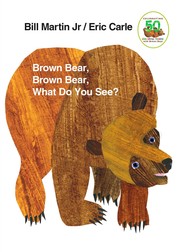
Brown Bear, Brown Bear, What Do You See?
3,226-word summary 14 min read 26 pages in the book
- First published
- 1967
- Publisher
- Henry Holt and Company
- Pages
- 26
- ISBN
- 9780805047905
Reading options
What's inside (7 sections)
I first read this one standing up, which sounds odd until you have tried to read to a room of three year olds. They do not sit still. I had borrowed the book for a niece, 26 pages, first published in 1967 by Henry Holt and Company, text by Bill Martin Jr. and pictures by Eric Carle, and I figured I would get through it in two minutes. It took closer to ten because she kept stopping me to point and to answer before I could turn the page. That is really the whole trick of the book. It asks a question, answers it, and then asks it again before a small child can forget it.
The book is short enough to hold in one hand. The ISBN of the common modern board and hardcover edition people buy now is 9780805047905. It is 26 pages long, which in practice means about eleven spreads plus the opening and closing. There is almost no plot in the usual sense. No one goes anywhere. No problem gets solved. A brown bear looks at a red bird, the red bird looks at a yellow duck, and so on down a chain of animals until a teacher looks at children, and the children look back at everybody. That sounds too thin to work for almost sixty years, but in a preschool room it works exactly because it is thin.
How a teacher's text met a young artist in 1967
Bill Martin Jr. was already well known in schools in 1967. He had been a teacher, a principal, and a writer of reading materials for young children. He cared a lot about rhythm and repetition, the way children learn language by hearing patterns over and over. The story goes that he wrote the text for Brown Bear as a kind of chant that could be read aloud, almost sung, and he was looking for someone to illustrate it.
Eric Carle was much less known at the time. He had worked in advertising and design. He had not yet made The Very Hungry Caterpillar, that came later in 1969. Martin saw some of Carle's work, including a striking red lobster Carle had made for an advertisement, and asked him to try the bear book. Carle said yes.
What Carle brought was collage. He did not paint directly on the page with a brush in the usual picture book way. His method, which he kept using for decades, was to paint sheets of thin tissue paper by hand with acrylics and brushes, sponges, and sometimes his fingers and bits of burlap to make texture. Then he cut and tore those painted papers and layered them to form animals. So a brown bear is not brown paint on white paper. It is pieces of brown paper Carle had already painted, with darker flecks and lighter strokes, cut into a big lumbering shape and pasted down. The red bird gets that scarlet lift because the paper underneath already has movement in it.
People who have tried this in classrooms know how messy and slow it is. You have to paint far more paper than you need. You wait for it to dry. You cut. You arrange. You paste. Carle kept drawers of painted tissue. For Brown Bear he was still figuring out the style that later became famous, so the shapes are simpler and flatter than in his later books, with large areas of white behind them. That white space matters. A teacher holding the book up across a rug can be seen from the back row because each animal is huge and alone on the page.
The book came out from Henry Holt and Company in 1967. It sold steadily rather than exploding. Teachers passed it around. It became one of those books that lives in school closets in battered copies with taped spines. In 1992 Holt published a restored and slightly redesigned edition with Carle reworking the art, brighter colors and cleaner shapes, which is the version most people recognize now. If you compare an old library copy to the ISBN 9780805047905 printing, the animals feel bolder and the paper texture feels clearer, though the words stayed the same except for one detail I will get to later about the ending.
Walking the chain page by page
The structure is a chain question. Each spread asks, then answers, then hands the question to the next animal.
It opens:
Brown Bear, Brown Bear, what do you see? I see a red bird looking at me.
Turn the page. Now the red bird is asked. Red Bird, Red Bird, what do you see? I see a yellow duck looking at me.
Then Yellow Duck sees a blue horse. Blue Horse sees a green frog. Green Frog sees a purple cat. Purple Cat sees a white dog. White Dog sees a black sheep. Black Sheep sees a goldfish, sometimes called a gold fish in early printings, and the goldfish sees a teacher. Teacher sees children. Children see everybody, and in many editions that means small pictures of all the animals again in a parade.
That is the entire cast. Brown bear, red bird, yellow duck, blue horse, green frog, purple cat, white dog, black sheep, goldfish, teacher, children.
What makes it fun to read aloud is that the language barely changes. A two year old can guess what comes next after two turns. You can pause before the color word and let them fill it in. You can pause before the animal word and let the older ones shout it. The rhythm is steady, four beats, question then answer. Martin was careful with that. Brown Bear, Brown Bear, what do you see? It scans. Red Bird, Red Bird, what do you see? It scans the same way. Even odd ones like Purple Cat keep the beat because Martin picked animals with short names and colors with one syllable except yellow and purple, and those still fit if you say them a little quicker.
Each animal page gives you something to talk about if you want to stretch those 26 pages. The brown bear is big and shaggy, lumbering across the first spread. Toddlers often growl or lift their paws. The red bird is perched and bright, easy to spot. The yellow duck is round and friendly, with a big orange foot that sticks out. The blue horse is the first surprise, because horses are not blue. Kids notice. They will tell you horses are brown. That is a good opening to say, in this book they can be blue, what color would you make a horse? The green frog has wide eyes that stare straight out. The purple cat is sleek and a little sly, tail curled. The white dog is fluffy and fast looking, ears up. The black sheep is woolly, made from torn paper that really looks like wool. The goldfish is small after all those big mammals, floating in a little blue water, and that change in scale gets a laugh.
Then people appear. The teacher, in the original 1967 printing, was a woman described in some editions as mother in early drafts, and here is where edition changes confuse buyers. In the first edition the goldfish sees a mother figure looking at the children. In later school editions and in the 1992 restoration, that figure is more clearly a teacher. Some board book printings label her teacher, some older hardcovers say mother. The words shift by one line but parents notice when they memorized it as kids and now hear a different word. After the teacher, the last spread shows children, a mix of boys and girls, who see the brown bear and red bird and all the rest again. It loops. You could start over immediately, and many classes do.
I have seen a teacher do the whole book without actually reading most of the words after the first run. She pointed to the color, the kids said red bird, she pointed to the next, they said yellow duck. By the third time she only asked, what do you see? They did the rest. That is memory work disguised as play.
Why the tissue paper art still pops
It helps to picture how Carle actually built these pages, because that explains why cheap copies still look good from far away.
He would start with plain tissue, the kind that tears if you pull it, and brush acrylic paint across it in streaks. Sometimes he added texture by pressing other materials into wet paint. A piece of burlap leaves a crosshatch. A cut sponge leaves dots. A fingertip drags a line. He let those sheets dry and stored them by color. When he needed a brown bear, he did not mix brown on a palette and paint a bear outline. He pulled out sheets he had already painted in browns, chose bits with the right light and dark, cut a large body, a head, ears, legs, and pasted them over a sketch.
From a foot away you see fur. From ten feet away, which is how a child often sees it during circle time, you see a big brown shape that reads instantly. The edges are slightly rough because tissue tears with a soft edge. That roughness keeps the animals from looking like clip art. Even the flat white background helps. There is no forest to parse, no pond with reeds. Just animal, color, white.
The colors themselves were chosen for teaching, not for nature. Red, yellow, blue, green, purple, white, black, brown, gold. Those are the first color words most English speaking toddlers learn. Martin and Carle basically built a color test into a story, but without the pressure of flashcards. A child who will not answer what color is this? when you point to a card will happily shout blue horse! when the horse is enormous and silly.
I tried a small version of the art with my niece after reading. We painted printer paper with watercolors, tore it, glued a frog. Ours looked lumpy. Hers had three eyes because she kept adding. It still kept her busy for forty minutes, which told me something about why art teachers love this book. You can copy the process with cheap supplies and get a decent result. You do not need to draw well. You need painted paper and scissors.
One practical note. The 1992 restoration matters if you care about color accuracy. Printing in 1967 was less consistent. Some old copies have a muddy purple cat that looks almost gray, and a blue horse that leans teal. The restored edition cleaned the separations and Carle repainted or touched up several animals so the colors match the words more closely. If you are using the book to teach color names, you want the newer printing, the one most stores carry under ISBN 9780805047905. An old thrift store copy is fine for reading, but hold up the purple cat first and check that it still reads as purple in your room light.
Why teachers keep those 26 pages on repeat
Ask a kindergarten teacher why this book never leaves the shelf and you will hear the same answers in different words. It is predictable. It is short. It teaches something real without a lesson plan.
Predictability is the engine. Early readers need to feel successful. A book with a new sentence on every page makes a four year old guess constantly and often fail. A book where only two words change per spread lets that same child succeed on page three and feel smart. That feeling brings them back. Repetition builds memory for sight words like I, see, you, what, and for color words and animal names. Many classrooms put the pages on sentence strips in a pocket chart after reading and let kids rebuild the chain. Brown bear goes before red bird. Red bird goes before yellow duck. That is sequencing, which sounds fancy but really just means putting things in order, and it transfers to telling about their day or retelling other stories.
Reading aloud rhythm matters too. Martin wrote like someone who had stood in front of kids. The question invites a rising voice. The answer lets your voice settle. You can clap it. You can stomp it. You can hand out animal masks and let nine kids stand in a line and each say their line when pointed to. I watched a class do that with paper plates stapled to sticks, bear, bird, duck all the way to goldfish, and the goldfish kid, who was the smallest, got the biggest cheer because his animal was tiny after all the big ones. No rehearsal needed. The book is the script.
It also works for English learners and for speech practice. The sentence frame stays still while vocabulary swaps. I see a ____ looking at me. A child who knows red but not bird can point. A child who knows bird but not red can echo. A teacher can stretch it without breaking it. What do you see? I see a black cat climbing on me. Suddenly they are making their own pages.
And it is short enough to read twice in one sitting, which is rare. Twenty six pages in this layout means you can read it straight through in about three minutes if no one interrupts, and no one ever does not interrupt, so plan for eight. Reading it twice lets the shy kids join the second round after watching the first. Teachers tell me the second reading is often louder than the first.
There is also a social reason it sticks. The ending lands on children. The teacher sees the children, the children see the animals, which in pictures means they see back through the whole book. For a child sitting cross legged on a rug, being named as the seer feels good. You are in the book now. Many classes take a photo of the group for the last page or draw themselves as the final spread. That personalizes a mass market book in a way that costs nothing.
If you want to extend it, teachers do simple things that do not require prep. Color sorting with blocks after reading. Animal sounds. A walk where each child spots something brown, then red, then yellow. A folded mini book where each child draws their own chain. None of this needs the sequels, though schools often buy those too.
The Texas mix up, the sequels, and the honest limits
In 2010 the book made the news for a strange reason. The Texas State Board of Education briefly placed Brown Bear on a list of books to pull from a curriculum or review list for inappropriate content, and bloggers and newspapers picked it up. It turned out officials had confused Bill Martin Jr., the children's author who wrote the bear text, with Bill Martin, a philosophy professor who had written a very different book about Marxism. Same name, different person. Once reporters pointed it out, the listing was corrected and the picture book was cleared. It was embarrassing for the board and funny everywhere else, but it says something about how lists get made without checking basic facts. The bear book has no politics in it. It has a purple cat.
The mix up gave the book a second life in articles about censorship, though it was never really censored. If you see Brown Bear on a banned books display, that is why. Librarians like to include it because it lets them tell the story and remind people to check authors, not just titles.
The success led to three companion books that many families shelve together. Polar Bear, Polar Bear, What Do You Hear? came in 1991, with the same question structure but focused on sounds and zoo animals, and credited to Martin and Carle together. Panda Bear, Panda Bear, What Do You See? followed in 2003, with endangered animals, and Baby Bear, Baby Bear, What Do You See? came in 2007, with North American animals. They are not sequels with continuing characters. They are variations on the pattern with new animals and new learning angles. Polar Bear is about hearing, a lion roaring, a hippo snorting. Panda Bear names animals like bald eagle and water buffalo and notes they need care. Baby Bear stays closer to home with mountain goats and red foxes. Schools often buy the set and rotate them by theme. If your child loves the pattern, those are easy next reads. If you only want one, most teachers say start with Brown Bear because the colors are the simplest entry.
Now the fair criticism, because a book this short and famous earns some knocks.
First, it is very short and very simple. Twenty six pages with one idea can feel like paying for a pamphlet, especially in hardcover. A toddler may be delighted. A six or seven year old who reads early chapters may flip through in a minute and ask where the story went. There is no conflict, no surprise beyond the blue horse, no character growth. For older kids it works only as a tool to make their own books, not as a read for themselves.
Second, the thin plot means reread value drops fast at home compared to school. In a class of twenty, the group energy carries it. At home with one child and one tired parent on the tenth straight reading, the repetition can grate. You will find yourself skipping pages or doing voices just to stay awake. That is normal. This is a book built for groups and for learning, not for bedtime suspense.
Third, edition changes genuinely confuse. The mother versus teacher line, the exact wording of the goldfish page, and small shifts in the final children spread mean two copies on the same shelf can disagree. If you memorized brown bear, brown bear as a child and your kid's board book says something slightly different at the end, you are not misremembering. The text was adjusted for classroom use over the years and the 1992 rework locked in art that some older readers find brighter than they remember. Collectors care. Most families will not, but it is worth knowing if you plan to recite it from memory in front of a class that has the words on a chart.
Who is it not for? Confident readers over six will likely find it babyish unless they are making a parody version or reading to a younger sibling, which they often enjoy. Parents looking for a story with jokes or twists will not find much to hold onto. And if you want detailed natural facts about bears or ducks, look elsewhere. The blue horse tells you this is not a field guide.
But for its intended audience, babies through pre-K and early kindergarten, learning color words and animal names and the feel of a book that asks and answers, it still does the job with unusual economy. I keep my niece's copy because she wrote her name in it in green crayon on the frog page, which seems right. The frog is green. She knew that because the book told her, then asked her, then let her tell me.
FAQ
Who wrote and illustrated Brown Bear, Brown Bear, What Do You See?
Bill Martin Jr. wrote the text and Eric Carle made the collage pictures. It was first published in 1967 by Henry Holt and Company as a 26 page picture book.
Why was Brown Bear banned in Texas?
It was not really banned. In 2010 Texas briefly pulled it because officials confused the author with philosopher Bill Martin, who wrote a different book. The mistake was corrected.
What age is Brown Bear best for?
It fits babies through kindergarten best. Older kids usually find the pattern too simple after a few readings.
Similar books

Make Way for Ducklings
A pair of mallards raise eight ducklings on the Charles River and lead them across Boston to the Public Garden, with a little help from a friendly policeman.
2,044-word summary · 9 min read
The Mitten
Jan Brett retells a Ukrainian folktale about a boy, a lost white mitten, and the woodland animals that crowd inside until a bear sneezes.
2,609-word summary · 12 min read
Clifford the Big Red Dog
Emily Elizabeth picks the smallest puppy in the litter, loves him as hard as she can, and wakes up to a dog the size of a house.
2,092-word summary · 9 min read
The Story of Ferdinand
A gentle Spanish bull would rather smell flowers than fight, and when he is taken to the bullring he simply sits down among the flowers in the ladies' hats.
2,135-word summary · 9 min read
Caps for Sale
A peddler balances his caps on his head, naps under a tree, and wakes to find monkeys wearing his stock in this 1940 picture book.
2,787-word summary · 12 min read
Curious George
Curious George retold: a monkey sails from Africa to the city, phones the fire station, floats off on balloons, and finds home.
2,979-word summary · 13 min read
The Tale of Peter Rabbit
Peter Rabbit disobeys his mother, squeezes under the gate into Mr. McGregor garden, and ends in a chase back home to chamomile tea.
2,157-word summary · 10 min read
Are You My Mother?
A newborn bird falls from the nest and asks a kitten, a hen, a dog, a cow, a plane and a giant Snort if any will be his mother.
2,351-word summary · 10 min read

Amelia Bedelia
A literal-minded housekeeper follows her employer's list to disastrous and funny effect in the 1963 picture book that made wordplay a children's staple.
2,038-word summary · 9 min read
Go, Dog. Go!
Dogs drive, work, play, and climb a tree for a party in this Beginner Book built on repetition, opposites, and one very unpopular hat.
2,196-word summary · 10 min read
Click, Clack, Moo: Cows That Type
Cows learn to type, demand electric blankets, and go on strike in a deadpan picture book about negotiation and withheld labor.
2,617-word summary · 12 min read
Frog and Toad Are Friends
Five short stories about a cheerful frog and a grumpy toad who need each other for waking up, swimming, and waiting for the mail.
1,969-word summary · 9 min read
The Snowy Day
Peter in his red snowsuit explores fresh snow, from footprints and angels to a melted pocket snowball, in Keats classic winter day.
2,375-word summary · 11 min read
The Little Engine That Could
Watty Piper follows a stranded toy train past proud engines that refuse, to a small blue switcher who agrees to try the mountain and pulls her chanting load…
2,311-word summary · 10 min read
Stellaluna
A baby fruit bat falls into a bird nest, learns to perch and eat bugs, then reunites with her mother in Cannon's acclaimed 1993 picture book about difference…
2,486-word summary · 11 min read
The Jungle Book
Mowgli, raised by wolves in the Seeonee Hills, learns the Law from Baloo and Bagheera while Shere Khan circles. Kipling's 1894 story collection.
2,799-word summary · 12 min read
The Twits
Mr. and Mrs. Twit trade vile pranks and torment caged monkeys until the birds and monkeys flip the house on them.
2,864-word summary · 13 min read
Fantastic Mr. Fox
Mr. Fox raids three cruel farmers to feed his family, then outdigs tractors and a siege to host a feast underground.
2,910-word summary · 13 min read
Cloudy with a Chance of Meatballs
A grandfather tells of Chewandswallow, where soup rains and meatballs fall, until giant food storms force everyone to flee.
2,873-word summary · 13 min read
Chicka Chicka Boom Boom
Letters race up a coconut tree, tumble down with a boom, then climb again with help in this chant classic.
2,120-word summary · 9 min read
Mrs. Frisby and the Rats of NIMH
A widowed mouse races the spring plow to save her sick son Timothy, and finds help from the intelligent rats of NIMH hiding under the rosebush.
3,159-word summary · 14 min read
True Story of the Three Little Pigs
A. Wolf tells his side from the Pig Pen: he only wanted sugar for a cake, had a bad cold, and sneezed. You decide.
2,975-word summary · 13 min read
Alexander and the Terrible, Horrible, No Good, Very Bad Day
Alexander has one bad day from gum in his hair to bedtime, while his family copes and his mother stays honest.
2,548-word summary · 11 min read
One Fish, Two Fish, Red Fish, Blue Fish
Counting fish and silly creatures from here to there, with rhymes for beginning readers.
1,900-word summary · 8 min read
Madeline
Ludwig Bemelmans's 1939 Madeline: the twelve girls in Paris, Miss Clavel, the midnight appendix scare, and why the smallest girl became a classic.
2,944-word summary · 13 min read
The Polar Express
A doubting boy rides a night train to the North Pole and keeps a bell only believers hear.
2,195-word summary · 10 min read
The Lorax
The Once-ler fells Truffula Trees for Thneed greed despite the Lorax, who speaks for the trees, warning him to stop.
2,563-word summary · 11 min read
Goodnight Moon
A small bunny says goodnight to each object in the green room in this 1947 bedtime classic.
2,600-word summary · 12 min read
The Very Hungry Caterpillar
Eric Carle's hungry caterpillar eats through the week and turns into a butterfly: what the holes, counts, and days teach, and why kids still ask for it again.
2,413-word summary · 11 min read
The Cat in the Hat
A tall Cat turns a rainy day upside down for Sally and her brother, with Thing One and Thing Two in tow.
2,546-word summary · 11 min read