
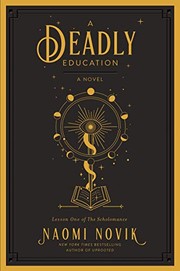
A Deadly Education
2,959-word summary 13 min read 336 pages in the book
- First published
- 2020
- Publisher
- Del Rey
- Pages
- 336
- ISBN
- 9780593128480
- Series
- The Scholomance (#1)
Reading options
What's inside (9 sections)
I picked this up because Uprooted had made me trust Naomi Novik with prickly heroines, and friends kept saying the Scholomance books were funnier and meaner. Del Rey published it in 2020, and the first US hardcover runs 336 pages, which I read in three sittings with a pencil nearby because the magic rules come fast. It is the first book in The Scholomance trilogy, followed later by The Last Graduate and The Golden Enclaves. The narrator is Galadriel Higgins, called El, a junior at a magic school that has no teachers and plenty of teeth. She can kill with a sentence and cannot light a lamp without a fight. That mismatch drives everything.
El is half Welsh and half Indian, raised outside enclaves by her mother Gwen, a famous healer who lives in a commune and gives away help. Her father died at his own graduation so her pregnant mother could get out. Before El was born, her great grandmother, a seer, said the girl would bring death and ruin and pull down enclaves. The family on her father's side turned away. Gwen refused the reading and raised El on strict mana, never taking life to feed spells. El grew up knowing she could rip power from living things as easy as breathing, and choosing daily to build power slowly instead through work and pain and patience.
A school that wants to eat you
The Scholomance sits in a void outside the world, reached only by induction at fourteen and left only by graduation at eighteen. There are no adults inside. The school itself hands out lessons, rooms, food, shop supplies, repair jobs. Stairs move. Vents breathe. Bathrooms flood on schedule. It feels half alive and wholly indifferent. It protects students enough to be useful and lets enough monsters through to keep them scared.
Monsters here are called maleficaria, shortened to mals. They eat wizards for mana, the energy wizards make and store. Young wizards after puberty shine bright to mals, which is why most magic children outside do not reach adulthood. Inside, wards and shutters and flame runs kill many mals, but small ones slip through pipes and vents. Soul eaters. Agglos. Pipesnakes. Things with teeth in ceilings. Students learn early to never walk alone, never sleep without wards, never answer a knock without checking.
The worst math waits at the end. For four years the school lets mals gather below in the graduation hall. On graduation day seniors must run that hall to the gates while hungry things wait. About half of students die before senior year. About half of those left die on the run. The school once had cleansing machinery that burned the hall with mortal flame, but the lower unit broke in the late 1800s and no crew has fixed it since. Powerful wizards tried and died. So the run is treated as normal. Alliances form around it. Enclave kids train with better gear. Independent kids scrape.
El explains all this in a voice that is tart and tired. She has survived two years by being careful and unfriendly. Her room is patched. Her crystals hold saved mana from crochet and exercise and grinding work. She eats in corners. People avoid her without knowing why, then dislike her once they feel her affinity. She reads as danger the way a live wire hums, even when she wants to help.
El and the boy who saves everyone
The book opens with a mal in El's room and Orion Lake killing it before she can. Orion is a junior from the New York enclave, handsome in an unaware way, loaded with stored power, famous for saving lives all over the school. He pulls mana from the mals he kills, which should be impossible, and he does it again and again. Crowds follow him hoping for protection or favor. Girls flirt. Enclave leaders court him. Teachers would love him if there were teachers.
El hates the rescue on sight. She had the mal handled and wanted the show of force to prove worth. Orion's habit of stepping in makes her look weak and keeps her from earning mana and standing. Worse, she sees the cost others miss. Every freshman Orion saves is one more mouth the mals below go without. Hunger builds. The graduation run grows harder. She tells him so in blunt terms and he stares like she spoke another tongue.
Orion starts trailing her. At first he thinks she might be a maleficer mixed up in a missing classmate, Louisa, who vanished under ugly signs. El is rude enough to look guilty, and her spells sound like murder when overheard. He watches her between classes, sits near her in the library, fixes her broken door after a fight. Rumor decides they are dating. El, who has never had rumor work in her favor, decides to ride it. Being Orion's supposed girlfriend gets her noticed by enclave kids who once stepped over her.
The turn I liked is that Orion keeps coming back after the suspicion clears. A real maleficer, a classmate named Jack, attacks El to feed, and Orion kills him in time. He apologizes in his clumsy earnest way. He admits he followed her for the wrong reason. He still wants to sit with her because she talks to him straight. No flattery. No ask for New York protection. She calls him an idiot to his face and shares her fries. He laughs like no one has been plain with him in years. Their bond grows from annoyance into something warm, though El keeps waiting for the price.
Mana, malia, and the prophecy
Magic here runs on two fuels, and Novik keeps the line bright. Mana is made by effort. Run stairs. Scrub floors. Do forms. Meditate. Store the yield in crystals. Cast from savings. Malia is stolen from living things. Bugs for small needs. Mice for more. People for real power. Users of malia are called maleficers, and the school can smell the rot on them. Most wizards cheat a little with bugs. El will not touch even that path beyond tiny things, because for her taking would be too easy and too sweet.
Her affinity is destruction. Ask her to mend and she sweats through easy words. Ask her to shatter stone or rot flesh or call cold fire and the spell comes out doubled and hungry. The school keeps feeding her combat texts and dark workings, which feels like proof of the prophecy. Classmates sense the cast of it and edge away. Even friends flinch when she practices. Gwen taught her to refuse the pull, to pay full price in blisters and headaches, to store mana in old family crystals rather than reach for shortcuts.
The prophecy itself hangs over every choice. A great seer said El would sow death and bring down enclaves. Enclave families know the line. Some fear her. Some want to cage her early with offers. El repeats her mother's answer as armor. She will not become that person. Yet the school rewards her darkest skills and starves her gentler ones, so every term feels like pushing uphill. When she gets a chance to show off by killing mals in front of witnesses, she passes it up to chase a worse threat alone, because parading power would feed the story she hates.
I found this the most honest magic cost in recent fantasy. No wand waves away effort. El pays for spells in sore arms and saved up hours, which makes her restraint feel physical rather than noble talk. Critics sometimes call the info dumps heavy in this stretch. They are. Novik pauses fights to explain storage limits and spell grammar. I forgave it because the rules pay off later when El must choose what to burn and what to hold.
Friends and enclave games
El starts the year alone and ends the middle with a small crew, and the path there is prickly and funny. Aadhya, an artificer from an independent family, first treats El as a rumor plus a useful rumor. Liu, whose formal name is Yi Liu, quiet and sharp, watches before trusting. El shares advantages as they come, seats near Orion, tips about shop hours, spare crystals, honest warnings about seniors. She makes a point of staying kind to the few who were kind before she was popular. That choice matters to her more than any enclave invite.
Enclaves are the rich kid tables of this world. Wizard families pool power behind walls in cities like New York, London, Shanghai, Mumbai. Kids born inside arrive at school with better clothes, better tools, guards of a sort, promises of safe jobs after. Everyone else hustles for a sponsor seat. Dinners and study groups double as tryouts. El wants a seat at first because independence has meant fear and hunger all her life. New York even floats her an invite through Orion's circle, the most prized ticket in the building, and for a chapter she can taste safety.
She turns it down. The scene lands because Novik earns it. El watches how enclave math works. Saved mana flows up. Favors flow down with strings. Independents die to keep enclave seniors safer on the run. Orion's mother will soon lead New York, and kindness from that quarter still serves New York. El tells them no in her flat way and builds a graduation alliance with Aadhya and Liu instead, three juniors with mismatched tracks and pooled savings. It is weaker on paper and stronger in trust. I cheered, though I also saw the cost. No walls. No rescue team. Only each other.
School tracks add texture. Students split into incantation, artifice, alchemy. El is an incanter with a project that needs all three, so she recruits Aadhya for making and Orion for brewing to build a resonant mirror. The mirror scene is pure Novik. It works, lights up, then repeats the old prophecy about death and fallen enclaves in front of others. Silence follows. Aadhya stays. Liu stays. Orion stays. That staying means more than any speech about friendship.
Romance stays light. El and Orion bicker over tactics and share quiet hours mending gear. A kiss comes late and feels earned, then awkward with monsters waiting downstairs. El prefers alliance and honesty for now.
The maw-mouth in the library
The set piece that sold me happens off stage on purpose. During a study session, mals hit the reading room in numbers and Orion rushes to the noise. El follows slower, reading the pattern wrong until she sees it. A maw-mouth is leaving the other way toward freshman dorms. A maw-mouth kills in a worse way. It keeps victims alive inside itself, aware and suffering, feeding it for years. Her father died inside one at his graduation. Only circles of strong wizards have ever killed one, and even then rarely. Inside El goes cold in a way she rarely allows.
She could stay and kill small mals where witnesses would praise her. Instead she goes after the maw-mouth alone. No audience. No backup. She spends nearly all her saved mana, shapes a working of ruin that fits her affinity like a glove, and unmakes the thing from inside its hunger. It is ugly and loud and lonely. Freshmen behind a door live because a junior they mock spent years of savings in minutes. She tells no one at first except Aadhya and Liu, partly from shock and partly from sense. Flaunting world class killing would mark her as a weapon or a threat to every enclave.
Novik stages horror well here. The library smells of dust and blood. Shelves lean. A page flutters through ash. El's hands shake after, her nose bleeds, her crystals sit empty as stones. The school, which often rewards killers with small gifts, offers her a rare book, a lure and a thank you at once. She takes it and hates that she wants it. I admired the restraint. Many fantasies would put this kill on a stage. Novik hides it in a corridor to show who El is when no one claps.
After, the hunger problem sharpens. Orion has saved so many that mals press harder against weak points. Patches fail. Barriers thin. El and Orion find tool marks where someone undid repairs. Fear spreads among seniors facing a harder run than any class in years. Whispers say some seniors would rather open vents and let mals feed on younger kids to ease their own run. El believes it because the math favors cruelty. The school feels less like classes and more like a ship taking water.
Fixing the hall
The last act turns into a heist with spells. A senior girl named Clarita floats the wild plan. Fix the broken scouring machinery in the graduation hall before the run. The machines once sent walls of mortal flame through halls to burn mals clean. The upper units still run twice a year and force everyone to shelter. The lower unit has sat dead for over a century. Crews sent down died. A famous living wizard tried years ago and only managed partial repairs that lasted three years before failing. Seniors call the idea suicide. Juniors call it the only chance.
El backs it because she sees no better trade. Planning takes chapters and I liked the grind. Artificers map gears. Alchemists brew sealants. Incanters practice shields. Enclaves donate mana in careful amounts, each gift logged for debt.
The descent is tense and short on heroics. About twenty go down in formation, shields up, lights low, mals pressing from dark. El and Orion hold the fighting edge while artificers work on the machine housing. Mals tear at shields. Spells misfire in close air. Two students die despite plans, one to a sudden breach and one holding a door past call. The machine catches, stutters, catches again. Seniors at the gate end report flame movement. The team yanks back up through spells and slams barriers as the warning bell rings for a scheduled scouring above.
They make shelter as mortal flame washes the upper halls. El throws her own flame as a shield around herself and Orion when they almost miss cover. Sprayers cool stone. Silence follows, the kind after loud danger. No one knows yet if the lower hall burned clean or if seniors will still run through teeth. The book refuses a victory parade. It gives tired kids soup and bandages and rumors.
Induction closes the loop. New freshmen drop in by magic, wide eyed, carrying letters from home. El finally feels part of a crowd rather than its warning. Then a freshman hands her a note from Gwen. It is short and loving and pointed. Stay brave. Stay kind. Keep far away from Orion Lake. El reads it twice while Orion jokes nearby. The last page lands like a door shutting softly. Readers who love slow burn dread will grin. Something about Orion, his endless mana, his mother's plans, his luck with mals, has reached even Gwen in her commune.
Where it drags
I had fun and I also skimmed. El narrates in long rants that run for pages, piling clauses with commas and asides in parentheses, explaining mana economics while a monster waits behind a vent. The voice is funny, sharp about class and manners, sharp about boys who mean well and cost plenty. It also repeats. How much El hates being saved. How much enclaves disgust her. How lonely she was. How rude she sounds when she means to be kind. After the fourth loop I got it and wanted plot to move.
The middle sags around popularity games. Once rumor pairs El with Orion, chapters fill with lunch table chess, who sits where, who owes whom notes, which enclave smiled. Some of it pays off in the alliance choice. Much of it circles. Aadhya and Liu deserve more early page time, since they carry the theme of chosen family, yet they fade during long Orion passages. I wanted another night of the three juniors working on the mirror rather than another debate about New York manners.
Orion himself can feel too good to be true. He saves hundreds, shares power, apologizes, cooks, listens, never asks for return. Novik hints at something off in his endless supply and the way mals ignore him, and Gwen's note sharpens that hint, but inside this book he functions as a golden retriever with a sword. His flat goodness makes El's edge pop, yet it also flattens tension. I never feared he would fail. I feared El would burn out saving him from his own habit.
The school's reuse of danger also dulls. Alarm, sprint, ward, kill, patch wall, argue about mana, repeat. Individual mals blur after a while. Pipesnakes and soul eaters and agglos come so fast that only the maw-mouth stands apart. Readers who want set pieces with distinct geography may find halls and vents look alike. Readers who love systems and banter will mind less, because banter carries those runs.
Still, the core held for me. A girl told she will destroy the world decides to spend herself saving freshmen no one will thank her for. A boy raised to be a weapon learns to ask rather than grab. Three outsiders pool meager savings against rich walls. A broken machine gets fixed by kids because adults built a school and walked away. I closed the 336 page Del Rey first book wanting the second, which is the truest test. If you like magic with costs, schools with teeth, and narrators who insult you while earning you, start here and watch your own mana. You will stay up late.
FAQ
When was A Deadly Education published and how long is it?
Del Rey published it on September 29, 2020. The first US hardcover runs 336 pages and carries ISBN 9780593128480, which is the edition cited here.
Is this the first book in a series?
Yes. It opens The Scholomance trilogy as book one, followed by The Last Graduate and The Golden Enclaves. Novik also wrote Uprooted and the Temeraire series.
What is the difference between mana and malia?
Mana is built up through effort and stored for use, while malia is taken from other living things and marks the user as a maleficer. El refuses malia even though her gift would make taking it easy.
Similar books
More from The Scholomance first, then related titles.
The Last Graduate
El must survive graduation when the school feeds seniors to monsters.
2,232-word summary · 10 min read
The School for Good and Evil
Best friends Sophie and Agatha are taken to fairy tale school and sorted to wrong sides.
2,042-word summary · 9 min read

Blue Lily, Lily Blue
Blue searches for her missing mother while the Raven Boys wake a sleeper in the caves who is not the king they sought.
2,983-word summary · 13 min read
The Dream Thieves
Ronan pulls things from dreams while Gansey hunts a dead king and Blue tries to stay alive by staying apart.
1,922-word summary · 9 min read

Inkdeath
The final Inkworld novel sends Mo into the land of the dead, leaves Meggie choosing between two boys, and ends the Adderhead's immortality with three written…
2,062-word summary · 9 min read

Lioness Rampant
Alanna searches for the Dominion Jewel with the Shang Dragon, then returns to Tortall to face Duke Roger at Jonathan's coronation.
2,478-word summary · 11 min read

The Siren
Saved from a shipwreck in 1930, Kahlen becomes a siren who sings men to their deaths for the Ocean, until a boy in a college library makes her want a life she…
2,369-word summary · 11 min read

The Golem's Eye
Two years after The Amulet of Samarkand, Nathaniel is a rising bureaucrat, Bartimaeus is his unwilling servant again, and something made of clay is tearing…
2,299-word summary · 10 min read

Grip of the Shadow Plague
A plague turns Fablehaven's creatures of light into shadows while Kendra hunts an artifact in Arizona and Seth races to find the cause.
2,131-word summary · 9 min read

The Rose & the Dagger
Shahrzad is pulled from her Caliph husband and left in a desert camp of rebels, needing to break his curse and end a war before it ends her.
2,520-word summary · 11 min read

The Queen of the Tearling
Nineteen-year-old Kelsea leaves the woods to take her throne, ends a shipment of human captives, and draws the Red Queen's revenge.
2,357-word summary · 10 min read

We Hunt the Flame
In a fractured Arabia-inspired world, a disguised huntress and a prince-assassin race to find a magic-restoring book and confront an ancient evil.
2,195-word summary · 10 min read
The Magician
Sophie and Josh flee to Paris with Nicholas Flamel, where John Dee, Machiavelli, and an awakened god close in on the missing pages of the Codex.
2,162-word summary · 10 min read

The Hazel Wood
Alice Proserpine has spent her life running from bad luck. When her mother vanishes, she follows a trail of fairy-tale clues to her grandmother's estate and…
2,064-word summary · 9 min read

In the Hand of the Goddess
Alanna, still disguised as a boy, survives war, court plots, and a death duel as the Goddess's chosen warrior in the second Song of the Lioness book.
2,018-word summary · 9 min read

Blue Moon
Ever Bloom tries to save her immortal boyfriend, Damen, from a mysterious illness while a new student named Roman quietly takes control of her school and her…
1,998-word summary · 9 min read
An Enchantment of Ravens
Isobel, a mortal artist in the fairy town of Whimsy, paints a portrait of the autumn prince and falls in love with him, breaking the laws of her craft.
2,087-word summary · 9 min read
The Battle for Skandia
Will and Evanlyn are still hiding in the Skandian mountains when Halt and Horace arrive with word of a Temujai invasion that could roll on to Araluen next.
2,248-word summary · 10 min read

The Bane Chronicles
Eleven stories across five centuries follow Magnus Bane from a ban in Peru to his first date with Alec in this illustrated Shadowhunter companion.
2,470-word summary · 11 min read

The Indigo Spell
Sydney Sage hunts an aging witch, learns forbidden magic, and finally admits she loves Adrian, while the Alchemist tattoo on her cheek may be controlling her.
2,604-word summary · 12 min read

Wayward Son
Simon and Baz road trip America after the war to decide what normal means.
2,505-word summary · 11 min read

Rebel Angels
Gemma returns to the realms to bind magic while facing Circe and London season.
2,708-word summary · 12 min read
Furies of Calderon
Furyless Tavi defends Calderon Valley when the Marat return and lords scheme.
2,587-word summary · 11 min read
A Winter's Promise
Ophelia reads objects and is sent to marry Thorn on a cold ark.
2,502-word summary · 11 min read
Three Dark Crowns
Three triplet queens must kill each other for the crown, but love and gifts get in the way.
2,134-word summary · 9 min read

Every Heart a Doorway
Nancy returns from the Halls of the Dead to a school for travelers, where a murder forces portal children to face grief, belonging and the price of going home.
2,400-word summary · 11 min read

The Golden Lily
Sydney Sage guards Jill at Amberwood Prep in Palm Springs, studies forbidden magic, favors Adrian over Brayden, and faces Alchemist custody in this second…
2,988-word summary · 13 min read
Radio Silence
Head girl Frances loves a secret podcast made by shy Aled, and both crack under A-levels in Oseman's warm 2016 story of friendship, fandom, family and choosing…
2,778-word summary · 12 min read
Lirael
A Sightless Clayr girl and a prince afraid of Death join the Dog and Mogget to stop necromancers from waking the Destroyer Orannis at the Red Lake while old…
2,692-word summary · 12 min read
Edgedancer
Hungry street thief Lift and her vine-like friend Wyndle cross the Herald Nale in Tashikk when a child emperor shows Radiant signs and she refuses to step…
2,328-word summary · 10 min read