
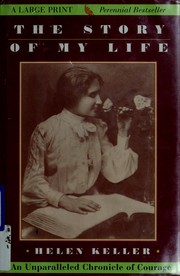
The Story of My Life
2,149-word summary 10 min read 240 pages in the book
- First published
- 1903
- Publisher
- Doubleday
- Pages
- 240
Reading options
What's inside (8 sections)
I picked up The Story of My Life expecting something dutiful, the kind of short classic you read for school and forget. Helen Keller published it in 1903 with Doubleday, about 240 pages in the standard modern edition, written while she was still in college. I finished it in two evenings and sat quiet for a while after. It is not a perfect book. Some of its language is old and some of its view is narrow. But the middle of it, the part about a child finding words again, is as moving as anything I have read this year.
The edition I read has three parts. First comes Keller's own story. Then comes a long set of her letters from 1887 to 1901. Then comes notes by her editor John Albert Macy, with letters and reports from her teacher Anne Mansfield Sullivan. The book is dedicated to Alexander Graham Bell, who helped the family find a teacher. Knowing all that helps. This is a young woman telling her life with her teachers beside her, not a neutral record.
A sunny start, then silence
Keller was born on June 27, 1880 in Tuscumbia, Alabama. Her father Arthur was a former officer turned newspaper man. Her mother Kate was much younger. The early months sound happy. Family lore says she spoke early and kept making a wah wah noise for water after other speech went.
Then at nineteen months, in February 1882, she fell ill. The family called it brain fever. Doctors now guess scarlet fever or meningitis. Whatever it was, it burned through her and left her deaf and blind. She does not remember the illness itself. She remembers the before as light and the after as a closing in. I found that image hard to shake. One winter she could hear a footstep and see a face. The next she lived by touch and smell and vibration.
She writes about that change without self pity. She is more interested in what she still had. She could feel her mother's dress, the wind from the door, the tremble of the floor when someone ran. She kept that one sound for water for a while. Then even that dropped away.
The child in the dark
The chapters about ages two to six are the hardest to read. Keller describes herself plainly as wild. She could not explain hunger or pain or anger except by grabbing, kicking, screaming. She knocked people, locked her mother in a room once and laughed, tipped furniture. Servants indulged her. Her parents loved her and did not know how to shape her. She knew she was different from the people around her and had no way to ask why.
What she did have was touch curiosity. She followed her mother by holding her skirt. She learned the kitchen by smell. She made crude signs, pointing and pulling. Martha Washington, the daughter of the family cook, tried to play with her. Those games often ended in fights. Keller is honest about hitting and breaking things.
I kept thinking about her parents during these pages. They took her to doctors. A friend told them about Laura Bridgman, a deafblind woman educated in Boston, and about Perkins Institution. That led them to Bell, and Bell pointed them to Perkins director Michael Anagnos. He recommended recent graduate Anne Mansfield Sullivan, herself half blind. When Sullivan arrived on March 3, 1887, Keller was almost seven.
One thing I appreciated is that Keller gives Sullivan a real arrival, not a halo. Sullivan brought a doll as a gift. She tried to hug her new pupil. Keller pulled away. Within hours they were already in a battle of wills over table manners and the manual alphabet. That stubbornness on both sides is the engine of the whole book.
March 1887
Sullivan's method sounds simple and was relentless. She spelled everything into Keller's hand, letter by letter. She did not start with a primer. She spelled doll while giving a doll, cake while eating cake. At first Keller only copied the shapes without knowing they meant the thing.
The famous mix up came with mug and water. Sullivan tried to separate them. Keller kept confusing the two signs. Sullivan dropped it for a bit, which I liked reading. Even this determined teacher knew when to stop pushing for an hour. Keller, meanwhile, got angry at being drilled. She smashed the new doll on the floor and felt the pieces under her feet with satisfaction. Sullivan swept them aside and took her outside. That walk matters more than the broken toy. Instead of punishing, Sullivan changed the scene.
They went down the path to the well house, covered in honeysuckle that March. Someone was pumping. Sullivan put Keller's hand under the cold stream and spelled w a t e r into the other palm, first slow then fast. Keller stood still. Then something clicked. She later called it a misty remembering, a thrill of returning thought. The finger shapes were not a game. They were the cool rush itself. That living word woke her soul, to use her phrase. She knew in that instant that everything had a name, and that names could be told hand to hand.
I have read that scene twice now and it still lands. What sells it is not grandeur but physics. Cool water on one palm, quick fingers on the other, the smell of vines. Keller writes that she left the pump wanting to learn every object in reach. She asked for mother, father, sister, teacher by the end of the day. She learned thirty words that evening by some counts, or at least learned that thirty things could be asked for. The exact number matters less than the hunger. She went to bed wanting morning.
If you only know one Keller story, it is this one. The book earns it by placing it inside weeks of failure first. Water without the earlier confusion over mug would feel cheap. With it, the pump feels like work paying off.
How she learned
After the pump, Sullivan built fast. She gave Keller raised print, then Braille. They walked and named everything. Keller learned verbs by doing. Love confused her until Sullivan tied it to sun and being held, not to a thing you can touch.
A few scenes stayed with me. The thunderstorm night when Sullivan held her and spelled through the noise. The walks where Sullivan described fields so fast Keller begged her to slow down. She writes about nature with appetite. Birds, dogs, river smells, snow she felt as vibration.
Speech came later and harder. Sullivan took her to Sarah Fuller in Boston for voice lessons. Keller put fingers on throat and face to feel vibration, then tried to copy. Her voice stayed hard for strangers to follow, and she knew it. She does not pretend speech solved everything.
Books became her second world. She read raised print and Braille, stories Sullivan told in full. Then at eleven came a wound she does not hide. She wrote a story called The Frost King. It closely followed Margaret Canby's Frost Fairies, read to her years before. People accused her of copying. An inquiry cleared her of intent but left her shaken. She uses it to ask how any child sorts memory from invention. A safer memoir would have skipped it.
Her days were not all lessons. She swam and got tossed by waves and asked who put salt in the water. She rode, climbed trees, got stuck, made mischief with dogs. Sullivan let her risk things. That balance of discipline and freedom is probably why the teaching worked. Keller felt like a child, not a case.
School, letters and college
The second half shifts from story to proof. Keller goes to Perkins, then schools in Boston, then Cambridge School to prepare for college. She takes entrance exams for Radcliffe in 1899 and 1900, enters in fall 1900, graduates in 1904, a year after this book appears. She wrote all this while still taking classes.
The letters cover 1887 to 1901 and show her voice changing. Early notes are short. Later letters run long, full of description and jokes. You can watch sentences grow muscles. You can also see Sullivan in the margins, correcting and shaping. Macy's notes admit how much early vocabulary came from Sullivan's narration. This was a partnership, not a miracle.
Macy's notes fill what Keller cannot explain. He prints Sullivan's letters to Mrs. Sophia Hopkins from the first months, the best teaching diary I have read. Sullivan describes bad days and tricks that failed, including two weeks alone in a small cottage to break the indulgence cycle. A modern reader may flinch. I did. It helps to read Sullivan's own worry rather than a smooth success story.
Macy can be admiring to a fault. Still, he includes scores, methods, failures, and the Frost King papers. The book feels edited but not scrubbed.
One thing I loved is how often Keller laughs in letters. She teases Bell. She jokes about exams. She was twenty two when the book came out. If you come expecting the adult activist, you will not find her here. You meet the student before the platform.
What to keep in mind and who should try it
I want to be plain about the problems, because they matter.
The language is dated in spots. Words used then for disability, for deafness and blindness and for intellectual difference, now read as slurs or at least as cold labels. Keller and Macy use terms common in 1903 archives and school reports. Modern editions sometimes note this. Mine did not throughout, and I winced. Read with that filter on. The ideas about effort and character are often generous, but the vocabulary belongs to its time.
The view is also narrow in ways Keller could not see at twenty two. This is a white middle class Southern family with servants, written by a young woman whose whole world after seven is Sullivan and books and schools. Tuscumbia in the 1880s and 1890s had Black neighbors, poverty, and the long shadow of slavery and war. You will learn almost nothing about that here. The household help appears mainly as background for Keller's childhood games. Perkins and Radcliffe appear as benevolent ladders. Class and race are not examined. That does not ruin the memoir, but it means you should not take it as a full picture of Alabama or of disabled life. It is one sheltered, hard won path.
There is also the filter question. Sullivan taught every word, Macy chose the letters, Hutton supplied notes, Anagnos and Bell hover as patrons. How much of Keller's voice is fully her own? Scholars still argue about it. Reading the letters helped me trust her more, because the style grows in a natural way and the mistakes feel real. Still, when Macy praises her style at length, I hear a manager praising his artist. Keep that distance in mind and the book gets more interesting, not less.
None of that stopped me from admiring what is here. The account of learning language from the inside is rare. Most education books are written by teachers. This one is written by the pupil who lived it, with the teacher's letters attached so you can check her. The pump scene, the Braille nights, the speech lessons with fingers on throats, the Frost King shame, the exam fear at Cambridge, all of it feels lived rather than assembled.
Who should read it. If you teach, study language, or care about access and learning, read it for method. Sullivan's practice of naming the world as it happens, then reading, then writing, still looks modern. If you like memoirs of childhood, read it for the Alabama garden and the well house and the broken doll. If you want disability history, read it alongside newer books by blind and deaf writers, so Keller's early voice sits inside a wider chorus rather than alone.
It took me about four hours across two nights, in the 240 page Doubleday text with letters and notes. I skimmed a few of Macy's longer school reports, I admit, and slowed for every Sullivan letter. The book dragged a little in the college exam lists. Names of courses and marks do not thrill. But the early chapters and the letters pulled me back each time.
I closed it thinking less about inspiration and more about work. A teacher spelled into a hand thousands of times in heat and rain. A child asked again and again until names held. That is the story here, not a miracle at a pump but practice after it. Keller says the living word set her free, and I believe her. Freedom then looked like lessons, letters, exams, and more lessons. It still does.
FAQ
What happens at the water pump?
Sullivan spells w-a-t-e-r into one hand while cold pump water runs over the other. Keller grasps that words name things and asks for many more.
When was the book written and what does it include?
It appeared in 1903 from Doubleday while Keller studied at Radcliffe. It holds her story, her letters from 1887 to 1901, and notes by John Albert Macy with Sullivan letters.
Does the book use dated language?
Yes, in places. Terms for disability common in 1903 now read as cold or offensive. Read with context and pair it with newer blind and deaf writers.
Similar books

Twelve Years a Slave
Free violinist Solomon Northup tells how Brown and Hamilton lured him south into twelve years of Louisiana bondage until Bass letters brought rescue in January…
2,931-word summary · 13 min read
Narrative of the Life of Frederick Douglass
Douglass names names from Maryland slavery to his 1838 escape, showing how literacy, wages, and faith were policed, then answers with defiance.
2,630-word summary · 12 min read

Long Walk to Freedom
Mandela's account of a Thembu childhood, a law practice, a banned movement, twenty-seven years in prison, and the negotiation that ended apartheid.
2,454-word summary · 11 min read

Down and Out in Paris and London
Orwell's account of washing dishes in Paris hotels and tramping through London does not ask for pity, only for a clear look at how poverty actually works.
2,282-word summary · 10 min read
Lone Survivor: The Eyewitness Account of Operation Redwing and the Lost Heroes of SEAL Team 10
Marcus Luttrell's account of the 2005 SEAL mission in Afghanistan that killed three of his team and left him alone.
2,144-word summary · 10 min read

The Letters of Vincent van Gogh
Vincent van Gogh's letters to his brother Theo, in a Penguin Classics selection edited by Ronald de Leeuw, trace a decade of work, faith, and obsession.
2,611-word summary · 12 min read
Ham on Rye
Henry Chinaski grows up rough in Depression Los Angeles and finds writing.
2,244-word summary · 10 min read
Wild Swans
Three generations of women survive warlords, revolution, and the Cultural Revolution in Jung Chang's family memoir.
2,356-word summary · 10 min read
American Sniper: The Autobiography of the Most Lethal Sniper in U.S. Military History
Navy SEAL sniper Chris Kyle recounts Texas roots, SEAL training, four Iraq tours, and the strain combat placed on his marriage and health.
2,011-word summary · 9 min read

Maus II: A Survivor's Tale: And Here My Troubles Began
Vladek survives Auschwitz and the death march while Art struggles with success, guilt, and his father's aging stubbornness.
2,111-word summary · 9 min read
Autobiography of Cotton
A Pulitzer winner traces her cotton-worker grandparents and a 1934 border strike through archives, memory, and damaged land.
2,213-word summary · 10 min read

All Creatures Great and Small
Young vet Herriot learns lambing, Tricki Woo, and Darrowby life.
2,327-word summary · 10 min read
A Moveable Feast: The Restored Edition
Young Hemingway writes hungry in Paris cafes among Stein, Pound and Fitzgerald.
2,116-word summary · 9 min read

The Communist Manifesto
Marx and Engels trace class struggle from bourgeoisie to proletarians, review rival socialisms, and close with a call to opposition parties. Notes on the 1848…
2,570-word summary · 11 min read
Walden
Thoreau builds a cabin at Walden Pond and spends two years testing what a person really needs to live well.
2,986-word summary · 13 min read
The Complete Persepolis
Satrapi's full black and white memoir in one volume, from revolution era Tehran through Vienna exile and back home again.
2,498-word summary · 11 min read
A Long Way Gone: Memoirs of a Boy Soldier
A Sierra Leone boy flees rebels, becomes a child soldier at thirteen, and fights his way back through rehab.
2,434-word summary · 11 min read
Persepolis
Marjane Satrapi's black and white memoir of growing up in Tehran during revolution and war, from a bold ten year old to a fourteen year old sent alone to…
2,984-word summary · 13 min read

A Promised Land
First-volume memoir from Iowa 2008 through the 2011 bin Laden raid, crisis management and doubt.
2,243-word summary · 10 min read
Three Cups of Tea: One Man's Mission to Promote Peace ... One School at a Time
Mortenson fails K2 builds schools in Pakistan after Korphe kindness.
2,554-word summary · 11 min read
The Prince
Machiavelli advises Lorenzo on rule through fear and love, fortune, cruelty and mercy.
2,204-word summary · 10 min read
The Last Lecture
Dying professor Pausch lectures really achieving childhood dreams.
2,579-word summary · 11 min read

Maus I: A Survivor's Tale: My Father Bleeds History
Art Spiegelman interviews his father Vladek about Sosnowiec and Auschwitz, drawing Jews as mice in this tense father and son memoir.
2,223-word summary · 10 min read
Between the World and Me
Coates writes to his son about the Black body in America, from Howard to the loss of Prince Jones.
2,234-word summary · 10 min read
I Know Why the Caged Bird Sings
Angelou recalls Stamps, St Louis and San Francisco, from childhood silence after trauma to voice through books and work.
2,607-word summary · 12 min read
I Am Malala: The Story of the Girl Who Stood Up for Education and Was Shot by the Taliban
Malala grows up in Swat, blogged for school under ban, and survives a bus shooting.
2,015-word summary · 9 min read

Night
Elie Wiesel's account of Sighet, the cattle cars, Auschwitz and Buchenwald, told in short flat sections by a boy about fifteen. Why the book carries the year…
2,594-word summary · 12 min read
Educated
Educated retold: Idaho scrapyard, no school, BYU, Cambridge, break with father and brother.
1,931-word summary · 9 min read
The Diary of a Young Girl
Anne Frank's diary explained: two years in the Secret Annex, the entries on fear and boredom, what Otto Frank cut, and why the book still reads like a…
1,913-word summary · 9 min read
The Zookeeper's Wife: A War Story
The directors of the Warsaw Zoo hid roughly three hundred Jews in empty cages and outbuildings after the German invasion, while Jan worked for the resistance.
2,065-word summary · 9 min read