
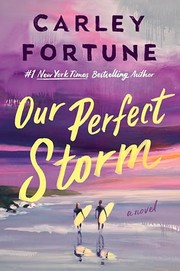
Our Perfect Storm
2,393-word summary 11 min read 432 pages in the book
- First published
- 2026
- Publisher
- Berkley
- Pages
- 432
- ISBN
- 9780593953242
Reading options
What's inside (7 sections)
I have a soft spot for the friends-to-lovers romance, and I have a particular soft spot for the version where two people have known each other since childhood and spend three hundred pages being furious about it. Carley Fortune's Our Perfect Storm is that book, published by Berkley in 2026, and it wears its ancestry on its sleeve. The two leads, Francesca Gardiner and George Saint James, compare themselves to Jo and Laurie from Little Women, a novel both of them love. I settled in expecting a slow burn and got something with a much higher heart rate.
The comparison to Jo and Laurie is doing real work. Jo and Laurie are the pair everyone knows should end up together and famously do not, at least not in the original book. Fortune is clearly aware of that. She builds a story about two people who have been each other's principal witness since they were eight and who keep choosing other paths, daring you to wonder whether this time the pattern will break. The result is warm, occasionally exhausting, and very sure of what it is doing.
Eight Years Old in Kawartha Lakes
Frankie and George meet as kids in rural Kawartha Lakes. She is Fran, the girl from a big, complicated family, the kind of household where there is always someone in the next room and always something being worked out. He is the boy next door who moves in with his eccentric grandmother. From the start they are a pair, the sort of children who are assumed to be a unit. They grow up together, survive the awkward years of adolescence, and eventually live together as young adults, still stubbornly, insistently just friends.
There is one kiss. They do not talk about it. If you have read a romance novel in the last twenty years, you know what one unmentionable kiss means. It sits in the history of the friendship like a loose floorboard, and Fortune lets it make a small sound whenever either of them gets too close. Both Frankie and George are passionate, impulsive, and headstrong. Their pattern has always been to clash and then come back together, sometimes within the same conversation. I recognize that rhythm from friendships that last a long time. The fight is not a rupture. It is a form of contact.
What makes the setup more than a standard trope is the length of the history. These two are not strangers who bicker for two chapters. They know the version of the other person that existed at eight, at thirteen, at twenty-two, and all those versions are still in the room when they argue. When George is unhappy about Frankie's engagement, he is not only reacting to the news. He is reacting to every year he has spent watching her choose a life that does not include him in the way he wants.
Frankie's family is the other half of the equation. Fortune gives us a girl who grows up in a house with a lot of people and a lot of noise, and George's home with his grandmother offers a kind of quiet she has never had. It is easy to see why the two of them gravitated toward each other. He is the boy from the calm house who understands the chaotic one, and she is the girl who brings noise and warmth into his life. The Little Women comparison works because Jo and Laurie were also defined by their households, by what they inherited and what they wanted to escape.
I should say that the childhood chapters are the ones I warmed to fastest. There is a looseness to them, a sense of two kids inventing a world together in a place where not much else is happening. Fortune writes rural Kawartha Lakes as a specific setting rather than a generic backdrop, and the long summers and the grandmother's house give the romance a physical home. When the book later moves to the rainforests of Vancouver Island, the contrast is deliberate. These two are always somewhere that feels slightly apart from ordinary life.
The Wedding That Wasn't
The trouble starts with Nate. Frankie is preparing to marry him, an older professor she has known for only a year, and he represents the maturity and stability she thinks she wants. Nate is the sensible choice made by a woman who has spent her life in a chaotic family and would like some quiet. George is unhappy about it, and his unhappiness finally comes out in a huge fight. He does not say the thing he should say, which is the whole problem. He shows up for the wedding weekend anyway, as her best man, because of course he does.
The rehearsal dinner is the pivot. Frankie worries that George will not appear, and then, when he does, she finds that what she wants is to be alone with him. For one evening, surrounded by all the people she loves, her life feels perfect. Fortune does a nice job with the ache of that moment. It is not a grand romantic gesture. It is a woman at a dinner table realizing that the arrangement she has made for herself is already coming apart, and that the person she wants to share the news with is the man standing next to her in a suit.
The next morning Nate ends the engagement. He leaves a cryptic note with no real explanation, and then he is gone. Frankie goes to a friend's house to wallow, which feels exactly right. She is not immediately transformed or liberated. She is humiliated and sad and angry, and she lies around like someone whose life has been rearranged without her consent. I liked this stretch. Fortune does not rush her heroine into clarity. The breakup is a mess that has to be sat through.
Nate is barely in the book, which is part of the design. He is less a person than an idea Frankie has been chasing, the idea of a grown-up life with someone steady who will not hurt her. The cryptic note he leaves is almost a device rather than a character choice, since the point is not why he goes but what his going forces Frankie to face. She has known him a year and was ready to spend her life with him, and the lack of an explanation is its own kind of cruelty. Fortune does not give us a villain to hate. She gives us a silence to sit in, and Frankie has to fill it herself.
George's position through all of this is complicated. He has spent the weekend being her best man, which means helping her prepare for a life with another man, and he has done it without making a scene. His unhappiness has to go somewhere, and it comes out in the fight before the wedding and then in the quiet after it. I kept thinking about how hard it is to be the person who loves someone and has no standing to say so. Fortune lets that frustration show without making George behave badly. He is unhappy, but he shows up. That combination is what makes him hard to resist.
A Honeymoon With the Wrong Person
Here is the conceit that gives the book its title and its engine. The honeymoon to Tofino, on the coast of Vancouver Island, is already planned and paid for. George proposes taking Nate's place. One week in the rainforests and misty beaches, in a romantic suite. It is a bold and slightly ridiculous suggestion, and Frankie agrees. She tells herself she is doing it to repair the friendship, one last chance before whatever comes next. She also understands, on some level she will not admit, that she is opening a door she has been leaning against for years.
This is where the book both thrives and shows its seams. The Tofino week is deliberately isolated, a romantic container in which two people cannot avoid each other. Fortune fills it with heavy longing, arguments, and flashbacks to the childhood that formed them. The past keeps interrupting the present. A joke from the old days, a reference to the grandmother, a remembered fight, all of it arrives mid-scene and reminds you that these two have a whole shared language the reader is still learning.
The slow realization that they can never go back to being kids is the emotional spine. Frankie and George keep reaching for the old pattern, the bickering and the instant forgiveness, and it no longer fits. They are adults with jobs and ambitions and damage. The friendship that once absorbed everything now has limits, and the tension of the book comes from them discovering those limits while sharing a very beautiful bathroom.
A recurring natural detail is the North Atlantic right whale, critically endangered. It shows up as a thread through the Tofino section, and Fortune uses it to ask readers to learn more, pointing toward the New England Aquarium and the Canadian Whale Institute. I have mixed feelings about this. On one hand it is a graceful way to give the story a quieter scale, a reminder of something vast and imperiled going on beyond the two people at the center. On the other hand, it is a noticeable authorial nudge, and a few of the whale passages felt placed for a purpose other than the story's. The whale is endangered, the book tells us, and asks readers to learn more, but the request sits slightly outside the narrative. It is the one place where I felt the author's hand rather than the characters' lives.
The Tofino setting itself is handled well. Fortune gives us rainforests and misty beaches and a romantic suite that is almost too romantic for the mess the two leads are in. The weather does a lot of work. The place is wet and green and full of the sense that the rest of the world is far away, which is exactly what two people need if they are going to have this conversation. I liked that the book makes the landscape part of the emotional logic instead of just pretty postcards.
The Fight to Stay
Fortune is at her best when she lets the arguments run long. Frankie and George are both headstrong, and neither of them is willing to be the first to say what they actually mean. Their fights have a specific quality, the way a fight only can between two people who know precisely where to push. They know the old wound, the unspoken kiss, the years of proximity. Every remark lands with the weight of history behind it. I found these scenes the most convincing part of the novel, more convincing than the soft moments, because the anger felt earned.
The book also has to deal with what each of them wants out of a life. Their professional ambitions pull in different directions, and Fortune has to resolve the question of what happens when two people who have always been a unit want different futures. The answer the novel arrives at is not that one of them gives in. The end insists that the only way forward is a new kind of relationship rather than a return to the old one. That is the right call for these characters. They have spent their whole lives being eight years old together, and a romance that simply restored the old friendship would have undone the point.
The emotional health angle matters too. Frankie has to reckon with why she wanted Nate in the first place, and George has to reckon with why he has spent years hovering at the edge of her life without ever claiming it. By the end, in what one reviewer calls a satisfying whirlwind, the romantic confusion, the family complications, both characters' emotional health, their conflicting ambitions, and their plans for the future all get tied off. It is a lot to resolve in a week in Tofino, and the pace in the final chapters reflects that. Things happen quickly.
A New Kind of Relationship
The ending works because Fortune understands that the fantasy is not the suite or the beaches. It is the recognition. Frankie and George finally say the things they have been circling since they were kids, and the book closes with them choosing each other on new terms, not as the continuation of a childhood bond but as something they have to build. There is real pleasure in watching two people who have been so stubborn finally get out of their own way.
Now for the honest part. The friends-to-lovers structure is predictable, and if that structure is not your thing, this book is not going to convert you. You can see where it is heading from the first chapter, and the tour through the will-they-or-won't-they is handled with the volume turned up. The angst is deliberately heightened, with the question of whether these two will get together treated as if the stakes were life and death. Readers looking for a light beach read may find the emotional pressure a bit much for a book with an island honeymoon.
The other criticism I have seen, and I think it is fair, is that the book leans so hard on George's side that some readers find Frankie sour or self-absorbed. George gets a lot of runway to be wounded and noble. Frankie spends a good stretch of the novel being difficult, and while the ending gives her clarity, it does not entirely balance the earlier pages. For a book about two headstrong people, it is a little too willing to forgive one of them for being headstrong and a little less generous to the other.
I still enjoyed it. Fortune writes the rhythm of a long friendship well, and the childhood flashbacks give the romance a weight that a story about two people meeting in a bar would not have. The whale sections are a strange choice, and the final act ties off more threads than feels strictly natural, but the central idea holds. Sometimes the person you have been waiting for has been in the next room your whole life, and the hardest part is admitting it.
FAQ
Is Our Perfect Storm part of a series?
No. It is a standalone contemporary romance from Carley Fortune, published by Berkley in 2026.
Why does the book keep referring to the North Atlantic right whale?
It is a recurring natural detail during the Tofino week. Fortune uses it to ask readers to learn more through the New England Aquarium and the Canadian Whale Institute.
Do Frankie and George end up together?
Yes, but on new terms. The ending rejects a simple return to their old friendship and has them build a different relationship.
Similar books
Every Summer After
Percy returns to Barry's Bay after years away and faces Sam, first love and the mistake that broke them.
2,091-word summary · 9 min read

The Next Always
A widowed architect restores an old hotel in Boonsboro and falls again for the bookseller across the street, in a warm small-town romance.
2,242-word summary · 10 min read
Wait for It
A twenty-nine-year-old hairstylist raising her two nephews meets her new neighbor, a former Navy man mid-divorce, in Zapata's slow-burn romance about trust and…
2,154-word summary · 10 min read
The Road Trip
Two exes squeeze into one small car for the drive to a Scottish wedding, with four years of history and one photograph between them.
2,418-word summary · 11 min read
My Favorite Half-Night Stand
Millie, a criminology professor who has always been one of the guys, invents a secret dating profile and matches with her best friend Reid.
2,362-word summary · 10 min read
Same Time Next Summer
A woman planning a perfect wedding meets her first love back at the beach house.
2,329-word summary · 10 min read

The Cheat Sheet
Best friends Bree and NFL star Nathan fake date for three weeks after her drunken confession goes viral.
2,401-word summary · 11 min read
This Summer Will Be Different
Lucy returns to Prince Edward Island and tries not to repeat one night with her best friend brother Felix.
1,905-word summary · 8 min read
Thank You for Listening
A former child star turned audiobook narrator takes a final romance job to help her grandmother, only to fall for the secretive voice reading opposite her.
2,148-word summary · 10 min read

Kiss the Sky
Rose Calloway signs her family up for a reality show to save her fashion line, and her old rival Connor Cobalt keeps pace.
2,178-word summary · 10 min read

In Flight
A first class flight attendant loses her composure over a billionaire hotel owner with turquoise eyes, and neither of them is as unbroken as they look.
2,187-word summary · 10 min read
Window Shopping
Two weeks before Christmas, an ex-convict with an eye for design insults a department store window and ends up hired by its cheerfully relentless manager.
2,049-word summary · 9 min read
Twisted Palace
Twisted Palace closes The Royals with Reed accused of murder and a father back from the dead. Ella fights to clear his name while the family finally acts like…
2,303-word summary · 10 min read
The Wrong Bride
In Catharina Maura's Windsors opener, model Raven Du Pont takes her absent sister's place at the altar beside billionaire Ares Windsor, the man she has…
2,397-word summary · 11 min read

The Fake Out
A guarded hockey physiotherapist agrees to fake date her team's captain to spite her cheating ex, and finds he has been paying attention to her for years.
2,345-word summary · 10 min read
Ten Tiny Breaths
Four years after a drunk-driving crash took her parents, boyfriend and best friend, Kacey flees to Miami with her sister and falls for a neighbor hiding a…
2,599-word summary · 12 min read

Roomies
A Broadway archivist with a crush on a subway busker marries him to solve his visa problem, and finds the roommates arrangement harder to keep practical than…
2,030-word summary · 9 min read
Pumpkinheads
Deja and Josiah have worked the Succotash Hut together every autumn. On their last Halloween shift, she pushes him to chase a crush and they discover something…
2,409-word summary · 11 min read
Pretend You're Mine
A broke stranger agrees to pose as a National Guard captain's girlfriend in Benevolence, Maryland, only to find his locked basement holds a grief that could…
2,260-word summary · 10 min read
One with You
The final Crossfire novel finds Eva Tramell and Gideon Cross secretly married and fighting to stay that way, as old trauma, a tell-all book, and a dangerous…
2,344-word summary · 10 min read
Off to the Races
A disgraced politician's daughter takes a job training a difficult racehorse at Gold Rush Ranch, where her new boss carries a family scandal of his own.
2,318-word summary · 10 min read
Love Her or Lose Her
Rosie Vega wants more from life than a perfume counter and a silent marriage, so she asks her stoic husband Dominic to try therapy.
2,433-word summary · 11 min read

Girls in Pants: The Third Summer of the Sisterhood
The four friends face their last summer before college, with art school, an old flame, a guilty conscience and a new baby in the balance.
2,382-word summary · 11 min read

Breathe
A seventeen-year-old takes her pregnant mother's housekeeping job on an Alabama island and meets the owner, a teen rock star who wants nothing more than to be…
2,983-word summary · 13 min read

Beautiful Oblivion
Cami tends bar and keeps her long distance boyfriend a secret, until a night at the Red Door puts Trenton Maddox in her way.
2,322-word summary · 10 min read

The Rom-Commers
A stalled screenwriter leaves her Texas caretaker life for six weeks in Los Angeles to fix a famous writer's terrible rom-com script, and finds far more than a…
2,356-word summary · 10 min read
Say You'll Remember Me
A vet who writes off a sick kitten falls for the woman who saves it, then follows her into the hard, funny work of caring for a mother with dementia.
2,293-word summary · 10 min read

Rush
Gabe Hamilton has wanted his best friend's sister for years. When Mia signs a contract giving him control of her life, their secret arrangement turns obsessive…
2,591-word summary · 12 min read

Great Big Beautiful Life
Two rival journalists chase the biography of a reclusive media heiress on a Georgia island, only to find her family history holds a secret bigger than either…
2,394-word summary · 11 min read
99 Percent Mine
Darcy Barrett has wanted her twin brother's best friend since she was eight. When they inherit their grandmother's cottage, Tom Valeska arrives with power…
2,391-word summary · 11 min read