
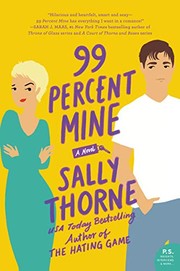
99 Percent Mine
2,391-word summary 11 min read 368 pages in the book
- First published
- 2019
- Publisher
- William Morrow
- Pages
- 368
- ISBN
- 9780062884282
Reading options
What's inside (7 sections)
I came to this book because I liked The Hating Game. Sally Thorne writes sharp banter and people who say one thing while meaning another, and I expected more of the same. What I got was slower and hotter and more concerned with family. This is a book about a woman who has wanted the same man since she was eight years old, a run-down cottage, and a pair of twins who cannot agree on anything. It is a romantic comedy, but the things that stuck with me were the arguments between a brother and sister.
The facts first. 99 Percent Mine went on sale on January 29, 2019 from William Morrow, an imprint of HarperCollins. The hardcover runs 368 pages. It is a standalone novel, though Thorne gave it a special section with two happy endings: one for Darcy and Tom, and an epilogue about Lucy Hutton and Josh Templeman, the couple from The Hating Game. If you have not read that book, nothing here will confuse you. If you have, the epilogue is a nice extra.
Darcy, Tom, and the 99 percent problem
Darcy Barrett, the narrator, opens by talking about bartending. She works at a local biker bar, pouring drinks for a rowdy crowd, and she is good at reading people. She has a fellow bartender named Holly, whom she thinks is far too sweet for the place, and a bouncer named Keith, who makes advances toward her. Those early pages establish that Darcy is harder than she looks and that she would rather be somewhere else. When Keith pushes too far, she handles him in her own rough way and goes home shaken. She has a photography background but has let it go, which is the first sign that she is a person who stopped trying at something she once loved.
That choice to drift is the key to her. Darcy is not lazy. She is a photographer who once had real promise and now pours drinks in a place where nobody asks her to look closely at anything. Thorne keeps returning to the idea that Darcy has been waiting, as if her life has been on hold since the summer she was eight and Tom Valeska first became the standard by which she measures every other man. The biker bar is funny and a little sad at the same time, and it tells you more about her than a page of straight explanation could.
The real subject arrives when Tom Valeska comes back into her life. Darcy has been in love with him since she was eight. Tom was her childhood neighbor and her twin brother Jamie's best friend, which is the whole problem. Jamie saw Tom first and claimed him as his own, and Tom has spent his life being loyal to Jamie. The number in the title comes from that arrangement: as far as Darcy can tell, Tom is about 99 percent her brother's and maybe one percent hers. He was engaged to a woman named Megan, and Darcy's long stretch of wanting him had nowhere to go.
The number in the title is more than a joke about percentages. It belongs to the private language the Barrett twins share, a way of claiming things and daring each other to take them. The book returns to the word "mine" in its most charged moments, including a line about being "one thousand percent mine until the end of time." That childish claim is exactly what Darcy is trying to make real as an adult, and the people around her keep treating it as a family game. Thorne uses the repeated word to show how much is at stake in something that sounds, on the surface, like a silly slogan.
Thorne does a good job of showing how a childhood crush hardens into a habit of mind. Darcy has traveled and dated and gone through the motions of looking for someone else, but she compares every man to Tom and finds them lacking. She jokes that she peaked at twenty. That line is funny on the page and sad underneath it, because a woman who believes her best days are behind her at twenty is not really living in the present. The book takes that weakness seriously even while it jokes about it.
Jamie matters as much as Tom. The twins have a history of needling each other, and their fights are the parts of the book with the most bite. Jamie is protective and loud and often clueless about the tension between Darcy and Tom. He is also the person Darcy is closest to, which gives her a reason to keep Tom at arm's length and a reason to resent doing so. The push and pull between loyalty to a brother and loyalty to herself is the strongest thread in the story.
The cottage and the contractor
The plot kicks into gear with an inheritance. Their grandmother has died and left Darcy and Jamie her cottage, with instructions that they fix it up and sell it. The house is a mess, full of memories for Darcy and full of dollar signs for Jamie. He wants to gut it and put in grey and chrome, the sort of renovation that would erase everything she loved about the place. She wants to hold on to the magic, or at least to the idea of it. Neither of them is entirely wrong, and Thorne lets the argument breathe.
Darcy's plan is to leave. She figures she will stick around just long enough to get the renovations started, then take a seat on a plane and go back to her life. That plan falls apart the night she finds Tom's car in the driveway. He has come back to town, his engagement is over, and he is the contractor hired to work on the house. He arrives with power tools and a way of looking at her that she cannot ignore. Suddenly staying seems reasonable. She tells herself she is staying to protect the cottage from Jamie's design ideas. She is not staying because Tom is single for the first time in close to a decade, or because he looks good in a tight t-shirt, or because having him around makes her want to pick up her camera again.
The cottage itself does a lot of work in the book. It is a place where the three of them were young together, and it is also a job site with faulty wiring and dust and unfinished rooms. Thorne keeps the two ideas side by side. Every scene in the house carries the weight of who they used to be, and every hammer strike reminds them that the place will be sold. Tom moves through the rooms with the confidence of a man who has flipped houses before, measuring, stripping, and deciding what can be saved. Darcy, who has spent years avoiding anything that resembles a home, finds herself caring about paint colors and old floorboards.
Darcy's photography comes back in small ways, as she starts noticing Tom the way a photographer notices a subject: the line of his collarbone, the expression he tries to hide. That is one of the nicer touches in the book. Her camera was a way of seeing that she gave up, and wanting Tom again is tangled up with wanting to see clearly again. The renovation gives her something to point the lens at, and the house becomes the place where she slowly stops performing toughness for everyone, including herself.
Sparks, wiring, and a bad proposition
The middle of the book is a long slow burn. Darcy wants Tom to see her as a woman rather than as his best friend's sister. Tom keeps his distance, partly out of loyalty to Jamie and partly out of fear. They work side by side, trade jokes, and circle each other. Thorne is very good at the small physical details of attraction: a hand at the back of the neck, a pulse under skin, the way a clean joke can sound suggestive when two people want it to. The book is explicit once things finally happen, and readers who want a sweet romance without steam should know that going in.
Darcy eventually makes her move, and it does not go smoothly. She propositions him, he rejects her, and he pulls further away. It is a low point for her, because the rejection from Tom lands on top of a lifetime of feeling second best in her own family. The scene is not treated as a simple romantic setback. Thorne connects it to Darcy's older wound, which is that she has spent years waiting for people to choose her.
They find their way back to each other through a physical arrangement that neither of them wants to name honestly. Tom asks her not to tell Jamie. Darcy agrees, but she cannot keep the secret, and when it comes out Tom loses his temper and leaves the house. He accuses her of breaking his trust, and she has to face the fact that she did. This is where the book gets its sharpest edge. The fight is not really about the secret. It is about whether Tom can put Darcy ahead of Jamie without feeling that he is betraying someone.
I wanted this stretch to be shorter. The same misunderstandings get revisited more than once, and Tom's hot and cold behavior starts to feel like a way to fill pages. Darcy can be exhausting too, especially when she narrates her own cleverness at length. But the underlying conflict is sound, and the payoffs are earned rather than handed over.
The fight with Jamie and the way back
With Tom gone, Darcy and Jamie are left to deal with each other. Their argument is the best part of the book. They finally say out loud what they have been circling: that both of them want their childhood friend back, and that neither has been honest about what the cottage means. Jamie admits enough for Darcy to see that he is not just trying to cash in. She admits enough for him to see that she is not just being difficult. The reconciliation is quieter than the romantic one, and it lands better.
Tom, for his part, has to get over himself. He comes around when he realizes that protecting Jamie has become an excuse for avoiding a real choice. The resolution takes place at an airport, on a trip that includes Jamie and his new girlfriend, Truly, who is also Darcy's friend. That Truly is both the friend and the girlfriend is one of those conveniences the book asks you to accept. Tom and Darcy finally talk plainly, he says what he wants, and the two of them get their ending. The extra section at the back gives them a second look at their future and then hands Lucy and Josh their own moment.
Thorne's humor is on display throughout. There is a running bit about pizza as a precious natural resource that can heal a bad mood, and a line about every evil overlord needing a fluffy cat to stroke. Darcy's internal monologue is full of small jokes that keep the tone light even when the feelings are serious. When Tom asks what she would do if he were hers, she tells him she has a big imagination and asks him to be specific. The banter is the author's strongest habit, and it is on nearly every page.
What works and what drags
The romance works because the history between Darcy and Tom is given real weight. Twenty years of wanting someone does not disappear because two people are alone in a renovated kitchen. Thorne understands that a long crush is partly about the person and partly about the story you have told yourself, and she lets Darcy work through both. The steamy scenes are written with the same wit as the funny ones, which keeps them from feeling pasted on.
The family material is better than the genre usual. Jamie is not a villain who exists to keep the couple apart. He is a brother who loves both people and is badly served by their silence. The cottage gives the story a physical shape: something is being built here, and the people in it have to decide what is worth keeping before it is sold. Darcy's camera is a small but useful thread, a reminder of a talent she has set aside and a way for her to see Tom clearly again.
The weaknesses are real. The inheritance premise is convenient, since it takes a grown man and woman and locks them in the same house for months. The will never quite explains why the renovation has to happen before anything else can be decided. The will-they-won't-they section runs long, and Tom's loyalty to Jamie is tested so many times that it starts to feel like a stalling device. Some of the supporting characters, especially Keith at the bar, are drawn broadly and then dropped. The Hating Game epilogue is a treat for fans and dead weight for anyone who came to this book on its own.
None of that stops it from being a good read for the right reader. If you want fast banter, a heroine with a sharp mouth, a hero who has to learn to choose, and a fair amount of heat, this delivers. If you want a tightly plotted romance with a clean reason for every delay, you may find yourself skimming. I liked it more when it stayed with the twins in the cottage and less when it retreated into the same argument for the third time.
The title, in the end, is a better description of the book than the plot is. Darcy wants all of Tom, and Tom has spent his life giving most of himself to someone else. The question is not whether they will end up together. It is whether either of them can stand to want something that much and say so out loud. That is a small question for a novel to ask, but Thorne makes it feel like the only one that matters while you are in the room with these people.
FAQ
Is 99 Percent Mine part of a series?
No. It is a standalone romantic comedy. It shares a setting detail with Sally Thorne's debut The Hating Game, and a later edition adds a short epilogue about that book's couple, Lucy Hutton and Josh Templeman.
Who are the main characters in 99 Percent Mine?
Darcy Barrett is a photographer who has drifted into bartending. Tom Valeska is her twin brother Jamie's best friend and her lifelong crush. Jamie and Darcy's friend Truly round out the central group.
When was 99 Percent Mine published and by whom?
It went on sale on January 29, 2019 from William Morrow, an imprint of HarperCollins. The hardcover edition runs 368 pages.
Similar books
Off to the Races
A disgraced politician's daughter takes a job training a difficult racehorse at Gold Rush Ranch, where her new boss carries a family scandal of his own.
2,318-word summary · 10 min read
Love Her or Lose Her
Rosie Vega wants more from life than a perfume counter and a silent marriage, so she asks her stoic husband Dominic to try therapy.
2,433-word summary · 11 min read

The Next Always
A widowed architect restores an old hotel in Boonsboro and falls again for the bookseller across the street, in a warm small-town romance.
2,242-word summary · 10 min read

Act Your Age, Eve Brown
Eve Brown crashes into a Lake District bed and breakfast, breaks the owner's arm, and talks her way into his kitchen. A grumpy-sunshine romance about work,…
2,474-word summary · 11 min read

Indigo Ridge
A new police chief in a Montana town meets the founding family's eldest son in a bar, and one night later a body turns up under their cliff.
2,763-word summary · 12 min read

At First Sight
Jeremy and Lexie are married and expecting a baby when anonymous emails tell him the child may not be his.
2,317-word summary · 10 min read
True Believer
Jeremy Marsh, a science journalist who debunks paranormal claims, comes to a small North Carolina town and falls for a librarian who believes in things he…
2,125-word summary · 9 min read

Delilah Green Doesn't Care
Delilah returns to Bright Falls to photograph her stepsister's wedding and falls for Claire, a bookstore owner and single mother, while a cruel bet threatens…
2,315-word summary · 10 min read
My Killer Vacation
A teacher and a bounty hunter share a Cape Cod rental with a corpse and a growing attraction.
2,625-word summary · 12 min read

Final Offer
Cal Kane must spend the summer at Lake Wisteria to inherit, but his childhood ex Lana, now a mother, says the house belongs to her family.
2,379-word summary · 11 min read

Things We Left Behind
Lucian Rollins returns to Knockemout to bury his father's past and collides with librarian Sloane Walton.
2,777-word summary · 12 min read
Flawless
Pro bull rider Rhett Eaton is benched by scandal, and his agent's daughter Summer must keep him in line in Chestnut Springs.
2,528-word summary · 11 min read

Kiss the Sky
Rose Calloway signs her family up for a reality show to save her fashion line, and her old rival Connor Cobalt keeps pace.
2,178-word summary · 10 min read
Window Shopping
Two weeks before Christmas, an ex-convict with an eye for design insults a department store window and ends up hired by its cheerfully relentless manager.
2,049-word summary · 9 min read
Pretend You're Mine
A broke stranger agrees to pose as a National Guard captain's girlfriend in Benevolence, Maryland, only to find his locked basement holds a grief that could…
2,260-word summary · 10 min read

Beautiful Oblivion
Cami tends bar and keeps her long distance boyfriend a secret, until a night at the Red Door puts Trenton Maddox in her way.
2,322-word summary · 10 min read
Say You'll Remember Me
A vet who writes off a sick kitten falls for the woman who saves it, then follows her into the hard, funny work of caring for a mother with dementia.
2,293-word summary · 10 min read

Great Big Beautiful Life
Two rival journalists chase the biography of a reclusive media heiress on a Georgia island, only to find her family history holds a secret bigger than either…
2,394-word summary · 11 min read

The Bookshop on the Corner
A Birmingham librarian loses her job, buys a van, and moves to the Scottish Highlands to run a mobile bookshop. Warm and bookish, with uneven pacing.
2,557-word summary · 11 min read

Ricochet
Lily Calloway tries to stay celibate for ninety days while Loren is in rehab, leaning on Rose, Connor, and Ryke as therapy forces her to face her childhood.
2,575-word summary · 11 min read

My Dark Romeo
A debutante ball kiss traps Dallas Townsend in a marriage to Romeo Costa, a man who wants her as leverage in a war against his father and her fiance.
2,530-word summary · 11 min read
Under Locke
Iris Taylor moves to Austin broke and wary, takes a front-desk job at a tattoo shop, and spends the book learning that Dex Locke’s blunt cruelty and unexpected…
2,591-word summary · 12 min read
The Ex Talk
Two rival public radio producers pretend to be exes for a dating show, then fall for each other while the lie grows.
2,389-word summary · 11 min read

Two by Two
Sparks's twentieth novel turns from first love to a marriage breaking up: Russell Green loses his wife and his job, then rebuilds his life around his…
2,192-word summary · 10 min read

There Are No Saints
Two rival artists circle a struggling San Francisco painter. Cole Blackwell wants her, Alastor Shaw wants her dead. Book one of the Sinners duet.
2,190-word summary · 10 min read

The Predator
Coder Morana Vitalio and mob enforcer Tristan Caine chase stolen software while a case of missing girls from twenty years back catches up with them both.
2,296-word summary · 10 min read
The Casanova
Kate Landon's boss is also the pen pal she falls for online, hiding behind fake names, until family secrets and a trip to Paris get in the way.
2,274-word summary · 10 min read

2 States: The Story of My Marriage
A Punjabi boy from Delhi and a Tamil Brahmin girl from Chennai meet at IIM Ahmedabad, and turn a love marriage into a campaign to convince two families.
2,634-word summary · 12 min read

Juniper Hill
Fleeing New York with her baby, Memphis takes a housekeeping job above Knox Eden's garage, and the grumpy chef becomes the first person she can rely on.
2,021-word summary · 9 min read

Garden Spells
Two sisters reunite in their family home in Bascom, North Carolina, where an apple tree shows anyone who eats from it the biggest event of their life.
2,030-word summary · 9 min read