
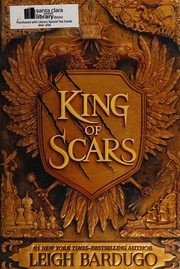
King of Scars
2,934-word summary 13 min read 528 pages in the book
- First published
- 2019
- Publisher
- Imprint
- Pages
- 528
- ISBN
- 9781250142283
- Series
- King of Scars (#1)
Reading options
What's inside (8 sections)
I came to King of Scars because I missed Nikolai. He stole every scene in the Shadow and Bone books as Sturmhond, the pirate prince with jokes for everything, and then he had to grow up fast into a king with a ruined country. I wanted to see if Leigh Bardugo could carry a whole book on him. This is the 2019 book from Imprint, 528 pages in the hardcover first edition, and it opens the King of Scars duology, with Rule of Wolves coming after it. You really want the earlier Grisha books under your belt first. Shadow and Bone explains what the Fold was and who the Darkling was, and Six of Crows explains why Nina is grieving and why Fjerda hates Grisha. The book assumes you know those pieces.
Ravka is in bad shape when this starts. The civil war is over, the Shadow Fold that split the country is gone, but gone does not mean healed. Villages are empty, the treasury is empty, the Second Army of Grisha soldiers is thin, and two neighbors are circling. Fjerda to the north burns Grisha as witches and trains wolf soldiers called druskelle to hunt them. Shu Han to the south is rich, secretive, and building its own weapons. Nikolai Lantsov is young, charming in public, tired in private, trying to hold all of this with talk, loans, and half built airships.
That public charm is part of the fun and part of the strain. In Os Alta he jokes with ministers, flirts with diplomats, promises roads and grain he does not have. Behind closed doors he meets with his inner circle. Zoya Nazyalensky, his general and guard, watches him closest. Genya Safin, the Tailor who can change faces, watches too, along with her husband David Kostyk, who cares more about Grisha steel and theory than court manners. Tolya and Tamar, the huge twins who rowed with Sturmhond back in the pirate days, stand watch and say little. They all know something is wrong with the king at night.
The thing inside Nikolai
What happened to Nikolai at the end of the war left a mark that will not close. Without spoiling the exact mechanics from Ruin and Rising, the Darkling put something in him. At night Nikolai loses time. He wakes on the floor or outside his rooms with dirt under his nails and blood he cannot explain. Sometimes his voice sounds wrong to him. He starts setting locks and chains and asking Zoya to stay near, not for protection in the normal sense but to stop him if he turns.
Bardugo writes these night sections with a tight focus on small physical detail. A cracked mirror. A torn sleeve. The taste of copper. A servant who heard scratching and says nothing the next morning. Nikolai tries to laugh it off in daylight. He tells himself a king cannot afford to be ill, and a country that just survived a monster cannot hear that its king carries one.
Zoya is the counterweight here. She is a Squaller, which means she handles wind and pressure, and she is famous for it. Soldiers respect her and fear her a little. She lost her aunt early, she fought beside Alina Starkov, she has been angry for years about being seen as beautiful first and useful second. With Nikolai she drops a lot of that armor. They bicker the way people do when they have almost died together too many times to be polite. She is also the only person he lets see him chain his own wrist to the bed.
I liked how practical their plan is. No grand quest announced at court. They keep the throne running with paperwork and appearances while quietly chasing stories about saints and cures. David brings old texts about amplifiers and thorn wood and saints bones. Genya worries about what tailoring cannot fix. Tolya prays. Tamar sharpens knives. It feels like a war council for one mans body.
The criticism starts here too, and it is fair to name it early. This first third repeats a lot of Grishaverse history. If you just read the earlier books, pages of reminders about who the Darkling was, what jurda parem does, how the Fold fell, can feel slow. I skimmed a little. For a new reader it is helpful, for a returning reader it stalls the night horror that is actually working.
Zoya, saints, and the monk who wants to help
The way out, or what looks like a way out, comes through religion. After the Fold vanished, people did not stop needing something to believe. A group called the Cult of the Starless Saint has grown fast. They say the Darkling was a saint, that the Fold was holy, that Ravka fell because it turned from him. Most of Ravka hates them. The palace calls them traitors. But they keep stories about places where the Fold left scars, thin spots where saints still speak.
Their guide in this book is Yuri Vedenen, a young monk. He is earnest, sunburned from travel, sure his visions matter, and completely out of his depth with soldiers. He tells Nikolai and Zoya about a forgotten chapel and a remnant of darkness that did not vanish with the rest, a kind of pocket where time stopped. He believes Sankta Elisaveta can cleanse the king.
Nikolai agrees to go because he is out of options. Zoya goes because she will not let him go alone. They leave Os Alta in secret, which is its own risk, and travel with Tolya, Tamar, and Yuri. The chapters on the road give Bardugo room to do what she does well. Bad food, wet boots, arguments about maps, Zoya snapping at Yuri for praying too loud, Nikolai trying to keep spirits up while feeling the thing inside him get stronger the closer they get.
What they find is strange even by Grisha standards. There is a place that feels like the Fold in miniature, cold and humming, and inside it are figures out of Ravkan prayer books. Sankta Elisaveta, remembered for roses and mercy and also for darker stories about thorns. Sankt Juris, the soldier saint who is tied to the first amplifiers. Sankt Grigori is there too in the lore around them. None of this is presented as a simple blessing. The saints are powerful and tired and not kind in the way Yuri expected.
Elisaveta takes charge of Nikolai. She speaks of rituals, hunger, roots, and a garden that feeds on pain. Juris takes an interest in Zoya. He pushes her wind powers past cutting and shielding into something older. Training scenes with Juris are some of the best in the book because Zoya has to admit she is afraid of her own ceiling. She has always wanted to be the strongest. Now someone offers to make her stronger and the price is unclear.
Yuri watches all of this with growing doubt. He came to serve saints and finds saints who argue and scheme. His faith wobbles in a way that felt true to me. He wanted a story where the holy heal the king. He gets a negotiation.
Nina in Fjerda as Mila Jandersdat
The other half of the book belongs to Nina Zenik, and it reads almost like a different novel for a long stretch. After Crooked Kingdom, Nina is broken. Matthias Helvar, the Fjerdan boy who learned to love a Grisha and then died for it, is dead. Nina promised to bring him home to Fjerda and bury him where his people can honor him. She does that early, in snow and silence, and it hurts to read. Then she stays.
Her cover is Mila Jandersdat, a plain Fjerdan girl. With her are Leoni, a young Grisha who loves machinery and drink, and Adrik, who lost an arm and kept his humor. Officially they run a kind of mission kitchen. In practice they are Nikolai's eyes in the north, finding Grisha girls and women and getting them out before the druskelle or the local preachers do. Fjerda teaches that Grisha are unnatural, that their power comes from evil, that burning them saves the village. Girls hide coughs that are really Inferni sparks. Mothers hide daughters who can stop hearts.
Nina is perfect for this work and terrible for it at the same time. She is a Heartrender, so she can slow a pulse, ease pain, kill if she must. She loves food and jokes and company, and Fjerda gives her none of that. She speaks the language with an accent she has to sand down. She misses Matthias so badly she talks to him in her head. Bardugo lets her be funny and wrecked in the same paragraph, which is why readers love her.
The mission sharpens when Nina meets Hanne. Hanne lives as a girl in a strict Fjerdan town, bound tight to hide a strong Grisha gift. Hanne is also the child of Jarl Brum, the druskelle commander who hunted Nina and Matthias, and Ylva, a Hedjut woman kept apart. That parentage matters for the plot and for the theme. Hanne knows both the hate and the cost of it from inside one house. Nina sees Matthias in Hanne's stubbornness and sees a future worth saving.
What they uncover is ugly. In remote settlements, young Grisha women are held and dosed with jurda parem, the drug from Six of Crows that makes power flare and then enslaves the body. The women are forced to bear children while addicted, so the babies are born needing the drug too. The men running it talk about breeding stronger Grisha and selling the cure. Nina, Leoni, and Adrik have to decide between blowing the operation open and getting the captives out alive. They cannot do both cleanly.
This is where the book is strongest on detail. The cold that gets into bandages. The way parem withdrawal shakes hands and blurs sight. The cheese Nina hoards because she is always hungry. The Fjerdan hymns about fire that Hanne hums without thinking. I believed this thread completely.
The problem is connection. For hundreds of pages, Nina's story barely touches Nikolai's. You turn from a saint ritual to a snow kitchen and your brain has to reset. It pays off later, but in the middle it can feel like two books pressed together.
The king who stayed behind
While the real Nikolai is gone, the throne cannot sit empty. This is my favorite invention in the book. Isaak Andreyev, a junior guard who looks a little like Nikolai around the chin and eyes, is pulled into a desperate plan. Genya will tailor his face, teach him the smile and the walk, pad his shoulders, drill him on jokes and war stories. Tolya and Tamar are away, so the palace Grisha close ranks around the boy.
Isaak is sweet and serious, the son of count nobodies who joined the guard to matter. Suddenly he has to matter as the King of Ravka. He practices signatures. He learns which minister wants flattery and which wants numbers. He sits through parliament sessions where landowners argue about taxes for airships and roads while refugees sleep in churches. He learns that being king is mostly listening and choosing which disappointment to hand out first.
Bardugo uses Isaak to show the politics Nikolai usually hides with charm. Ravka needs money for its flying craft and its border forts. Nobles want to keep their sons out of uniform. Priests want the Starless cult crushed. Merchants want trade with Shu Han even if it means bowing. Isaak has no practice lying, which makes him oddly good at it, because people expect a liar and get a nervous boy trying hard.
The bride hunt drives this section. A marriage could buy peace or money. The Shu Han delegation arrives with Princess Ehri, small, polite, clever, interested in engineering and Grisha theory. Isaak, who was told not to feel anything, likes her at once. She asks about his ships. She remembers his guards names. She seems to see the person under the tailoring.
Then the twist lands. What looks like a courtship turns into a knife plot. The woman Isaak knows as Ehri is not the princess but a member of Shu Hans secret guard, the Tavgharad, trained to take her place. The false Ehri kills Isaak and then herself, meaning to leave bodies that point at Fjerda and start a war Ravka cannot afford. It is brutal and fast after so much slow court talk, which is the point. The real Ehri has been hiding among her own guard. When the real Nikolai returns and meets her, he sees someone who understands risk and chooses her anyway, not for love in the simple sense but for respect and alliance.
I found the Isaak chapters moving and a little long. Moving because Isaak wants to be worthy and knows he is a stand in. Long because parliament debate and dress fittings take pages that could have gone to Zoya or Nina. Still, the payoff matters. You see what the crown costs an ordinary person, so you feel what it costs Nikolai.
Ritual, betrayal, and what the ending sets up
Everything converges back at the Fold remnant. Elisaveta has been preparing Nikolai for a cleansing that involves starvation, thorned vines, and old hungers. She speaks softly about sacrifice and gardens and second chances. Juris trains Zoya harder, pushing wind into fire and stone, showing her how amplifiers join to their bearers. Yuri prays and translates and slowly realizes he brought a king to a trap.
The betrayal, when it comes, makes sense in hindsight. Elisaveta does not want to heal Nikolai. She wants a door. She has waited centuries in that pocket, feeding on faith and anger, and she sees in Nikolai's demon and Yuri's devotion a way back into the world. She turns on Juris, and Juris, dying, does something desperate and old. He gives himself to Zoya, bone and power joined, so she can live and fight. Zoya does not ask for this. She wakes with a dragon's strength in her and grief she did not choose.
I will not lay out every beat of the rite because the horror works better when you meet it on the page. What matters is the cost and the swerve. Nikolai does not walk out clean. The thing inside him is answered, but answers in this world have teeth. And the Darkling, who readers thought was finished when the Fold fell, finds a crack. His spirit gets into Yuri, the earnest monk who wanted saints to be good. The last pages reframe the duology. This was never only about curing one king. It is about what happens when worship keeps evil alive after the battlefield is empty.
That sets up Rule of Wolves directly. Ravka has a king marked inside and out, a general carrying a saints bones, a spy network in Fjerda holding rescued girls, a Shu Han princess tied to the throne by a bloody choice, and a enemy wearing a friends face. If you like seed planting for a sequel, this delivers.
So does it work as a whole. Mostly yes, with clear drags. The strengths are character voices and political texture. Nikolai's humor under pressure, Zoya's ambition cracking into care, Nina's hunger for life while mourning, Isaak's decency, Hanne's quiet defiance. The Grishaverse feels lived in here, with hymns, food, uniforms, ship oil, parem shakes, thorn roses. The weaknesses are pace and balance. The middle recaps too much, the two main threads stay apart too long, and Isaak arrives late enough that some readers will resent leaving Nikolai and Nina for him. I did at first, then I missed Isaak when he was gone, which tells you Bardugo won me over.
Who should read it. Read it if you finished Shadow and Bone and Six of Crows and want the aftermath, the bills and funerals after the war. Skip it as an entry point. Starting here would spoil earlier endings and confuse the magic, since Bardugo explains orders and amplifiers quickly and moves on. If court intrigue bores you and you only want heists, this will test you. If you like scarred people trying to rule kindly in a world that rewards cruelty, stay.
I closed the book thinking less about magic systems and more about use. Nikolai uses jokes to buy time. Zoya uses wind to keep people at distance. Nina uses kindness as cover and cover as kindness. Elisaveta uses faith as soil. None of them get what they want cleanly. That feels honest for a book called King of Scars. Healing, when it comes at all, leaves a mark.
A note on craft and patience
One more honest point before I shelve it next to Crooked Kingdom. Bardugo's sentences are easy to read, sometimes too easy. She can resolve a tight spot with a clever reveal, a hidden knife, a timely storm, and after a while you expect rescue. The Fold remnant chapters avoid that by letting loss stand. Juris stays dead. Isaak stays dead. Hanne stays at risk. That firmness helps the softer court chapters, where talk could drift.
Patience helps too. The first two hundred pages build and remind. The next two hundred tighten. The last hundred move fast and hurt. If you felt the start was slow, you are not alone. Keep going for Zoya's training and Nina's rescue. They carry the middle and make the ritual land harder than it would have on its own.
FAQ
When was King of Scars published?
Imprint published it on January 29, 2019. The hardcover first edition runs 528 pages and the ISBN is 9781250142283.
Is King of Scars part of a series?
Yes. It is book one of the King of Scars duology, followed by Rule of Wolves. It continues the Shadow and Bone and Six of Crows stories.
Do I need to read the earlier Grisha books first?
It helps a lot. The book assumes you know Nikolai, Zoya, Nina, the Darkling, the Fold, and jurda parem from the earlier Grishaverse books.
Similar books
More from King of Scars first, then related titles.
Rule of Wolves
A strained king, storm general, and spy witch face invasion, saints, and old shadows in finale.
2,372-word summary · 11 min read
Shadow and Bone
Orphan Alina Starkov learns she is a Sun Summoner who may destroy the Shadow Fold, if the Darkling lets her.
2,284-word summary · 10 min read
Ruin and Rising
Hiding in the White Cathedral, a weakened Alina hunts the firebird while the Darkling holds Ravka and the Fold widens.
2,775-word summary · 12 min read
Siege and Storm
Alina hunts a second amplifier with Mal while the Darkling returns and Sturmhond offers a cunning alliance.
2,122-word summary · 9 min read
Crooked Kingdom
Double-crossed after the Ice Court heist, Kaz and his crows return to Ketterdam to take back everything.
1,949-word summary · 9 min read
Six of Crows
Kaz Brekker gathers five outcasts in Ketterdam for an impossible heist to steal jurda parem, a drug that makes Grisha power deadly.
2,292-word summary · 10 min read

Inkdeath
The final Inkworld novel sends Mo into the land of the dead, leaves Meggie choosing between two boys, and ends the Adderhead's immortality with three written…
2,062-word summary · 9 min read

Lioness Rampant
Alanna searches for the Dominion Jewel with the Shang Dragon, then returns to Tortall to face Duke Roger at Jonathan's coronation.
2,478-word summary · 11 min read

The Siren
Saved from a shipwreck in 1930, Kahlen becomes a siren who sings men to their deaths for the Ocean, until a boy in a college library makes her want a life she…
2,369-word summary · 11 min read

The Golem's Eye
Two years after The Amulet of Samarkand, Nathaniel is a rising bureaucrat, Bartimaeus is his unwilling servant again, and something made of clay is tearing…
2,299-word summary · 10 min read

The Rose & the Dagger
Shahrzad is pulled from her Caliph husband and left in a desert camp of rebels, needing to break his curse and end a war before it ends her.
2,520-word summary · 11 min read

The Queen of the Tearling
Nineteen-year-old Kelsea leaves the woods to take her throne, ends a shipment of human captives, and draws the Red Queen's revenge.
2,357-word summary · 10 min read

We Hunt the Flame
In a fractured Arabia-inspired world, a disguised huntress and a prince-assassin race to find a magic-restoring book and confront an ancient evil.
2,195-word summary · 10 min read
The Magician
Sophie and Josh flee to Paris with Nicholas Flamel, where John Dee, Machiavelli, and an awakened god close in on the missing pages of the Codex.
2,162-word summary · 10 min read

The Hazel Wood
Alice Proserpine has spent her life running from bad luck. When her mother vanishes, she follows a trail of fairy-tale clues to her grandmother's estate and…
2,064-word summary · 9 min read

In the Hand of the Goddess
Alanna, still disguised as a boy, survives war, court plots, and a death duel as the Goddess's chosen warrior in the second Song of the Lioness book.
2,018-word summary · 9 min read

Blue Moon
Ever Bloom tries to save her immortal boyfriend, Damen, from a mysterious illness while a new student named Roman quietly takes control of her school and her…
1,998-word summary · 9 min read
An Enchantment of Ravens
Isobel, a mortal artist in the fairy town of Whimsy, paints a portrait of the autumn prince and falls in love with him, breaking the laws of her craft.
2,087-word summary · 9 min read

The Bane Chronicles
Eleven stories across five centuries follow Magnus Bane from a ban in Peru to his first date with Alec in this illustrated Shadowhunter companion.
2,470-word summary · 11 min read

The Indigo Spell
Sydney Sage hunts an aging witch, learns forbidden magic, and finally admits she loves Adrian, while the Alchemist tattoo on her cheek may be controlling her.
2,604-word summary · 12 min read
The Last Graduate
El must survive graduation when the school feeds seniors to monsters.
2,232-word summary · 10 min read

Rebel Angels
Gemma returns to the realms to bind magic while facing Circe and London season.
2,708-word summary · 12 min read
Furies of Calderon
Furyless Tavi defends Calderon Valley when the Marat return and lords scheme.
2,587-word summary · 11 min read

A Winter's Promise
Ophelia reads objects and is sent to marry Thorn on a cold ark.
2,502-word summary · 11 min read
Three Dark Crowns
Three triplet queens must kill each other for the crown, but love and gifts get in the way.
2,134-word summary · 9 min read

Every Heart a Doorway
Nancy returns from the Halls of the Dead to a school for travelers, where a murder forces portal children to face grief, belonging and the price of going home.
2,400-word summary · 11 min read

The Golden Lily
Sydney Sage guards Jill at Amberwood Prep in Palm Springs, studies forbidden magic, favors Adrian over Brayden, and faces Alchemist custody in this second…
2,988-word summary · 13 min read
Lirael
A Sightless Clayr girl and a prince afraid of Death join the Dog and Mogget to stop necromancers from waking the Destroyer Orannis at the Red Lake while old…
2,692-word summary · 12 min read
Edgedancer
Hungry street thief Lift and her vine-like friend Wyndle cross the Herald Nale in Tashikk when a child emperor shows Radiant signs and she refuses to step…
2,328-word summary · 10 min read
Daughter of No Worlds
A former slave with rare magic hires exiled warrior Max to train her for a daring rescue, sparking slow burn love and wider war in this big 520-page fantasy…
2,529-word summary · 11 min read