
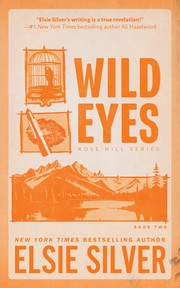
Wild Eyes
2,018-word summary 9 min read 464 pages in the book
- First published
- 2024
- Publisher
- Bloom Books (Forever / Grand Central Publishing)
- Pages
- 464
- ISBN
- 9781464220821
- Series
- Rose Hill (#2)
Reading options
What's inside (8 sections)
The girl who did not own her songs
Skylar Stone is twenty-six and a chart-topping country-pop star. She also does not own most of the music she has made. That discovery, and the slow realization that her life and relationships have been staged by the people around her, especially her father and manager, is what sends her out of Los Angeles. A manufactured breakup and a wave of bad press are the last straw. She gets in her car and drives to Rose Hill, a small mountain town in British Columbia, intending to escape and write music on her own terms.
This is the second book in Elsie Silver's Rose Hill series, following Wild Love, and it uses the same small town and the same figures on the edge of the story. You do not need to have read the first book. Skylar's situation is self-contained, and the recurring characters are there to widen the world rather than to carry essential information. What matters is the contrast the book sets up immediately: a woman whose entire life has been managed for public consumption arrives in a place where nobody cares that she is famous, or so she thinks.
Her first day goes badly. She poses for a selfie too close to a grizzly bear. Weston Belmont, a rugged horse trainer and rancher who is also a single father, pulls her out of the situation and takes her to Wild Rose Records, where his childhood friend Ford Grant runs a studio. That is the meet. It is absurd, and the book knows it is absurd. Rose Hill is a place where a pop star can nearly be eaten by a bear on her first morning.
Silver gives Skylar an interior life that is more interesting than the usual celebrity-in-hiding setup. She is not simply running from paparazzi. She is running from a family business in which her father was both parent and manager, a combination that makes rebellion feel like betrayal. The false tabloid story that follows her to Rose Hill is not just bad press. It is evidence that the people controlling her career are willing to sacrifice her reputation to manage a narrative. When she asks what she wants, later in the book, it is a question she has genuinely never been asked before. That is why Rosie's question lands so hard. It is not advice. It is the first time anyone has treated her as someone whose answer matters.
The cabin and the children
West's sister Rosie arranges for Skylar to stay in a rustic guest cabin on the ranch. The accommodations are sparse. There is a mouse living in the cabin whom Skylar names Scotty, and she struggles with the general lack of comfort. This is where the book's comedy lives, and it works because Skylar is not a fish out of water in the usual sense. She is a woman who has never been allowed to be uncomfortable in public, and the cabin gives her the chance to be miserable without an audience.
West tries to keep his distance. He is hiding the fact that he recognized her almost immediately and has been a fan for years. Skylar, for her part, connects quickly with his children. Emmy is talkative and open. Oliver is selectively mute. Both of them take to her in a way that West notices and does not entirely welcome. His caution is practical. He has built a quiet life around his children and does not want instability brought into it, especially by a celebrity with a reputational disaster following her.
A family dinner goes wrong when Emmy breaks a glass. The sound triggers something in Skylar, and she opens up about her strict upbringing and the false story the tabloids told about her. It is the first real crack in the armor. Later, a cruel Google alert and a text from her father trigger a full panic attack. West throws her phone into the lake to cut off the pressure. It is a wildly impractical gesture and exactly the kind of thing the book likes about him. He is a man who acts first and explains later.
Cherry and the album
One of the recurring motifs is Cherry, a rescue parrot who refuses to fly. Cherry is a mirror of Skylar, a creature with the ability to leave who has decided, for reasons nobody can fully explain, not to. West recruits Skylar to help at Emmy's soccer game, where she gets hit in the face with a ball, and the two of them keep being thrown into situations that make care impossible to avoid. At the pub, West explains that he keeps relationships casual to protect his son, which is his way of telling her that the distance is not about her.
The writing of the album is the book's best thread. With Ford's help, Skylar starts making a raw record called Photosynthesis. Ford is a useful counterweight to West: a friend who recognizes her talent and lets her work without the machinery of her father's management. The album gives the romance a purpose beyond itself. Skylar is not in Rose Hill merely to be restored by a man and his children. She is there to make something she can actually own.
A canoe outing on the lake turns intimate. They confess their fears and kiss passionately, and the canoe capsizes, which is both funny and a release of everything they have been holding back. Afterward they agree to slow things down for the children's sake. That decision is one of the things that makes the book work better than a straightforward fling would. West is a father first, and Skylar's attraction to him includes the way he cares for Emmy and Oliver. Oliver writes the first lyric of one of her songs. Emmy gives her a pocketknife for bear protection. She wears one of West's old concert T-shirts, and he finally admits he is her biggest fan.
The parts that stay with you
The book is full of small, precise gestures. West bids ten thousand dollars at a charity bachelor auction to hide his jealousy when Skylar bids on a date with him. On the tree swing they have sex for the first time on the hood of his truck, and she feels completely exposed and completely trusted. He makes her grilled cheese, explains his knuckle tattoos, washes her hair gently and calms a skittish horse when his parents arrive unexpectedly. She writes the line "I found home in a broken glass" on a receipt, and he watches her record. The recurring "wild eyes" phrase is West's description of a woman who chooses fight over flight, and Skylar grows into it.
The motif of the broken glass is worth pausing on. It links back to the dinner where Emmy broke a glass and Skylar's trauma surfaced. By the time she writes that line, the broken thing is no longer only a source of fear. It is the place she found something whole. Silver is not subtle with this material, but she is sincere, and the sincerity carries it.
Skylar is nominated for a Billboard award and has to return to Los Angeles. She promises to come back, and they keep in touch by phone. She returns early. Cherry finally flies for the first time, and West declares his love. It is the book's cleanest piece of symbolism: the bird that would not fly and the woman who kept leaving finally do the same thing in the same chapter.
Then the outside world catches up. Ford reveals that private photos of Skylar have been leaked online. She has a panic attack, is warned by Bree, and finds paparazzi outside a pet store. Rosie asks her what she truly wants. Fearing she will hurt West's children, Skylar leaves, handing him an envelope of money for the kids' college funds. West breaks down, and Ford gives him the tough love he needs.
One thing the book handles well is the way children change the rules of a romance. West is not simply resistant because he is brooding. He has a son who does not speak and a daughter who attaches easily, and both of them will be hurt if this goes badly. Skylar's growing closeness with them is not a shortcut to winning him over. It is the thing that makes her afraid, because once she loves them, leaving becomes a real cost. When she eventually does leave, the envelope of money for their college funds is heartbreaking precisely because it is practical. She is trying to pay for the damage she knows she will cause.
The public reckoning
On a talk show, Skylar unplugs her microphone and fires her father and agent on air, exposing the exploitation. Ford reveals that the agent was behind the hack. West borrows a jet to fight for her. At the awards ceremony she wins for Photosynthesis, announces her retirement from the public music industry, and reconciles with West, who surprises her on the red carpet. It is a big, satisfying sequence, and it is the payoff the title has been promising. The woman who did not own her songs ends up owning the decision to stop making them for other people.
The epilogue jumps a year ahead. Skylar lives with West and his children, attends therapy, and organizes a charity talent show with Doris. West proposes on the backroad where they first met, and she accepts. The therapy matters. The book is not interested in a woman whose problems are solved entirely by love. Skylar keeps doing the work, and the epilogue makes a point of showing it.
The series connection is worth a word. Rose Hill has already introduced the town and several of its people in Wild Love, and this book returns to them from a different angle. West's sister Rosie, the studio owner Ford, and the wider Belmont family give the town continuity. Read on its own, the book still works, but it is clearly written for readers who already know these people. The epilogue's charity talent show brings several of them back together, and the effect is that of a reunion rather than a plot necessity. That is a fair trade for a series romance.
What works and what does not
The strengths are the ones that made Rose Hill popular. The banter is sharp, the children are real characters rather than props, and the physical setting gives the book a texture that a generic contemporary romance would not have. The forced proximity of the cabin and the ranch gives the relationship a natural pressure, and the grumpy sunshine dynamic between West and Skylar is handled with enough warmth that neither of them becomes a caricature. The found family theme is genuine. By the end, the people in Rose Hill have chosen one another.
The weaknesses follow from the book's design. West is described in marketing terms as a billionaire, which sits oddly with his presentation as a rancher and horse trainer. The label appears to be a carryover from the first book rather than something this story needs. The pace also sags in the middle, where a number of chapters circle the same emotional ground: Skylar is afraid, West holds back, Cherry refuses to fly. The leaked-photos crisis and its resolution arrive quickly after that stretch, and the talk-show confrontation depends on a few convenient discoveries. Readers who want a tightly plotted thriller will not find one here. This is a romance that asks you to enjoy the approach rather than the puzzle.
I liked it most when it stayed small. A man washing a woman's hair. A little boy writing the first line of a song. A parrot that finally opens its wings. The grand gestures are enjoyable, but the book is at its best in the cabin and the barn, where two people who have both been managed by other people are trying to work out what it would mean to choose something for themselves.
FAQ
Is Wild Eyes part of a series?
Yes. It is book two of the Rose Hill series, following Wild Love. It is set in the same small British Columbia town and features the same recurring characters.
When was Wild Eyes first published?
It was first published on September 3, 2024, by Bloom Books, an imprint of Forever and Grand Central Publishing. A UK edition appeared from Piatkus the same year.
What is the album Photosynthesis in the book?
It is the raw record Skylar begins making in Rose Hill with the help of Ford Grant, a studio owner and childhood friend of West. It is the first music she makes on her own terms and wins her a Billboard award.
Similar books
More from Rose Hill first, then related titles.
Wild Love
A full retelling of Elsie Silver's Wild Love: a heroine's return to Rose Hill, a grumpy billionaire neighbor, forced proximity, and a slow burn first in a new…
3,067-word summary · 14 min read
King of Sloth
Party heir Xavier chases publicist Sloane who refuses to fall in forced job.
2,017-word summary · 9 min read
Off to the Races
A disgraced politician's daughter takes a job training a difficult racehorse at Gold Rush Ranch, where her new boss carries a family scandal of his own.
2,318-word summary · 10 min read

Reckless
Guarded Winter and charming Theo fake date through wedding season.
2,051-word summary · 9 min read
Powerless
Sloane flees her wedding and hides with best friend Jasper in Chestnut Springs, where eighteen years of friendship turn into something more.
2,195-word summary · 10 min read
Heartless
Gruff single dad Cade Eaton hires bubbly Willa Grant as summer nanny in Chestnut Springs, and two months together wear down his walls.
2,967-word summary · 13 min read
The Wrong Bride
In Catharina Maura's Windsors opener, model Raven Du Pont takes her absent sister's place at the altar beside billionaire Ares Windsor, the man she has…
2,397-word summary · 11 min read
My Dark Romeo
A debutante ball kiss traps Dallas Townsend in a marriage to Romeo Costa, a man who wants her as leverage in a war against his father and her fiance.
2,530-word summary · 11 min read
Juniper Hill
Fleeing New York with her baby, Memphis takes a housekeeping job above Knox Eden's garage, and the grumpy chef becomes the first person she can rely on.
2,021-word summary · 9 min read
The Simple Wild
City Calla flies to Alaska to face dying father and gruff pilot Jonah, learning bush life and love.
2,284-word summary · 10 min read
Secretly Yours
A bubbly Napa gardener sends anonymous love letters to her grumpy professor neighbor in this steamy small-town rom-com.
2,504-word summary · 11 min read

Final Offer
Cal Kane must spend the summer at Lake Wisteria to inherit, but his childhood ex Lana, now a mother, says the house belongs to her family.
2,379-word summary · 11 min read
Things We Left Behind
Lucian Rollins returns to Knockemout to bury his father's past and collides with librarian Sloane Walton.
2,777-word summary · 12 min read
The Fine Print
Grumpy heir Rowan Kane must fix Dreamland to inherit, and clashes with sunny creator Zahra Khan.
2,697-word summary · 12 min read
It Happened One Summer
LA It girl Piper is cut off and sent to Westport where gruff captain Brendan challenges her glitter.
2,089-word summary · 9 min read
Twisted Love
Sunshine Ava Chen falls for her brother's cold billionaire best friend Alex Volkov as old fires and revenge surface.
2,495-word summary · 11 min read
Things We Never Got Over
Naomi runs from her wedding to help her twin in Knockemout and clashes with Knox Morgan.
3,358-word summary · 15 min read
Hopeless
Fake engaged to town hero Beau Eaton, outcast bartender Bailey Jansen finds pretend and real blurring in Chestnut Springs.
2,491-word summary · 11 min read
Flawless
Pro bull rider Rhett Eaton is benched by scandal, and his agent's daughter Summer must keep him in line in Chestnut Springs.
2,528-word summary · 11 min read
The Distance Between Us
Seventeen-year-old Caymen Meyers distrusts rich people, then a wealthy boy keeps proving her wrong while her mother's doll shop struggles to survive.
2,231-word summary · 10 min read
My Roommate Is a Vampire
A struggling artist takes a cheap room in Chicago and discovers her polite, nocturnal roommate is a vampire with a proposition.
2,502-word summary · 11 min read

In Flight
A first class flight attendant loses her composure over a billionaire hotel owner with turquoise eyes, and neither of them is as unbroken as they look.
2,187-word summary · 10 min read
Window Shopping
Two weeks before Christmas, an ex-convict with an eye for design insults a department store window and ends up hired by its cheerfully relentless manager.
2,049-word summary · 9 min read
Second First Impressions
A risk-averse retirement-villa manager and the developer's tattooed son are thrown together at work, where her fear of the outside world meets his relentless…
2,073-word summary · 9 min read
Pretend You're Mine
A broke stranger agrees to pose as a National Guard captain's girlfriend in Benevolence, Maryland, only to find his locked basement holds a grief that could…
2,260-word summary · 10 min read
Love Her or Lose Her
Rosie Vega wants more from life than a perfume counter and a silent marriage, so she asks her stoic husband Dominic to try therapy.
2,433-word summary · 11 min read
Game On
Tyler Neumann blackmails tattoo artist Stella McCormick into fake dating as a route to his father, and this trilogy closer turns revenge into something harder…
2,395-word summary · 11 min read

Breathe
A seventeen-year-old takes her pregnant mother's housekeeping job on an Alabama island and meets the owner, a teen rock star who wants nothing more than to be…
2,983-word summary · 13 min read
Barbarian Alien
Stranded on a frozen alien world, Liz accepts a symbiont to survive and finds it choosing Raahosh, the tribe's grumpiest hunter. A stubborn, steamy fight for…
2,778-word summary · 12 min read
The Witness
A Chicago murder witnessed at sixteen sends a woman into hiding in the Arkansas Ozarks, where a police chief starts asking questions about her past.
2,217-word summary · 10 min read