
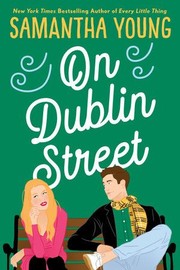
On Dublin Street
2,491-word summary 11 min read 336 pages in the book
- First published
- 2012
- Publisher
- NAL
- Pages
- 336
- ISBN
- 9780451419705
- Series
- On Dublin Street (#1)
Reading options
What's inside (7 sections)
I came to this one sideways. A friend who reads a lot of romance told me it was the book that got her through a hard winter, and she said it with enough feeling that I wrote the title down. I expected something light. What I got was heavier than I expected and also funnier than I expected, sometimes in the same chapter. It was first published in 2012: Samantha Young first released it herself that October, and then the NAL trade paperback came out that December. The NAL paperback runs 336 pages. It is the first book in the On Dublin Street series, and it follows Jocelyn Butler and Braden Carmichael from a bad first meeting to an ending two years later that earned its tears, at least for me.
A note before I start. This is an adult romance with explicit scenes and with grief sitting at the center of it. If you need to know whether it is only for romance readers, I would say no, but I would also say it asks you to care about two people sorting out whether they can love anyone without losing them. That is the whole engine. Everything else is decoration.
A new flat and a strict rule about attachment
Jocelyn Butler, called Joss by nearly everyone, is twenty-two and half American and half Scottish. She finished college and wants to be a writer. Four years ago she left the United States and started over in Scotland. Further back than that, when she was still at school, she lost her whole family in a car crash. Later she lost her best friend too. The details come out slowly, the way they do with people who do not talk about such things, but the shape is clear from the start: Joss decided that caring leads to funerals, so she stopped caring, or tried to.
Her system works, after a fashion. She is blunt to the point of rudeness. She says what she thinks and does not apologize for it. She keeps friendships shallow and romance shallower. She tells herself this is strength. Watching her, I kept thinking it looked more like a cast on a broken bone that she forgot to take off. It holds her up and it also stops her moving.
The story starts moving when Joss needs a new place and finds a room to rent in a flat on Dublin Street in Edinburgh. The flat belongs to Ellie Carmichael, a warm and chatty young woman who talks enough for both of them. Ellie takes to Joss right away, which confuses Joss, since she is used to keeping people at arm's length and Ellie simply walks around the arm. The flat is good. The rent is fair. There is only one catch, and it is a large Scottish catch with brown hair and blue eyes.
The catch is Braden Carmichael, Ellie's older brother. He is thirty, rich, and used to running rooms. He owns a club called Fire. People call him The Suit, which tells you most of what you need about how he dresses and how he negotiates. He is handsome in an intimidating way and he knows it. He also has a history that left marks: he was once engaged to a woman called Analise, who cheated on him with a former friend of his called Gavin. He does not trust easily either, though his way of not trusting looks nothing like Joss's. Where she freezes people out, he manages them.
Their first meetings go badly. He thinks she is rude. She thinks he is arrogant. They are both right, which makes it fun to read. He calls her Jocelyn instead of Joss, claiming Joss sounds like a boy's name and Jocelyn suits her better. She pretends this does not affect her. It affects her.
The arrangement, and why it never stood a chance
Braden wants Joss. That part is never in doubt. What makes the book more interesting than its setup is that he sees, early, that she will run from anything shaped like a relationship. So he proposes something with no shape at all: a private arrangement between friends, physical, with no claims and no future discussed. No strings, no labels, no promises to break. Joss, who has been managing her loneliness with rules, finds this logical. She agrees. She tells herself it is only sense.
Of course it never stood a chance, and the book is honest about that from the start. The arrangement gives them a reason to spend time together, and time does what time does. They spar. She is quick and he is quicker, and each of them is startled to meet someone who does not fold. He is bossy and used to obedience; she disobeys on principle. The banter carries a lot of pages, and I laughed more than once. There is a scene at the gym, early on, where Joss has a panic attack thinking about her parents and a stranger named Gavin helps her through it, which matters later in ways I did not expect. Little threads like that keep appearing. Young plants people and then brings them back when you have forgotten them.
The Edinburgh setting does real work. This is not a postcard version of the city. It is flats and buses and friends' kitchens, a club on a weekend, a family house full of noise. Joss writes while the city goes on around her. She is working on a fantasy story with her parents in the lead roles, which is her way of keeping them alive without admitting she is doing it. Ellie drags her to dinners. Ellie's friends Jenna and Ed come in and out. Adam, Braden's best friend, circles Ellie in a way that Joss notices before Ellie admits anything. The flat on Dublin Street starts to feel like a household, which is exactly what Joss told herself she did not want.
Fair warning is due here about Braden. He is dominant and possessive, and some of his behavior reads as controlling: the jealousy, the orders, the assumption that he knows what Joss needs better than she does. The book frames this as care backed by money and confidence, and for many readers that is the appeal. For others it will grate. I landed somewhere in the middle. His softer moments with Ellie and later with Joss are convincing, but there are scenes, especially around other women from his past, where I wanted someone to tell him to stop talking. Young lets him be wrong sometimes, which saved him for me.
The middle of the book turns on jealousy from both sides. At a party at Fire, Ellie lets slip that some of Braden's former girlfriends are present, and Joss, stung, spends the evening talking to Gavin from the gym. Braden, seeing them together, loses his temper completely and hits him. It is ugly. Then comes the twist that reframes it: Gavin is the man Analise cheated with. Braden had sworn off that kind of violence, and breaking the promise shakes him. He drags Joss to his office and demands to know what she is doing. She screams back at him about his exes circling all night and asks whether she mattered so little. He apologizes. She says he cannot hurt her, meaning she will not give him the power to. And he hears, correctly, that she already has.
Her past, in pieces
What lifts the book above a standard will-they-or-won't-they is the way Joss's grief is written. It does not arrive as one big speech. It leaks. A family dinner at the Nicholls' house, with Ellie's mother Elodie and stepfather Clark and the younger kids Hannah and Declan being loudly kind, sets off a panic attack that shames her. Writing about her parents sets off another. She starts seeing a psychologist, Dr. Kathryn Pritchard, and those sessions are handled with more care than I expected from this genre. The advice is plain and practical. Nobody is cured in a chapter.
Two old wounds drive her. One is the crash that took her parents and sister, which she survived by not being there and then punished herself for surviving. The other is guilt about her teenage best friend Dru, who died, and who had liked a boy Joss also liked without saying so. Joss kept quiet to spare her friend's feelings, and has spent years turning that silence into blame. These are the kinds of griefs that do not respond to logic, and Young gets that. People around Joss keep telling her sensible things. The sensible things bounce off. What reaches her is slower: being needed, being missed, being sat with.
Braden's past mirrors hers without copying it. His father Douglas never cared for him or Ellie. His mother Evelyn is more decoration than parent. He grew up fast and decided love was a contract people break. Ellie's family became his real family, and his devotion to Ellie is the best evidence in the book that he can love steadily. Joss watches all this and feels pity for the boy he was, then is embarrassed at caring, which Ellie finds delightful. Those small beats, Joss being caught caring, do more romantic work than the explicit scenes. They show the wall cracking from the inside.
I should mention the explicit content plainly since it affects who should pick this up. There is a lot of it, and it is graphic. Young writes it with enthusiasm and with attention to the emotional state of both people, which kept it from feeling inserted. Joss's responses change as her feelings change, and Braden reads her closely, sometimes too closely. Readers who like heat will be satisfied. Readers who skip such scenes will find themselves skipping a fair number of pages. Neither reaction is wrong. The book knows what it is.
Ellie, and the scare that breaks everything open
The crisis that breaks the couple apart has nothing to do with cheating or misunderstanding, and I was glad of that. Ellie learns she has a brain tumor that may be cancerous and needs surgery. For Joss this is not sad news about a friend. It is proof that her whole theory of life is correct: love someone and the universe takes them. She does the thing she always does. She leaves. She ends it with Braden before he can be taken from her, pulls away from Ellie when Ellie needs her most, hides at her friend Jo's place, and tells herself she is being rational.
It is painful to read because you can see the mistake and also see why she cannot see it. Braden is hurt and furious. He gets counsel from Elodie, who understands both of them better than they understand themselves. Dr. Pritchard tells Joss, in effect, to stop rehearsing loss and start practicing loyalty. And then Braden says the thing that finally gets through: if Joss is so sure she feels nothing, she at least owes Ellie an apology. Go and say it to her face. That dare works where tenderness failed. Joss goes to Ellie, holds her, and says she loves her out loud, maybe for the first time in years.
The reconciliation between Joss and Braden is messy, which suited me. He lies to her, saying he has been with someone else, to force a reaction. She throws plates at him. He admits the lie and holds his ground while she rages. She says they should wait until after Ellie's recovery to talk. He tells her he loves her and will not let go, and Ellie, from her sickbed, backs him up by saying he fights for what he wants. Adam chooses that moment to declare himself to Ellie in front of everyone, which could have felt crowded but actually felt right, like a family deciding things all at once.
Ellie's surgery goes well. Joss, still half bolted for the door, decides to fly back to Virginia to face her family's death on its own ground, and maybe to stay there. Braden meets her with fury instead of patience. He tears up her ticket. She explodes at him: she was safe before him, safe and numb, and he should stop trying to fix her. He answers that she was never as broken as she believes, and that his feelings are not a repair project. She finally says she loves him, and means it as a choice rather than a slip. They come together as a real couple at last, and she starts telling him her memories of her family, letting him know her the way he asked to from the start.
The epilogue jumps two years ahead. A wedding is being prepared. Everyone fusses over Joss and asks if she is all right. She answers with two words: I am ready. After four hundred pages of a woman bracing for impact, the line works. She is not saying life will be safe. She is saying she will meet it anyway.
What stayed with me, and what I would warn about
Let me be honest about the flaws, because they are real. The book is long for its story, and the middle repeats its pattern: closeness, panic, retreat, forgiveness. A reader with less patience than mine might start skimming around page two hundred. Some side plots, like the business with Rhian and her boyfriend James turning up at the flat, feel like filler from a longer draft. Braden's wealth solves problems a little too neatly, and his possessiveness, as I said, will bother some readers more than it bothered me. The prose can tip into the purple in heated moments. And the Virginia trip that ends the book feels rushed after so much slow circling.
Against that, the strengths are considerable. Joss's voice held me: funny, prickly, and sad in turns, with a way of deflecting that feels observed rather than written. Ellie is a triumph, the kind of secondary character who earns her own books, which of course she later got. The family scenes have warmth without turning sugary. The therapy thread is respectful. And the central idea is sound and humane: that grief makes its own rules, and that breaking them requires other people, not just willpower.
Would I press it on a friend? I would press it on the friend who gave it to me, with thanks, and on anyone who likes romance with real stakes and a Scottish setting. I would warn a reader who dislikes jealous heroes or explicit scenes to look elsewhere. For me, on balance, it earned its reputation. The #1 international bestseller tag and the Goodreads lists make sense once you meet Ellie and watch Joss fight herself. I finished it liking all three of them, Joss, Braden, and Ellie, and curious about Adam, which is exactly what a first-in-series should do.
FAQ
When was On Dublin Street first published?
It was first published in 2012. Young first released it herself in October 2012, and the NAL trade paperback followed that December. The summary follows that text and keeps its facts aligned.
Is On Dublin Street the first book in a series?
Yes. It is the first book in the On Dublin Street series, followed by books about the wider circle such as Ellie and Adam. Each later book centers on different characters.
Is On Dublin Street only for romance readers?
It is written for adults, with explicit scenes and heavy themes around grief and loss. Readers who want romance without those elements may prefer a lighter book.
Similar books
More from On Dublin Street first, then related titles.
Point of Retreat
Will and Layken keep love and two brothers together through bills, jealousy, and a pregnancy scare.
2,037-word summary · 9 min read
Slammed
Grieving Layken falls for neighbor Will, then learns he is her teacher, and poems carry them.
2,793-word summary · 12 min read

Sam's Letters to Jennifer
A grieving journalist reads her grandmother's letters and finds a decades-long love affair that changes how she sees her family.
2,310-word summary · 10 min read

Amy & Roger's Epic Detour
Amy Curry has not driven since the crash that killed her father. With Roger at the wheel and a box of maps between them, a cross-country trip becomes a slow…
3,034-word summary · 13 min read

One to Watch
A plus-size fashion blogger takes the lead role on a reality dating show to prove she belongs on television, and finds she might want what the cameras offer.
2,478-word summary · 11 min read
Rule
A tattoo artist still grieving his twin and the polished girl who has loved him since she was thirteen finally collide one drunken night in Denver.
2,014-word summary · 9 min read
The No-Show
Three women are stood up on Valentine's Day by the same man, but the timeline is not what it seems. O'Leary's warmest book with a knife in it.
2,127-word summary · 9 min read

Collided
Sophie bets she can resist playboy Liam, then pit walls fall.
2,219-word summary · 10 min read
To Love Jason Thorn
Childhood friends Olive and Jason reunite when the Hollywood star returns home, fake a romance for the cameras, and face old family wounds before trust turns…
2,506-word summary · 11 min read

This Man
Ava O Shea meets Jesse Ward while designing The Manor House, and their obsessive affair tests her work and limits.
2,209-word summary · 10 min read
The Upside of Falling
Two teens fake-date for a summer dare and end up facing grief, family secrets, and first love.
2,274-word summary · 10 min read
The Coincidence of Callie & Kayden
Callie saved Kayden in an alley and meets him again in college, where both must face assault and abuse to learn trust.
2,578-word summary · 11 min read
Playing for Keeps
Childhood neighbors Haley and Jason turn a long prank war into a fake relationship that turns real.
2,571-word summary · 11 min read
Gabriel's Rapture
A professor faces a hearing while Julia fights for her own name in Florence, testing love through distance and work.
2,480-word summary · 11 min read

Effortless
Kiera and Kellan try to build trust after choosing each other, tested by tour life, jealous fans, and Denny's lingering presence.
2,568-word summary · 11 min read

The Takeover
An arrogant CEO and the sharp employee forced to staff his deal trade insults, trips and late nights across a long push-pull, until pride and jealousy force…
2,580-word summary · 11 min read
The Heart Principle
Violinist Anna Sun plans one night with Quan Diep, then faces autistic burnout and family duty after her father's stroke in Hoang's 352-page 2021 Berkley…
2,793-word summary · 12 min read
Tangled
Told by a cocky businessman, a bet to win the new associate who rejects him turns into real pursuit, strict rules, a painful reveal and a wedding-level happy…
2,868-word summary · 13 min read
Pushing the Limits
Scarred Echo and foster kid Noah take on tutoring, family secrets, and a custody fight in this 2012 debut about trust after harm.
2,831-word summary · 13 min read
Never Too Far
Blaire flees Rosemary Beach after Rush's lies, then must decide if his pursuit and Nan's exposed schemes earn trust again.
2,626-word summary · 12 min read
Captivated by You
Eva and Gideon hide a secret Caribbean marriage while planning a Monterey wedding as Gideon arrest, press threats, and Corinne strain test them in Crossfire…
3,016-word summary · 13 min read
Before We Were Strangers
Matt waits fifteen years to ask Grace why she left after one college night that shaped them both.
2,386-word summary · 11 min read
Thoughtless
Kiera follows her boyfriend to Seattle and falls for her roommate, rock singer Kellan Kyle, in a messy love triangle about loyalty and desire.
2,997-word summary · 13 min read
The Switch
A burned-out consultant and her 79-year-old grandmother swap London and Yorkshire homes for two months, facing grief, dating apps, and village politics.
2,782-word summary · 12 min read
The Edge of Never
Grieving Camryn boards a bus and falls for secret-carrying Andrew.
2,482-word summary · 11 min read
This Girl
Honeymoon retelling as Will recalls first love, classroom ban, loss, fights, and vows that stick.
2,526-word summary · 11 min read
The Keeper of Lost Things
An old writer collects lost objects and leaves the quest to his housekeeper.
1,934-word summary · 9 min read
Forever, Interrupted
Elsie elopes in May, loses Ben nine days later, and learns grief beside the mother in law she never met.
2,051-word summary · 9 min read
Addicted to You
Lily hides sex addiction and Lo hides drinking while faking love to fool their rich families.
2,064-word summary · 9 min read
A Bend in the Road
Widowed sheriff Miles loves teacher Sarah while her family's secret touches his wife's death.
2,182-word summary · 10 min read