
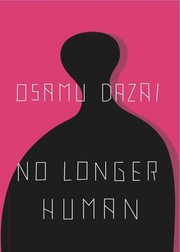
No Longer Human
2,320-word summary 10 min read 192 pages in the book
- First published
- 1948
- Publisher
- New Directions
- Pages
- 192
- ISBN
- 9780811204811
- Original title
- Ningen Shikkaku
Reading options
What's inside (9 sections)
I picked up No Longer Human by Osamu Dazai because I kept seeing it on late night lists. People pass it around like a warning and a recommendation at the same time. Short book, heavy reputation, second best seller in Japan behind Kokoro, TikTok favorite now, postwar classic then. I expected something cold. What I found was sadder and stranger, and for long stretches very plain in a way that makes it hit harder.
The facts first, since they matter here. It was first published in Japanese in 1948 as Ningen Shikkaku, which gets rendered as No Longer Human or as disqualified from being human. The first publisher in Japan was Chikuma Shobo. It appeared about a month after Dazai died in 1948 at thirty eight. This summary follows the New Directions English translation by Donald Keene, 192 pages, ISBN 9780811204811, first put into English in 1958. That edition is the one most American readers meet.
It is short. It is also not light. Alcohol abuse, drug use, failed suicide pacts, a sexual assault, time in a mental ward. If you want plot twists, there are not many. If you want mood, there is plenty.
Three photos and a bundle of notebooks
The book does not start with Yozo. It starts with someone else looking at three photographs of a man called Oba Yozo.
In the first photo he is a small child, surrounded by women, smiling in a way the narrator finds odd. In the second he is a student, handsome in a thin way, smiling again, but the smile looks staged. In the third he is older, maybe thirty, hair gray, face lined, smiling with no charm left. The narrator says he has never seen such an unhappy looking person who still smiles. Then he says a woman he knows has these notebooks written by Yozo, and he has agreed to pass them on.
That frame matters. We are told from the start that these are papers left behind, copied out ten years after they were written. Yozo speaks in first person inside, but someone else holds the outer edge. Dazai keeps that small distance the whole way. It stops the book from reading as diary, even when the material feels close to his own life.
The notebooks are three. Childhood. Youth in Tokyo. Adult collapse. The language is direct. Keene keeps sentences short. No fancy build. Yozo states shame the way other people state weather.
The child who learned to clown
The first notebook covers Yozo as a boy in a well off family in the north of Japan.
He says early that he never understood humans. Other children seemed to know rules he missed. Adults laughed at jokes he did not get, got angry at things he thought were small, forgave things he thought were large. He writes about watching servants and guests and feeling sure they all shared some secret agreement about how to act. He felt outside it.
His answer was to perform. He became funny on purpose. He tripped, made faces, said odd things to get laughs. At home he asked for a lion mask he did not even want, just because he thought that was what a boy should ask for when his father brought gifts from Tokyo. The family laughed. He felt relief. If they laughed, they would not look too closely.
There is a darker thread here that the book does not soften. Yozo says servants abused him when he was small. He tells no one. He says he did not trust that adults would believe him, and he feared making trouble more than he feared the acts themselves. He keeps that habit of silence for the rest of the book. When something harms him, he folds it in and jokes past it.
School sharpens the fear. A classmate named Takeichi sees through one of his clown routines. Yozo panics, then befriends him to keep him close. Takeichi shows him a reproduction of a Van Gogh painting and Yozo feels something crack open. Someone else made inner pain visible and people called it art. Yozo starts to draw. He makes a self portrait so ugly and honest that he hides it from everyone except Takeichi. Takeichi says he could be a great painter. For a page or two you think maybe art will save him.
It does not, but that small exchange stays with me. Yozo wants to be seen without being punished for being seen. Painting offers that for a minute. Jokes offer it too, but jokes wear out faster.
I found this section painful in a quiet way. Not because big events happen. They do not. It is the daily effort that tires you out. A boy studying faces to copy them, always tired, always acting.
Tokyo, Horiki, and the long slide
The second notebook moves Yozo to Tokyo for university. He is supposed to study. Instead he meets Horiki, a fellow art student who talks well and lives loosely.
Horiki is important because he is not evil. He drinks, chases women, skips class, jokes about leftist meetings without caring much for politics. He offers Yozo a ready made life: bars, cheap rooms, laughter that asks nothing. Yozo, who is tired of pretending alone, latches on. He starts drinking hard, smoking, paying for company. He goes to political gatherings he does not believe in because Horiki goes.
Painting fades. The self portrait promise fades. Yozo still draws now and then, but drink takes the center.
Then comes the first real break. After a night with a married woman, he agrees to die with her. They go into the water together in what Japanese custom calls shinjû. She dies. He lives. He is left with guilt that has no clean shape, plus police attention and shame from his family. The university expels him. A family friend takes charge of him.
What struck me here was how little Yozo argues for himself. He accepts blame, accepts help, accepts punishment, but he does not change course. He drifts to a single mother connected to Horiki, tries for a while to play father to her small girl Shigeko, keeps house in a loose way. For a few weeks it looks almost normal. Then drink comes back and fear comes back and he leaves them. He moves in with the madam of a bar. He meets a young woman named Yoshiko. Each move feels less like choice and more like water finding a lower place.
Keene keeps this part flat on purpose, I think. No swelling music. Yozo records a night of drinking the way you might record bus fare. That flatness makes the horror plain. You keep waiting for him to turn. He keeps not turning.
Yoshiko and what love cannot fix
The third notebook is the hardest to read, even though it starts with hope.
Yoshiko is young, inexperienced, kind in a simple religious way. She asks Yozo to stop drinking. For a while he does. He finds work as a cartoonist. He lives more cleanly. He tells himself this is a normal life at last.
Horiki returns. That return feels true to life. Old friends know where the door is. Horiki teases him back into bars and late nights. Yozo goes, partly from weakness and partly because he does not believe he deserves the clean stretch.
Then a specific night breaks the marriage. While Yozo talks with Horiki about Dostoevsky and Crime and Punishment and asks what the opposite of crime might be, a casual acquaintance assaults Yoshiko in another room. Yozo blames himself for talking and drinking while it happened. Yoshiko withdraws. Yozo withdraws further. Trust between them thins to nothing.
From there the fall is fast. Another suicide attempt with sleeping pills. Hospital. Then morphine. Yozo describes becoming an addict with the same dull tone he used for everything else. No drama. Just need, money, lies, need again. His family sends him to a mental institution. When he leaves, his older brother helps him move to a remote place. The book ends with Yozo saying he feels neither happy nor unhappy now, only older than his years. The frame narrator closes with a line from someone who knew Yozo, saying people often called him an angel in the sense of being untouched by common life.
I sat with that ending for a while. It refuses comfort. Yoshiko did nothing wrong and love did not cure anything. Horiki did not force anything and company still harmed. Yozo harmed others too, by leaving, by drinking, by using kindness and then dropping it. The book lets all of that sit without sorting it into moral columns.
Why the pictures and papers form matters
It helps to say plainly how the book is built, because the shape carries meaning.
Three photos at the start show a smile decaying over time. Three notebooks show a mind narrowing. A preface and epilogue show that others only saw the outside. Yozo says humans frightened him because their logic felt powerful and hidden. He says he could believe in punishment but not in love, and he tells a story about little Shigeko asking if God grants wishes. He answers in his head that he feared God and could not picture heaven. That passage explains a lot. If you expect punishment, you stop asking for help.
Dazai also returns to loyalty and betrayal. Yozo betrays his family by wasting money, betrays women by leaving, betrays Takeichi promise of art, betrays Yoshiko by failing to protect the home they made. Others betray him too, in small and large ways. The book does not excuse him. It shows a person who feels disqualified and then acts in ways that confirm the feeling.
One more craft point. The English is spare. Some readers call it blunt. The Japan Times review by William Bradbury called it timeless but noted that bluntness keeps it from feeling like raw autobiography. I agree. Even at his lowest, Yozo writes in clear sentences. That control is part of the chill. He is not ranting. He is reporting from inside a life he has already left.
What strains and who should skip it
I admire this book more than I enjoyed reading it. That seems fair to say.
What works: the early clown idea is sharp and specific. The Takeichi friendship, the lion mask, the hidden self portrait, the fear of being found out. Those details stay with you. The Tokyo drift feels honest about how addiction actually proceeds, not as one big fall but as many small returns to the same bar with the same friend. The Yoshiko section avoids easy blame. Dazai does not make her a saint who saves or a fool who fails. She is a young person outmatched by illness she did not cause.
What strains: the middle repeats. Drink, women, money trouble, shame, drink again. After a while the cycle flattens even as it should deepen. Horiki never grows past function. He is the friend who keeps the bottle open. The women, especially the bar madam and the single mother, get less inner life than they deserve. They enter to shelter Yozo and exit when he leaves. Yoshiko gets more care, but even she feels seen mostly through Yozo need.
There is also the autobiography question. Dazai attempted suicide more than once and died with a partner in 1948. Readers now find the book through stories about his death. That frame can push you to read Yozo as Dazai and miss the artifice. The photo device, the ten year gap, the calm prose, all signal fiction built from lived pain, not a note left on a table. If you read it as gossip, you lose half the book.
Who is it for? Readers who can sit with bleakness without needing growth at the end. Readers interested in postwar Japan, in shame as a social force, in how a sensitive person can fail at ordinary life. It helped me to read it slowly, a notebook a day, and to step away between.
Who should wait? Anyone in a rough patch around depression or substance use. Anyone who needs characters to learn. Yozo learns almost nothing he can use. That is the point, but it can feel cruel if you came for repair.
Short books often promise a quick punch. This one is 192 pages and feels longer, not from padding but from weight. I closed it thinking about the schoolboy practicing smiles in a mirror, and about how early he decided other people held a manual he would never get. Everything after follows from that decision, which may have been wrong and still ruined him.
If you read it, read Keene introduction if your copy has one, then put it down for a day before you judge Yozo. Pity comes fast. Understanding takes a bit more time, and the book earns that extra day.
A note on editions and place in his work
Dazai wrote The Setting Sun in 1947 and No Longer Human in 1948 as his last finished novel. A short piece called Goodbye was left unfinished at his death.
The Japanese first edition came from Chikuma Shobo. English readers met it through New Directions in 1958, then in paperback in 1973. Later translators have offered new versions under titles like A Shameful Life and a 2024 Tuttle version, but the Keene text remains the common door in. The ISBN for that paperback door is 9780811204811.
I mention this because titles shift. Ningen Shikkaku means something like disqualified as a human. No Longer Human sounds final. A Shameful Life sounds moral. The Japanese allows both and neither fully. Keep that looseness in mind and Yozo voice makes more sense. He is not saying he is a monster. He is saying he lost his membership card and never found the office to replace it.
FAQ
When was No Longer Human first published?
It was first published in Japanese in 1948 as Ningen Shikkaku by Chikuma Shobo. This summary follows the New Directions English translation by Donald Keene, 192 pages, ISBN 9780811204811.
Is it autobiography?
No. Readers often treat it as close to his life because Dazai died in 1948 soon after it appeared, but the narrator Yozo Oba is a fictional character and the book frames his notebooks with an outside narrator.
Is it a hard read even though it is short?
It is short and the plot is simple, but the mood is heavy. It deals with alcohol abuse, drug use, suicide attempts, and assault. Readers who want a warm classic should skip it for now.
Similar books

Revolutionary Road
A Connecticut couple who believe they are too good for the suburbs plan to move to Paris, and the plan slowly exposes everything they cannot say to each other.
2,085-word summary · 9 min read

Sophie's Choice
A young Southern writer in 1947 Brooklyn befriends a brilliant, unstable couple and slowly learns the story of the Polish Catholic woman at the center of their…
2,798-word summary · 12 min read
The House of Mirth
Lily Bart, beautiful and penniless at twenty-nine, navigates New York's marriage market until a Dorset yacht scandal strips her of the only currency she has.
2,468-word summary · 11 min read
The Heart is a Lonely Hunter
A deaf man becomes the quiet center for lonely souls in a small Georgia mill town.
2,000-word summary · 9 min read
Faust, Part One
A restless scholar bets his soul against one perfect moment, then ruins an innocent girl in Goethe's 1808 verse tragedy.
2,568-word summary · 11 min read
Ethan Frome
In snowy Starkfield, farmer Ethan Frome falls for his wife's young cousin Mattie, and one sled ride ends any hope of escape.
2,558-word summary · 11 min read
The Sorrows of Young Werther
A young artist writes letters about his love for Lotte, promised to another, until feeling turns fatal in Goethe's 1774 classic.
2,934-word summary · 13 min read
Paradise Lost
Blind Milton's epic of Satan's revolt, Adam and Eve's fall, and their hard walk out of Eden.
2,963-word summary · 13 min read
Julius Caesar
Brutus joins Cassius to kill Caesar for Rome, then loses Rome to Antony words and Octavius swords.
1,916-word summary · 9 min read
A Streetcar Named Desire and Other Plays
Blanche DuBois moves in with Stella and Stanley in New Orleans while her past closes in, plus two more Williams plays.
2,902-word summary · 13 min read
Madame Bovary
Emma Rouault marries Charles Bovary for romance, then seeks lovers and luxury until debts ruin them both.
2,400-word summary · 11 min read
A Farewell to Arms
Frederic loves Catherine in Italy until desertion leads to Switzerland and stillbirth.
2,502-word summary · 11 min read
Othello
Iago's lies drive the Moor of Venice to murder his innocent wife in Shakespeare's tragedy of jealousy.
2,409-word summary · 11 min read
East of Eden
In California's Salinas Valley, the Trasks and Hamiltons replay Cain and Abel through love, betrayal, and the hard choice to rise above the past across two…
2,734-word summary · 12 min read
Flowers for Algernon
Charlie Gordon's experimental surgery makes him a genius, then the mouse Algernon starts to slip.
2,074-word summary · 9 min read

The Bell Jar
Esther Greenwood wins a New York internship that should feel bright, then sinks into depression at home. Plath's 1963 novel follows her breakdown, treatment,…
2,504-word summary · 11 min read
Macbeth
Macbeth hears witches hail him king and murders Duncan with Lady Macbeth pushing him on.
4,056-word summary · 18 min read
Lolita
Humbert Humbert confesses his obsession with Dolores Haze and the road trip that ruins them.
2,706-word summary · 12 min read
Hamlet
Hamlet sees his father's ghost in Elsinore and pretends madness to test Claudius and Gertrude while Denmark slides toward duel and death.
2,996-word summary · 13 min read

Anna Karenina
Anna leaves Karenin for Vronsky while Levin seeks faith and farming outside Moscow.
3,942-word summary · 18 min read
Wuthering Heights
Emily Bronte's Wuthering Heights retold: Heathcliff and Cathy on the moors, two houses, two generations.
2,056-word summary · 9 min read
Romeo and Juliet
Shakespeare's Romeo and Juliet retold: Verona feud, balcony, Friar's plan, and why the last minutes collapse.
2,531-word summary · 11 min read
Of Mice and Men
Steinbeck's Of Mice and Men retold: George and Lennie on a California ranch, the dream farm, and why mercy ends it.
2,237-word summary · 10 min read
The Great Gatsby
The Great Gatsby through Nick Carraway: Gatsby's parties, the green light, Daisy and Tom, and why Fitzgerald's 1925 novel ends as a judgment on the American…
2,501-word summary · 11 min read

The Long Winter
Dakota Territory, 1880: seven months of blizzards cut a town off from the railroad, and a family survives on twisted hay, ground wheat, and a dangerous wheat…
2,210-word summary · 10 min read

The Crying of Lot 49
A California woman named executor of her ex-lover's estate follows a muted post horn into a possible centuries-old postal conspiracy, and Pynchon refuses to…
2,003-word summary · 9 min read
Silas Marner
A falsely accused weaver hoards gold in Raveloe until a stolen hoard and an abandoned child remake his narrow life.
2,699-word summary · 12 min read

Make Way for Ducklings
A pair of mallards raise eight ducklings on the Charles River and lead them across Boston to the Public Garden, with a little help from a friendly policeman.
2,044-word summary · 9 min read
Alone With You in the Ether
Two people in Chicago agree to six conversations, and the experiment becomes a love affair that is also a study of bipolar disorder, obsession, and the shape…
2,713-word summary · 12 min read
A Long Way Down
Four strangers meet on a London rooftop on New Year's Eve, each planning to jump, and end up making a pact to stay alive until Valentine's Day.
2,145-word summary · 10 min read