
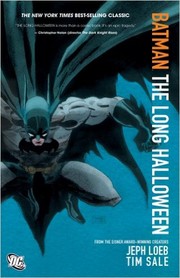
Batman: The Long Halloween
2,041-word summary 9 min read 384 pages in the book
- First published
- 1996
- Publisher
- DC Comics
- Pages
- 384
- ISBN
- 9781401232597
Reading options
What's inside (10 sections)
Ask for Batman recommendations and you get the same three books: Year One, The Dark Knight Returns, and The Killing Joke. The Long Halloween is the one that hangs around the edge of that conversation, and around October I start to think it is the most re-readable of the bunch. It is a mystery built like a calendar, one murder per holiday, and rereading it is like watching a magic trick you already know the secret to. You notice the hands.
It ran for thirteen issues from 1996 to 1997, written by Jeph Loeb and drawn by Tim Sale, and it has been collected in several editions since, including the 2011 paperback most readers will find today. It is set in Batman's early career, right after Year One, in a Gotham where the mob still runs things and a man dressed as a bat is a new and not entirely welcome development.
An alliance of three
The book's real love story is not between Batman and anyone. It is the partnership of three men: Batman, Captain Jim Gordon, and district attorney Harvey Dent. They meet in secret, on rooftops and in Dent's office, and they make a pact to take down Carmine Falcone, the mob boss the whole city calls the Roman. Each man believes the other two are the plan. Batman thinks Dent's legality can do what the cowl cannot. Dent thinks Batman's fear can do what the courts will not. Gordon just wants his city back. The fact that all three are wrong is the story.
Loeb writes the trio with a warmth that pays off later. Their banter, their nicknames, the way Dent ribs Batman about being scary while clearly liking him: this is the machinery that makes the last third hurt. You have to believe in the friendship before you can watch it fall apart, and the book spends its first half making you believe.
A body every month
The plot device is clean and brutal. On Halloween night, a murder is committed by someone the papers christen Holiday. The weapon is a .22, quiet and small, and the victims are all connected to the Falcone organization. Then Thanksgiving comes and there is another. Then Christmas. Then New Year's. In every chapter, on every holiday, someone new turns up dead, and the investigation restarts from whatever the last chapter left standing.
Batman's ritual in the early stretch of the book is a small masterpiece of comic-book structure. Each holiday, he visits Calendar Man, locked in Arkham Asylum, and each holiday Julian Day finds a new way to needle him, offering riddles dressed as small talk. Calendar Man is a gimmick character from the 1950s who becomes, in Sale's drawings, something much worse: a skinny man in a cell who knows things and enjoys the knowing. These scenes are the book's spine, and they get under your skin in a way the more famous villains do not.
The mystery itself is a proper whodunit, with a field of suspects that includes Falcone's heirs, his lieutenants, and members of his own household. Loeb and Sale keep the cast just tight enough that a reader can hold all the names, and just loose enough that the answer stays out of reach. I have read this book four times and I still think the clues are fair.
The freaks behind the curtain
One of the quiet ideas the book is working with is Gotham's transition from a city of gangsters to a city of monsters. The Falcones and Maronis still think they are the top of the food chain, and every holiday, from the shadows of the story, comes a reminder that they are already obsolete. The Joker shows up with his own theory about Holiday and a New Year's present for the city. Poison Ivy and the Mad Hatter drift through as hired and self-appointed chaos. Scarecrow turns a bank into a horror show. Solomon Grundy rises out of the city's underside like something the sewers finally coughed up. And Catwoman is everywhere, half ally, half antagonist, watching the mystery from an angle nobody else has.
None of these appearances are decoration. They are the book watching the old order die and the new one hatch, and Loeb uses them to keep the mystery unstable: every time the Falcones seem cornered, a costumed maniac reminds everyone that the rules have changed. If you have ever wondered where the idea of Gotham's "mob years" giving way to the Arkham years comes from in modern storytelling, this book is one of the texts that codified it.
Harvey Dent, and the fall
The middle of the book belongs to Harvey Dent. He is the best of the three partners and the most fragile, a man who genuinely believes in the law and is slowly discovering that the law loses. His marriage to Gilda is small and real in these pages. His anger at the Falcones grows teeth. By the time an acid attack tied to the mob war finally reaches him, the book has spent so long showing you the pressure on him that the transformation does not read as a comic-book inevitability. It reads as a breakdown.
Two-Face, when he arrives, is not a villain from a different story. He is Harvey Dent with the pretense stripped out, flipping a coin about whether the night ends with justice or revenge, and the final chapters are as much a horror story about friendship as they are a mob thriller. Batman and Gordon lose their partner and gain a rogues gallery entry, in the same week. The book never says the word "failure" out loud. It does not need to.
Two confessions
The mystery's resolution is the part people argue about at comic shops, and Loeb designed it that way. A Falcone confesses to the Holiday murders, and the case appears closed. Then the final chapter opens a second door. Gilda Dent, alone in a house, tells a story of her own that fits the facts just as well, burns the evidence, and leaves the reader holding two confessions that cannot both be true as stated. The book does not reconcile them. It does not try.
I have seen this called a cheat, and I understand the complaint. A detective story that refuses to name a single killer is asking for trouble. But the answer this book is actually interested in has never been the killer's identity. It is the question of what happens to a man who spends years hunting a monster and slowly becomes one. Whether the bullets came from Alberto Falcone's hand or Gilda Dent's matters less than what the hunt did to the three men on the rooftop in the first chapter, and the ambiguity keeps the book's real subject in focus. I think it works. I know not everyone agrees.
Tim Sale's Gotham
The other reason to own this book is the art. Tim Sale draws Batman in heavy shadow and awkward angles, built like something assembled rather than born, and his Gotham is a city of doorways that look like mouths. The palette runs on Halloween colors, oranges and browns and blacks, with red arriving only when things go wrong. Sale's faces are huge and expressive, so a chapter can be carried by an eyebrow, and his chapter-opening holiday cards, each chapter bookended by the date, give the whole thing a ritual rhythm. The 2011 edition shows the pages well, and if you can find an oversized edition, take it, because Sale's layouts are worth the extra inches.
Legacy
The Long Halloween's fingerprints are on a lot of Batman afterward, most visibly on Christopher Nolan's films, and it spawned a direct sequel, Dark Victory, plus a Catwoman companion called When in Rome, both by the same team. It is also, along with Year One, the book that much of the modern understanding of Batman's second year is built on. Its reputation is deserved.
The caveats are the usual ones for Loeb and Sale. The pacing between holidays can get glum, and the middle stretch cycles through suspects without much forward motion, which is a deliberate echo of a year passing and also, occasionally, just slow. The prose is quiet almost to the point of understatement in places, and readers who come for Batman doing Batman things will find he is almost a supporting player in his own book. Come for the mystery and the friendship, and the rest follows.
What I keep returning for is the ending's image of the three partners on a rooftop, one short of a trio, the city still standing and somehow worse off than when they started. It is a detective story where the detective work matters, a tragedy where the tragedy is structural, and the most autumnal thing ever drawn for a character who dresses like a bat. Read it in October if you can. It knows what month it is.
The Loeb and Sale catalog
The Long Halloween did not come out of nowhere. Loeb and Sale had already tested the format with Haunted Knight, a collection of three Halloween specials that previewed the tone, the villain cameos, and the seasonal structure that this book would expand into a year. After the miniseries landed, they returned with Dark Victory, a direct sequel that picks up the pieces of Harvey Dent's story and folds the origin of Robin into a second holiday-murder plot, and with Catwoman: When in Rome, which follows Selina Kyle to Italy to chase the question of her parentage that The Long Halloween only teases.
The partnership did not stay in Gotham. Superman for All Seasons is their take on Smallville and Clark Kent's first year, told across the seasons, and it is probably the most beloved thing they made together. Spider-Man: Blue and Daredevil: Yellow apply the same structure to Marvel characters, and Hulk: Gray applies it again, each one a retrospective narrated by the hero to a lost love. If you like the tone of The Long Halloween, the wistfulness and the long shadows, the rest of the shelf is consistent. Sale's art is the connective tissue: elongated figures, heavy blacks, faces carved rather than drawn, and a sense of silhouette that makes every panel feel like it was lit by a streetlamp. His pages do not look like anyone else's, which is why so much of the book gets remembered as images rather than panels.
The story's reach also kept growing. Christopher Nolan's Batman trilogy borrowed heavily from it, and not just in mood: Batman Begins puts Carmine Falcone at the center of Gotham's corruption, and The Dark Knight builds its entire Harvey Dent arc out of the blueprint this book drew. In 2021, DC adapted the story directly as a two-part animated film, splitting the thirteen issues down the middle, which is a decent way to experience it if you want voices and motion but a lesser one if you care about Sale's linework. Print remains the right format for this one.
For readers mapping the larger Batman canon, the useful frame is trilogy: Year One establishes Batman, The Long Halloween covers the transition year when the mob still thinks it runs things, and Dark Victory closes the loop by bringing in Robin. You can read any of them alone, and I would still recommend Year One first, but The Long Halloween is the volume that does the most work for the least setup. It is also, of the three, the most fun to re-read with a notebook, which is exactly what a mystery this constructed deserves.
One last argument for the reread, which is really an argument about how the book is built. The first chapter tells you almost everything, if you know how to look: the friendships, the pressure points, the clock that will run all year, and a version of Harvey Dent who is already making the choices that will doom him. Loeb writes it so smoothly that hardly anyone catches it the first time, which is why the second time through feels less like a story and more like a confession. Bring the notebook.
FAQ
Where does Batman: The Long Halloween fit in Batman's timeline?
It is set in Batman's early years, shortly after Batman: Year One, and it is often read as the bridge between Year One and the stories that follow Harvey Dent's turn as Two-Face.
Who was the Holiday killer?
The book presents two confessions, Alberto Falcone's and Gilda Dent's, and never fully reconciles them. Loeb left the ambiguity intentional, and readers still argue about the answer.
Do I need to read other Batman comics before The Long Halloween?
No. It is self-contained, though reading Year One first explains the state of Gotham and Batman's early relationship with Jim Gordon.
Similar books
Batman: The Killing Joke
The Joker shoots Barbara Gordon and tortures Jim Gordon to prove madness is one bad day away from anyone.
2,016-word summary · 9 min read
Batman: Year One
Honest cop Gordon and returning Bruce Wayne start at the bottom of rotten Gotham in endless rain.
1,993-word summary · 9 min read
Batman: The Dark Knight Returns
A 55-year-old Bruce Wayne ends ten years of retirement to face gangs, the Joker, and Superman.
2,249-word summary · 10 min read

What She Knew
Rachel lets her eight-year-old son run ahead in a Bristol park, and the nine-day search turns her into a suspect in the public eye.
2,952-word summary · 13 min read

The Beach House
A young valet is beaten to death at a Hamptons party, and his law-student brother spends a year building a case against the family that covered it up.
2,049-word summary · 9 min read
The Art Forger
A disgraced Boston painter agrees to copy a Degas stolen from the Gardner Museum, then begins to suspect the original she is copying is itself a forgery.
2,117-word summary · 9 min read

Six Years
A professor who promised to forget the woman he loved sees her husband's obituary and discovers that the wedding, the marriage, and the woman herself may never…
2,076-word summary · 9 min read

How the Light Gets In
Gamache investigates the murder of the last Ouellet quintuplet while the Sûreté he served is dismantled from inside by the man who took his protégé.
2,279-word summary · 10 min read
Bury Your Dead
Recovering from a failed raid that killed his officers, Gamache investigates a murder in a Quebec City library while Beauvoir reopens a case in Three Pines.
2,022-word summary · 9 min read

The Trespasser
A Dublin Murder Squad detective investigates a staged dinner-party killing and finds a cover-up that reaches into her own department.
2,051-word summary · 9 min read

Rules of Prey
Minneapolis detective Lucas Davenport hunts a killer who leaves a new rule at every scene and treats murder as a game of wits.
1,914-word summary · 9 min read

The Late Show
Exiled to the LAPD night shift after accusing her supervisor, Renée Ballard keeps two cases that were meant to be handed off at dawn: a brutal assault and a…
2,563-word summary · 11 min read
The Black Dahlia
James Ellroy builds a fiction around the real Black Dahlia murder, following two Los Angeles cops whose partnership and obsessions destroy them.
2,533-word summary · 11 min read
Ms. Marvel, Vol. 1: No Normal
Kamala Khan, a Jersey City teenager and Carol Danvers fan, gains shapeshifting powers and has to decide what kind of hero she wants to be.
2,579-word summary · 11 min read
Finger Lickin' Fifteen
Lula sees a celebrity chef decapitated and talks Stephanie into entering a barbecue contest to lure the killers, while Ranger hires her to find a security leak…
2,248-word summary · 10 min read

4th of July
Lindsay Boxer shoots two armed teenagers in self-defense, faces a wrongful-death trial, and spends her leave chasing a string of throat-slashing murders in…
2,192-word summary · 10 min read
The Camel Club
Four Washington misfits witness a murder on Roosevelt Island and stumble into a conspiracy that reaches the Oval Office, with a hostage president and a nuclear…
2,354-word summary · 10 min read

61 Hours
A bus crash strands Jack Reacher in a snowbound South Dakota town where a drug gang, a corrupt police force, and a single witness are on a collision course.
2,227-word summary · 10 min read
The Last Mile
Melvin Mars is hours from execution for his parents' murder when another man confesses, and FBI cold case detective Amos Decker goes looking for the trap.
2,746-word summary · 12 min read

Still Missing
A realtor is abducted at a Vancouver Island open house and held for more than a year. Told through therapy sessions, the novel follows her escape and the hunt…
2,466-word summary · 11 min read
Fearless Fourteen
Bounty hunter Stephanie Plum babysits a teenager, guards a fading singer, and hunts nine stolen million dollars under her boyfriend's basement.
2,466-word summary · 11 min read

Bad Luck and Trouble
A deposit of $1,030 summons Jack Reacher back to his old army unit, which is being picked off one name at a time.
2,366-word summary · 11 min read

3rd Degree
The third Women's Murder Club novel follows a San Francisco terror cell and a three-day killing schedule, and it costs the club a member.
2,685-word summary · 12 min read

Worth Dying For
Reacher stops for one night in rural Nebraska and finds a family that runs the county, a missing girl and a shipment worth killing for.
2,021-word summary · 9 min read

Say You're Sorry
A widowed prosecutor defends the teenager accused of killing her babysitter, uncovering a small town's secrets and a killer hiding in plain sight.
2,116-word summary · 9 min read
Locke & Key, Vol. 1: Welcome to Lovecraft
After their father is murdered, the Locke children move into a haunted family estate where keys unlock doors to ghosts, other places, and dangerous secrets.
2,019-word summary · 9 min read
Lean Mean Thirteen
Stephanie Plum's ex-husband disappears after she attacks him, leaving her suspected of murder and chasing a forty-million-dollar secret through Trenton.
2,100-word summary · 9 min read
Finlay Donovan Knocks 'Em Dead
Someone has put a contract on Finlay Donovan's ex-husband, and the novelist and her nanny have to find the hitman before the school pickup.
1,990-word summary · 9 min read

Echo Burning
Reacher hitches a ride with a Texas woman who wants her abusive husband killed, then has to prove she did not murder him when he comes home.
2,209-word summary · 10 min read
A Rule Against Murder
Gamache's anniversary at a remote lodge turns into a closed-circle murder when the family statue kills Julia, and everyone at the Manoir had a reason.
2,201-word summary · 10 min read