
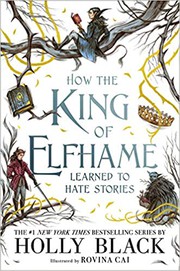
How the King of Elfhame Learned to Hate Stories
2,902-word summary 13 min read 192 pages in the book
- First published
- 2020
- Publisher
- Little, Brown Books for Young Readers
- Pages
- 192
- ISBN
- 9780316540889
- Series
- The Folk of the Air (#4)
Reading options
What's inside (8 sections)
I came back to this book because Cardan kept nagging at me after The Queen of Nothing. Jude had carried three books on her shoulders, all fury and schemes, and I wanted to know what the boy beside her had lived through. This slim illustrated volume gave me that. Holly Black published it in 2020 with Little, Brown Books for Young Readers, and the first hardcover runs 192 pages with full color art by Rovina Cai on nearly every spread. It is commonly listed as The Folk of the Air #3.5, a companion set after the trilogy, and it reads like someone opening a locked drawer. These are Cardan's memories, told in his voice, sour and sad by turns.
The shape is unusual. A frame story in the present follows High King Cardan and High Queen Jude as they slip into the mortal world to hunt something that is killing mortals near the woods. Between hunts, Cardan remembers. Each memory chapter pairs with a painting, moss and antler and cold sea light, and each memory circles the same question. Why does this king flinch at stories. The answer builds slowly. Someone told him tales when no one else would sit with him, and those tales taught him that softness gets you eaten.
The Boy In The Stables
Cardan starts as the inconvenient child. He is the youngest son of High King Eldred, born to Lady Asha, a court lady with ambition and little patience for nursery life. Eldred barely looks at him. Asha sends him away when his crying or his questions annoy her. At nine he sleeps in the palace stables some nights, curled in straw, playing a private game where he pretends someone is out searching for him. Nobody comes. That detail landed hard for me. Not beaten yet, not cruel yet, just small and waiting for a knock that never sounds.
In the stables he meets Aslog of the West. She is a troll woman, broad and scarred, come to the palace to demand justice. She served a lower queen for seven years and was cheated of her promised reward, and when she asked Eldred to intervene he refused. Eldred did not like to meddle in the affairs of lesser courts, and Aslog left the throne room with nothing. Furious and needing an audience, she finds the boy in the straw and offers him the one thing nobody else gives him. A story.
Her tale is about a boy with a wicked tongue who is cursed to carry a heart of stone. Because he feels nothing, he can face a monstrous bride through three nights of horror without flinching. On the last night she bumps his chest in play, the stone breaks, feeling floods back, and he weeps with love for her and his kin. She mistakes his tears for fear, her hunger takes over, and she tears him apart. Young Cardan demands the moral and hates the answer. Aslog tells him, in her rough way, that clever words are no defense against teeth. I paraphrase her because the chill matters more than the phrasing. Tales in her mouth are not comfort. They are warnings that the soft get devoured.
That night sets the pattern. Cardan learns that stories lodge inside you and shape what you dare to want. He also learns that his father will not protect the slighted, whether troll wife or small son.
Lady Asha And The Move To Hollow Hall
Lady Asha is hard to pity and hard to dismiss. She is beautiful, sharp, and tired of being the mother of a child the court treats as spare. She bore Eldred a son in hopes of favor and got little for it. When Cardan is small she keeps him close in bursts, then pushes him off. She spits at his feet when she is led away later, or so he remembers, and that image stays with him longer than any lullaby. He wants her love and resents her for making him want it. Black writes that bind without excusing either side. Asha wanted a better life and used the tools she had. Cardan paid part of the price.
A disgrace arranged by his brother Dain gives the court an excuse to move Cardan out. Dain, steady and honored and already gathering power, frames the boy in a way that makes him look wild and unfit for palace rooms. Whether Eldred believes it or simply finds it convenient, the result is the same. Cardan is sent to Hollow Hall to live under his eldest brother Balekin. This is where the cruelty training starts in earnest.
Balekin rules Hollow Hall like a lesson in fear. He drinks deep, keeps loud company, talks of harder rule for Faerie and less patience with mortals. He teaches Cardan that pain is instruction. Beatings come for small failures and for no reason at all. The worst part, for me, was the use of Margaret. She is a mortal servant in Balekin's household, ensorcelled and obedient, and Balekin orders her to strike Cardan so the humiliation cuts deeper. A faerie prince beaten by a mortal woman's hand, in front of his brother's friends. Cardan remembers the strap in her hand more than the pain itself, and the blank look in her eyes that told him she had no choice.
Hate warms him where nothing else does. He says so in his own sour way. Hate for Dain, for his father, for brothers who would not take him in, for the one who did, for his mother who turned away. Hate feels hot after years of cold, so he welcomes it and lets it fill his chest. Not a heart of stone, he thinks, but a heart of fire. Under Balekin he remakes himself. He learns wines and powders that blur the nights. He learns tailoring with sharp edges, rings and boots meant to announce danger. He learns to talk first and cut deepest, so nobody sees the stable boy still inside.
One small mercy survives this period and matters later. Years on, grown and with power of his own, Cardan finds Margaret again in the mortal world and quietly frees her from enchantment. He does not make a speech about it. He does it because he remembers her face and cannot stand what was done through her. It is the first hint that the fire in him never fully burned out the part that notices other people's chains.
Nicasia, Locke And Valerian
By his teens Cardan has a circle. Nicasia, princess of the Undersea, proud daughter of Queen Orlagh, who carries the sea's contempt for land courts and wants land boots to kiss her shoe. Locke, charming master of revels to be, who has an empty family house to run wild in and an endless hunger for sport. Valerian, quiet and vicious, who loves pain the way other folk love music. And Cardan, modeling himself on Balekin, playing the worst version of himself because it gets laughs and keeps him from being pitied.
They fill their days with hunts and feasts and mean games. Nicasia mocks land faeries and mortals alike, then curls against Cardan in mossy corners and whispers of running off to the Undersea with him. Locke suggests dares and smooths over the fallout with a grin. Valerian finds the weak spot and presses. Cardan plays along, trying to prove he can be crueler and cooler than all of them.
Locke's view of harm sticks in my throat. He calls cruelty merriment, a game where everyone supposedly agrees to play. Cardan borrows that language for a while because it lets him sleep. If it is all a game, then nobody is really hurt and he is not really at fault. Black lets that excuse rot slowly. Cardan sees a mortal girl weeping after one of Valerian's tricks and feels something twist, then drinks until it stops twisting. He sees Nicasia preen when land courtiers flinch, and feels admired and sick at once.
The group breaks on betrayal. Nicasia takes up with Locke behind Cardan's back, or Cardan reads it that way, and the humiliation burns worse than Balekin's strap because he had started to trust their small pack. He tells Locke he is done with his framing of pain as fun. He tells Nicasia to stay away from him for her own good on a night when Balekin's plans turn violent. Both scenes are clumsy and proud. He cannot say he is hurt, so he says he is bored. He cannot say he is scared, so he says he is disgusted. That habit, learned at Hollow Hall, will poison his early dealings with Jude too.
What I appreciated here is how plainly the book shows neglect turning into performance. Eldred never claimed him. Asha never kept him. Balekin claimed him only to break him. So Cardan builds a self that cannot be broken because it claims to want nothing. It is armor, and like most armor it chafes the wearer most.
The Mortal Girl Who Would Not Bow
Jude Duarte arrives at court as everything Cardan pretends to despise and secretly envies. She is mortal, raised in Madoc's house after Madoc killed her parents and carried her and her sisters to Faerie. She trains with a sword before lessons. She wears rowan against glamour. She stares back when Nicasia sneers. Cardan has spent years learning that mortals are brief and breakable, mice in a house of cats, as Balekin puts it. Then this girl refuses to squeak.
At school he targets her because she reacts. Dumped trays and tripped feet and enchanted fruit, the whole petty arsenal. He tells himself he hates her noise, her reaching above her station, her talk of knighthood. Under that, and the book is honest about this, he hates that she wants something clearly and chases it. He has never let himself want anything so openly. Her conviction shames his drift, so he tries to snuff it.
Two moments from this stretch stayed with me. Cardan watches Jude refuse faerie fruit that would enchant her, though everyone laughs at her caution. He mocks her for it later, but he remembers the set of her jaw. Then Valerian holds Jude under water, and Cardan waits too long before calling a halt. He carries that delay like a stain. Black does not let him off. Wanting to be better after the fact is not the same as being brave in the moment.
The book also retells familiar trilogy beats from inside his head. The coronation where Eldred steps down and blood spills across stone. The nights Cardan wears the crown he never expected and finds it heavy. His fear that every lord in the hall can see the stable straw still stuck to his boots. His geas bargain with Jude, a year and a day of obedience that tastes like shame and relief both. His slow grasp that Jude lies the way faeries breathe, easily and for keeps.
Birds, Letters And A Heavy Crown
The bird passage the plot asks for comes in two places, and both are quieter than the sword fights. Early on, at Hollow Hall, Cardan hides from one of Balekin's rages in an orchard and watches starlings wheel over the wall. He envies them because they move together and nobody singles out one bird for punishment. Later, in the mortal woods frame, birds go silent right before the ground softens over Aslog's pit, and Jude lifts a hand to halt their party. Cardan notices the hush first because his nerves are still tuned to orchard listening. He thinks of those starlings and steps forward anyway. It is a small thread, but Black uses it to show how old fear stays in the body.
Letters carry the middle ache. When Jude is exiled to the mortal world after she kills Balekin as Undersea ambassador, Cardan writes to her and does not send half of what he writes. He drafts cold orders and burns them. What finally goes out is stiff and kingly, and Jude reads the stiffness as hate. From his side we see the hours behind each line. He paces. He asks the Court of Shadows for news of a mortal girl working in a fish shop. He fears that if he writes plainly she will see the stable boy and leave him for good.
Coronation anxieties fill these chapters like smoke. Cardan never trained to rule. Dain trained. Balekin schemed. Cardan performed. Now the Milkwood throne tests him daily. Orlagh of the Undersea presses him to marry Nicasia and renew the sea treaty. Madoc watches with an army at his back. He sits through feasts feeling like a fraud, waiting for someone to name him spare to his face. His answer is to lean into theater. Velvet and scorn, delay and jest. It works just often enough to keep him alive, and fails just often enough to keep him scared.
The serpent turn, which trilogy readers will know, gets only a brief inward glance here, and that restraint is wise. Cardan remembers scales and hunger and shame, and Jude standing her ground before him. He does not linger on magic mechanics. He lingers on her face, unafraid in a way that made him want to be worth her lack of fear.
The Monster In The Mortal Woods
The frame closes with teeth. Bryern, a phooka who once employed Jude in exile, brings word that mortals are dying near tangled woods in the human world, throats torn, bodies left for something's supper. Cardan and Jude ride out on ragwort steeds, wind sharp, glamour thin. Jude carries Nightfell, her mortal-made sword. Cardan carries worry he will not name. They find iron filings scattered where no faerie would walk willingly, and a pit dug deep and lined to dull magic.
The killer is Aslog herself. She has been murdering mortals and feeding them to her rival Queen Gliten's line in a long revenge for that cheated seven years of service. Gliten's knights hunt her. She hunts alone. When she sees Cardan she knows him, stable boy grown into a crown, and her smile is almost fond before it turns hungry. She springs her pit and Cardan drops in to spare Jude the fall, landing hard among iron that saps his strength.
Here Black pays off the title. Cardan, who claims to hate stories, must tell one to live. He starts Aslog's old fable again, the boy with the wicked tongue and the stone heart, but he changes it as he speaks. In his new version the boy learns that feeling is terrible and needed both, that a heart is a burden you carry because the alternative is worse, that tales can justify anything so you must choose the tale that leaves people alive. He spins detail to hold her attention, luring her closer to the edge, until sunrise crests the trees. Troll flesh hates dawn. Aslog lunges, misses her footing, and the pit takes her.
I will not pretend this fight matches the trilogy's battles for scale. It is a scuffle in cold mud, all iron ache and shouted lies. Its weight is inward. Cardan beats the woman who taught him fatalism by refusing her ending. He does not stop hating stories. He learns to wield them, and to distrust anyone, himself included, who claims a tale has only one moral.
The coda is gentle and I loved it for that. Back in Elfhame, with winter light on the palace floor, Cardan and Jude sit with Oak, the small horned heir hidden so long in Madoc's house, and with Liliver called Bomb, the cheerful explosives maker of the Court of Shadows who mothers Oak fiercely in her own odd way. Oak asks for a story and Cardan stiffens, then tells a short one with a kind ending. Bomb laughs and corrects his worst line. Jude rests her head against his shoulder and does not mock him for softness. It is the first tale he tells without trying to cut someone with it.
Fair criticism belongs here, because this book is not for everyone. At under 200 pages it moves fast and leans hard on prior books. A newcomer who starts here will meet Madoc and Orlagh and the Ghost without proper introductions and will wonder why a marriage by bargain matters so much. Some retold scenes feel brief if you wanted whole chapters from Cardan's eyes during exile or the poisoning at Locke's revel. Nicasia gets more page time than Jude in the middle third, which frustrated me on first read even though it serves his arc. Take this as dessert, not dinner. Read The Cruel Prince, then The Wicked King, then The Queen of Nothing, and let this fill the gaps and warm the edges.
I closed it grateful. Cardan began as a boy no one told stories to, became a prince who used stories as knives, and ends as a king learning to tell one that shelters instead of stings. The art helps. Cai paints him tail and all, sharp cheeked and tired eyed, often alone in large rooms. You see the stable straw and the crown in the same figure. For fans who wanted his side of the love and the fear, that image alone is worth the price.
FAQ
Do I need to read the trilogy first?
Yes. Start with The Cruel Prince, then The Wicked King, then The Queen of Nothing. This novella retells scenes and spoils all three books.
When was it published and how long is it?
Little, Brown Books for Young Readers published the hardcover on November 24, 2020. It runs 192 pages with full color art by Rovina Cai.
Is this a full novel or a companion?
No. It is a short illustrated companion, commonly listed as #3.5, with a mortal world frame plus memories from before, during and after the trilogy.
Similar books
More from The Folk of the Air first, then related titles.
The Cruel Prince
Mortal Jude fights for a place at the faerie court, bargaining with the prince she hates.
2,477-word summary · 11 min read
The Lost Sisters
Taryn Duarte writes a letter to her twin, Jude, explaining how she fell for Locke and why she stayed silent while he used them both.
1,914-word summary · 9 min read
The Wicked King
Jude must hold Cardan on the Elfhame throne while the Undersea plots.
3,439-word summary · 15 min read
The Queen of Nothing
Exiled Jude returns to Faerie to save Taryn and break a deadly curse.
2,091-word summary · 9 min read
The Stolen Heir
Feral ex-queen Suren joins Prince Oak on a frozen quest to stop her mother, Lady Nore.
2,305-word summary · 10 min read

The Iron Daughter
Exiled with Ash after the scepter theft, Meghan hunts the Iron stronghold as iron magic wakes inside her.
2,995-word summary · 13 min read

Wicked Lovely
Aislinn sees faeries and must decide whether to become Summer Queen while loving mortal Seth.
2,059-word summary · 9 min read
The Iron King
Meghan Chase follows her stolen brother into the Nevernever and bargains with a Winter prince to face the Iron King.
2,720-word summary · 12 min read
A Court of Thorns and Roses
Sarah J. Maas's A Court of Thorns and Roses retold: Feyre, Tamlin's Spring Court, the curse, and the trials Under the Mountain.
2,442-word summary · 11 min read
A Court of Mist and Fury
ACOTAR book 2 retold: Feyre in the Spring Court, the bargain with Rhysand, Velaris, and war with Hybern.
2,218-word summary · 10 min read
Tithe: A Modern Faerie Tale
A retelling of Holly Black's Tithe: Kaye Fierch returns to the Jersey Shore, discovers she is a changeling, and becomes the mortal sacrifice in a faerie power…
2,586-word summary · 11 min read

Vow of Thieves
Kazi and Jase return to Tor's Watch to find it occupied, and their marriage is tested by captivity, betrayal, and a war for the town of Hell's Mouth.
2,059-word summary · 9 min read

Archenemies
Nova steals for the Anarchists while Adrian hides his Sentinel identity, and a serum that erases prodigy powers puts them both at risk.
2,485-word summary · 11 min read

The Siren
Saved from a shipwreck in 1930, Kahlen becomes a siren who sings men to their deaths for the Ocean, until a boy in a college library makes her want a life she…
2,369-word summary · 11 min read
Cruel Beauty
A girl raised to kill the demon prince who rules her cursed land instead falls in love with him, in a retelling that mixes Beauty and the Beast with Bluebeard…
2,669-word summary · 12 min read
Demonglass
Sophie Mercer spends the summer at the Council's English estate, where two new demons, a suspicious host, and Archer's return complicate her plan to remove her…
2,771-word summary · 12 min read

Born at Midnight
Kylie Galen is sent to a camp for troubled teens and discovers it is a haven for vampires, werewolves, and witches, and that she may be something stranger…
2,310-word summary · 10 min read

The Rose & the Dagger
Shahrzad is pulled from her Caliph husband and left in a desert camp of rebels, needing to break his curse and end a war before it ends her.
2,520-word summary · 11 min read

We Hunt the Flame
In a fractured Arabia-inspired world, a disguised huntress and a prince-assassin race to find a magic-restoring book and confront an ancient evil.
2,195-word summary · 10 min read
Stars Above: A Lunar Chronicles Collection
Nine Lunar Chronicles stories fill in the histories of Cinder, Wolf, Thorne, Cress, Winter, and Jacin, and end with a wedding after the war.
2,230-word summary · 10 min read

Lore
Lore Perseous, the last of a hunted bloodline, is pulled back into the Agon when a wounded Athena offers her revenge against the god who killed her family.
2,188-word summary · 10 min read
House of Salt and Sorrows
Annaleigh Thaumas investigates her sister's death in a cursed island manor where the balls are illusions and the sea god is always listening.
2,025-word summary · 9 min read
Cemetery Boys
A trans brujo in East Los Angeles summons the ghost of a boy who refuses to move on, and together they uncover a murder hidden beneath Día de los Muertos.
1,997-word summary · 9 min read

Blue Moon
Ever Bloom tries to save her immortal boyfriend, Damen, from a mysterious illness while a new student named Roman quietly takes control of her school and her…
1,998-word summary · 9 min read
An Enchantment of Ravens
Isobel, a mortal artist in the fairy town of Whimsy, paints a portrait of the autumn prince and falls in love with him, breaking the laws of her craft.
2,087-word summary · 9 min read
Switched
A Minnesota teenager who can make people obey her discovers she is a changeling troll princess, and the hidden kingdom she came from wants her back.
2,131-word summary · 9 min read
A Reaper at the Gates
The Martial capital falls to an army of ghosts, Elias becomes the Soul Catcher, and Laia and Helene pay brutal prices as the Nightbringer moves to free the…
1,991-word summary · 9 min read
Fable
Abandoned on a lawless island at fourteen, Fable spends four years diving for gems to buy passage off it, straight into the cutthroat trade of the Narrows.
2,320-word summary · 10 min read
World After
Penryn wakes from near-death to find her altered sister Paige hunted as a monster, and follows her into the angels' scorpion factory and Uriel's coup.
2,213-word summary · 10 min read