
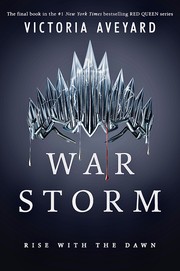
War Storm
2,860-word summary 13 min read
- First published
- 2018
- Publisher
- HarperTeen
- ISBN
- 9780062422996
- Series
- Red Queen (#4)
Reading options
What's inside (9 sections)
I picked up War Storm because I could not leave the Red Queen story half finished. I had read the first three books in quick runs and I needed to know how Mare and Cal ended up. I started it on a Friday night with tea going cold beside me and I told myself I would read a little and then sleep. I read past midnight instead. First published in 2018 by HarperTeen, this is book four in the Red Queen series and it closes the main run that started with Mare Barrow stealing in the Stilts. It is big and tired in the way last books often are. I liked finishing it even when parts of it wore me out.
My copy felt heavy in my hands and the story feels heavy too. Everyone in it has lost someone. Everyone has made a choice they wish they could redo. I went in wanting a clean win for Mare. I came out with something messier and more true to these people. If you loved the early court games and you want payoffs for Maven and Evangeline, this is the book that tries to give them to you. It does not always land, but it tries hard.
Where everyone stands when this one opens
The last book left Norta in pieces. Maven Calore sits on a throne that does not love him. Mare Barrow and Cal, who once stood close to that throne, are outside it now and marked as traitors by many. The Scarlet Guard has grown but it has also split and argued about what freedom should look like. Farley is still pushing for a Red future. Kilorn is still at Mare's side when he can be. Evangeline Samos is still sharp and proud as she looks for a way out that keeps her family safe.
What helped me was thinking of this book as three tired groups circling each other. You have Maven and what remains of his court, holding on through fear and old names. You have Mare with Cal and the Guard, trying to build trust after betrayals. And you have the free lands to the south and west, especially Montfort, watching and weighing whether to step in. Lakeland under Queen Iris and her family presses from the north with its own claims on water and land. Piedmont gets talked about as a possible ally through marriage and deals. I kept a little list on paper because names come fast in the early chapters.
The tone is worn down from the start. Mare narrates much of it and she sounds spent. She misses her brothers. She misses the girl she was before the palace put a name on her. Cal sounds spent in a different way. He was raised to rule and now he has no chair to sit in. He loves Mare but he also loves Norta in a way she does not fully share. Maven sounds hollowed out. I found those opening chapters sad rather than thrilling, which fit. This is not a book about hope sparking. It is about people trying to keep going after hope failed them once.
One thing I appreciated early was how the book reminds you what powers can and cannot fix. Mare can call lightning and it still does not buy bread or trust. Evangeline can bend metal into art or weapons and it still does not free her from her parents. Iris can work with water in ways that scare even Silvers and it still does not give her peace at home. Power opens doors but it also paints targets, and War Storm keeps showing that trade.
Mare in exile and the Montfort question
Mare spends a large part of this book away from home. After everything with Maven, she and Cal are not welcome in Norta as anything but prisoners or tools. They travel with Guard allies and spend time with Montfort people who live without kings. For Mare, who grew up Red under Silver rule, Montfort feels strange and bright. No one bows. People vote. Reds and Silvers live side by side, at least in theory. She wants to believe in it. She also flinches because every promise made to her before came with a hook.
I liked these travel sections more than I expected. They slow the war plot but they let Mare breathe. She trains. She argues with Farley about what the Guard owes ordinary Reds. She talks with Montfort officers who ask plain questions about why Norta should keep its crowns at all. There is a long stretch where Mare has to decide whether to be a symbol again. She hates being used as the lightning girl on posters. She also knows her face moves people who would never listen to speeches. That pull between private hurt and public use runs through her chapters.
Cal struggles here too. In Montfort he is just a man with fire and a famous name. Some Montfort folks respect his skill in a fight. Others see only a Silver prince who burned villages in his mother's war. He tries to learn. He listens more than he did in court. He still slips into command voice when stressed, and Mare calls him on it. I found their talks honest and sad. They love each other but they want different futures. Mare wants out from crowns. Cal wants to fix the crown he was raised for. Neither is wrong and that is why it aches.
Farley gets strong moments in this middle part. She is pregnant through much of the story and still working, still blunt. She pushes Mare to think past revenge on Maven. She pushes Cal to admit that abdication talk means little if Silvers keep land and guns. Kilorn stays loyal and funny in small ways, which I needed. When the book stays with these human talks around fires and in trucks and on base paths, it feels alive to me.
If there is a drag here, it is length. Some meetings repeat. Some debates circle back to points already made. I skimmed a few council scenes where new names piled up and the stakes stayed vague. The idea is sound, that freedom needs plans rather than slogans, but the pages could have been tighter.
Maven broken and hard to look away from
Maven gets his own chapters in this book and they are bleak. He is mostly alone in his head with memories of his mother Elara pressing in. He misses Mare in a twisted way. He hates Cal in a hot way that never cools. He tries to rule while Lakeland watches and his own lords doubt him. Iris Cygnet marries into his story as part of a Lakeland pact, and their scenes are cold and formal. She is strong and devout in her own way. He is polite and empty. Neither trusts the other, and both know the marriage is about ships and troops rather than care.
I had mixed feelings about these chapters. On one hand, they make Maven less of a cartoon villain. You see how Elara shaped him from childhood, how fear was planted early, how every comfort came with a price. On the other hand, the book asks for a lot of pity for a boy who ordered kills and torture. I felt sorry for the child he was while still angry at the king he chose to be. That tension is on purpose, I think. Whether it works will depend on you. For me, it worked in small doses and wore thin when his chapters lingered too long on the same ache.
His tie to Iris matters for the war plot. Lakeland wants ports and safety after old losses. Iris wants to protect her family and her faith. Maven wants soldiers and a shield against the Guard and Montfort. Their pact is shaky from the start because both sides plan to betray it if needed. I liked Iris more as the book went on, not as a friend to Mare but as a rival with clear reasons. She is not cruel for fun. She fights for her own people and she sees Mare as a storm that drowns coastal towns. That view stung because it has some truth.
There are prison scenes and interrogation scenes with Maven that are hard to read. Without giving late twists away, I will say the book keeps asking whether Maven can be saved or only stopped. Mare swings between hate and old pity. Cal swings between brother love and soldier duty. Evangeline sees him most clearly as a lost cause she once used. I kept turning pages here even when I felt uneasy, which says something about how well Aveyard writes needy, charming harm.
Maven remains the sad center even when he is off the page, because every plan has to answer what to do with him.
Evangeline and the marriage talk
Evangeline Samos was a surprise favorite for me in this finale. She starts as the steel queen of mean lines and perfect hair, and she ends as someone trying to pry herself free from her family. Her chapters are vain and funny about court life. She notices clothes and jewels the way Mare notices wires and storms. Under that shine, she is scared of her parents and tired of being traded for alliances.
Much of her plot turns on marriage bargaining. With Norta cracking, houses look south to Piedmont for support. Evangeline is pushed toward a match that would bind Samos metal to Piedmont wealth. She plays along in public while hunting for another path in private. I enjoyed how practical she is. She counts guards. She counts exits. She flatters Piedmont princes while memorizing their weaknesses. It is court intrigue in the old style, and after the muddy camps with Mare, I welcomed the silk and spite.
Her bond with her brother Ptolemus stays fraught. He loves her in his blunt way and he also serves House Samos first. Her mother and father press her to obey. Her feelings for Mare shift from hate to wary respect, though they will never be soft friends. There is one stretch where Evangeline helps Mare and Cal for reasons that are selfish and almost kind at once. I liked that mix. It felt human. She does not turn good all at once. She turns a few degrees toward free.
The Piedmont talks also show how little crowns care for Reds. While Silvers toast and dance, Red servants clear plates and Red soldiers drill outside. Aveyard lets that sit without a speech, and it lands. Evangeline sees it because Mare forced her to see it once, and she cannot fully unsee it now. Does that make her a rebel? No. It makes her uncomfortable in her own skin, which for Evangeline is huge growth.
My gripe here is sprawl. With Mare and Maven carrying chapters, plus Evangeline at times, the middle sags under viewpoints. I sometimes forgot whose chapter I was in for a page until a voice cue landed. Evangeline's voice is the strongest of the added ones, so I wished the book had trimmed others and stayed with her longer.
The road to the last fight
The back third moves toward open war. Alliances lock. Montfort agrees to help in exchange for terms about Red rights and future votes. The Guard masses. Lakeland commits ships and water workers. Norta under Maven digs in around key cities and dams and broadcast towers. Plans hinge on passes and rivers and who controls the lights when storms hit. Mare trains hard to link her lightning with weather and with allies who can amplify it. Cal drills troops who do not all trust a former prince.
I will keep battle specifics light because the fun is in the reversals, but the shape is this: a push into Norta from more than one side with a personal hunt for Maven himself. Farley coordinates comms and supply with brisk sense. Kilorn scouts and guards. Evangeline moves pieces inside Silver halls where soldiers cannot go. Iris defends her own with water walls that take huge effort to break. The action cuts fast between mud and marble, which I liked after the slow middle.
There are losses. This is a finale and Aveyard does not shield old favorites. One death hit me hard because it came during a quiet errand rather than a grand charge. Another hurt because the character chose it to buy time for Reds to run. I cried once, briefly, on a bus, which embarrassed me. The book earns those beats when it stays close to faces rather than maps. When it pulls back to generals moving marks, my attention slipped.
Mare's power grows here but so does its cost. She blacks out. Her hands shake. She needs rest she will not take. Cal begs her to pace herself and she snaps at him, then hates herself after. I believed their strain. Love under siege curdles into logistics, who sleeps, who eats, who stands watch. Aveyard writes that well. The quiet tent talks before battles felt truer than the speeches.
Piedmont and Lakeland choices tip key moments. Without spoiling, I will say oaths break and new ones form fast. Some Silver lords flip when they smell defeat. Some Red towns rise when they hear Mare is near. Montfort tech helps but cannot win hearts alone. The end of the fighting feels less like triumph and more like exhaustion, which suited me. War in this series has always been waste dressed as glory, and the last campaign shows the bill.
What the ending tries to do
After the final clash, the book spends a good while on fallout. Trials are discussed. Crowns are questioned. Mare has to face what revenge gave her and what it stole. Cal has to face whether he can love a country without ruling it. Maven's fate, which I will not spell out fully here, split my friends who read it. Some found it merciful. Some found it cruel. I landed somewhere in the middle, moved by one last talk and uneasy about what it asks us to forgive.
Evangeline's end thread pleased me most. She chooses a path that costs her House favor but buys her air. It is not a full escape and not a fairy tale. It is a door left open. Farley's thread pleased me too, in a tired domestic way that suits her no nonsense heart. Iris gets no easy pardon, but she gets understanding. The book lets Lakeland grief sit beside Red grief without ranking them, and I respected that.
Mare and Cal do not get a neat bow. Their love survives the war but not unchanged. One wants quiet. One feels duty like a coat he cannot take off. The last pages give distance rather than vows. I know readers who hated that. I did not. After four books of fire and lightning, a pause felt honest. People need time to become who the peace needs. The book says as much in Mare's tired voice, and I believed her.
The close favors healing over crowning, and that choice will please some and annoy others.
What worked and what dragged for me
What worked: the voices when they are sharp. Mare tired and wry. Evangeline vain but slowly kinder. Farley blunt and right about most things. The world building around Montfort as a vote based state gives the series a new model past kings. The action, when close up, crackles. Lightning on water, fire in halls. I felt those scenes in my chest.
What dragged: length and spread. This book runs long and you feel it in the middle council talks and in repeated Maven loops. Four or five viewpoints dilute pull. I would have cut one viewpoint thread and given those pages to Farley and Kilorn, who fade for stretches. The Maven sympathy bid will test patience if you came for justice after book three. And the final peace talks, while thoughtful, read slow after battle highs. I sipped water and pushed through.
Would I still tell a friend to finish? Yes, with a warning to pace yourself. Read it in chunks. Let the sad parts sit. Do not binge the middle or the names will blur. If you loved Glass Sword and King's Cage for court hurt and sharp girls, War Storm pays those off. If you wanted nonstop fights, the first half may feel talky. For me, the good outweighed the slow, mostly because Evangeline and Farley carried chapters where Mare flagged.
I closed the book late and sat quiet a while. Not because it is perfect. Because I had lived with Mare since her thief days and I hated to let her go tired and alone, even if alone was what she needed for now. That ache feels right for a series about blood and power. Crowns break. People remain, scarred and choosing. I am glad I saw it through, and I am glad to shelve it beside the others with the story complete.
FAQ
Is War Storm the last Red Queen book?
Yes. Published in 2018 by HarperTeen, it is book four in the Red Queen series and closes Mare Barrow's main story.
Who narrates War Storm?
Mare carries most chapters, with added viewpoints including Maven and Evangeline that show rival sides of the war.
Do Mare and Cal get a happy ending?
Not neatly. They survive the war but want different futures, so the book leaves them apart rather than wed.
Similar books
More from Red Queen first, then related titles.
Red Queen
In a world split by red and silver blood, a Red girl with impossible powers is forced into palace lies, a royal engagement, and a rebellion she cannot trust.
2,522-word summary · 11 min read

Glass Sword
Mare Barrow hunts newbloods with Cal while Maven hunts her after the palace betrayal.
2,268-word summary · 10 min read
King's Cage
Chained by Maven with Silent Stone, Mare endures while Cal and the Guard gamble on rescue and alliance.
2,001-word summary · 9 min read

A Reaper at the Gates
The Martial capital falls to an army of ghosts, Elias becomes the Soul Catcher, and Laia and Helene pay brutal prices as the Nightbringer moves to free the…
1,991-word summary · 9 min read

An Ember in the Ashes
Laia spies inside Blackcliff to save her brother while Elias, its finest soldier, plots desertion, until the Trials force them together.
2,828-word summary · 13 min read
The Battle for Skandia
Will and Evanlyn are still hiding in the Skandian mountains when Halt and Horace arrive with word of a Temujai invasion that could roll on to Araluen next.
2,248-word summary · 10 min read
Rule of Wolves
A strained king, storm general, and spy witch face invasion, saints, and old shadows in finale.
2,372-word summary · 11 min read

Days of Blood and Starlight
Karou takes up Brimstone's resurrection work while Akiva breaks with his empire as war burns Eretz.
2,866-word summary · 13 min read

A Torch Against the Night
Laia and Elias flee toward Kauf Prison to free Darin while Helene hunts them as the new Blood Shrike under the Commandant's shadow.
3,105-word summary · 14 min read

Reckless
Paedyn and Kai flee the scorched city into trials where every ally charges a price in blood.
2,007-word summary · 9 min read
Ruthless Vows
Iris hunts for missing Roman while Dacre holds his memory, and linked letters pull them toward war's end.
3,501-word summary · 16 min read
Inheritance
Eragon and Saphira march on Uru'baen to end Galbatorix, with hidden hearts and hard goodbyes.
3,160-word summary · 14 min read
Brisingr
Eragon rescues Katrina, backs a dwarf king, and earns a burning sword.
2,214-word summary · 10 min read
Ruin and Rising
Hiding in the White Cathedral, a weakened Alina hunts the firebird while the Darkling holds Ravka and the Fold widens.
2,775-word summary · 12 min read
Divine Rivals
Iris Winnow trades secret letters with rival Roman Kitt as gods Enva and Dacre wake to war.
2,594-word summary · 12 min read

Unravel Me
Juliette trains at Omega Point while Warner hunts her and Adam's touch starts to hurt them both.
2,262-word summary · 10 min read

Empire of Storms
Aelin gathers armies and faces Maeve while Elide and Manon flee Morath.
4,466-word summary · 20 min read
The Thief
A boastful young thief is pulled from a prison to steal a legendary stone for the king's magus, and the story he tells about himself is not the whole story.
2,514-word summary · 11 min read

The Blinding Knife
Kip trains to join the Blackguard while the Prism hides his true identity, loses his colors, and fights a war against a rogue drafter who wants to birth a god.
2,049-word summary · 9 min read

Inkdeath
The final Inkworld novel sends Mo into the land of the dead, leaves Meggie choosing between two boys, and ends the Adderhead's immortality with three written…
2,062-word summary · 9 min read

Vow of Thieves
Kazi and Jase return to Tor's Watch to find it occupied, and their marriage is tested by captivity, betrayal, and a war for the town of Hell's Mouth.
2,059-word summary · 9 min read
The Lost Sisters
Taryn Duarte writes a letter to her twin, Jude, explaining how she fell for Locke and why she stayed silent while he used them both.
1,914-word summary · 9 min read
The Icebound Land
Captured and enslaved in Skandia, Will fights a drug that erases him while Halt and Horace cut a bloody road through Gallica to bring him home.
2,088-word summary · 9 min read

Lioness Rampant
Alanna searches for the Dominion Jewel with the Shang Dragon, then returns to Tortall to face Duke Roger at Jonathan's coronation.
2,478-word summary · 11 min read

Iron Widow
Wu Zetian enlists to avenge her sister, kills her pilot, and becomes an Iron Widow in a mecha Huaxia where the machines are built to kill women.
2,444-word summary · 11 min read

Archenemies
Nova steals for the Anarchists while Adrian hides his Sentinel identity, and a serum that erases prodigy powers puts them both at risk.
2,485-word summary · 11 min read

The Siren
Saved from a shipwreck in 1930, Kahlen becomes a siren who sings men to their deaths for the Ocean, until a boy in a college library makes her want a life she…
2,369-word summary · 11 min read
Dealing with Dragons
A princess who hates embroidery runs away to become the cook and librarian for a dragon, then has to outthink wizards, knights, and a plot against the dragon…
2,563-word summary · 11 min read

Cruel Beauty
A girl raised to kill the demon prince who rules her cursed land instead falls in love with him, in a retelling that mixes Beauty and the Beast with Bluebeard…
2,669-word summary · 12 min read

Carve the Mark
On a planet divided between conquered and conqueror, the tyrant's sister and a kidnapped oracle's son discover that their gifts make them useful to everyone…
2,340-word summary · 10 min read