
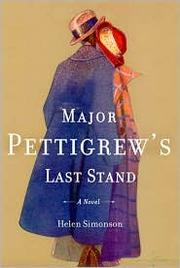
Major Pettigrew's Last Stand
2,957-word summary 13 min read 358 pages in the book
- First published
- 2010
- Publisher
- Random House
- Pages
- 358
- ISBN
- 9781400068937
Reading options
What's inside (8 sections)
I picked up Major Pettigrew's Last Stand because a friend kept describing it as a comfort read with teeth. That sounded contradictory enough to make me curious. I expected something light about village life in England. What I got was funnier and sadder than that, and more pointed about who gets to belong in a small place.
The book came out in 2010 from Random House, and the hardcover runs 358 pages. It is Helen Simonson's first novel. The setting is Edgecombe St. Mary, a small village in Sussex with a golf club, a church, a shop, and a long memory for how things are supposed to be done. The main character is Major Ernest Pettigrew, retired, sixty eight, a widower. His wife Nancy died six years before the story starts. He lives alone, keeps his routines, irons his shirts, reads Kipling, and tries to be courteous in a world that keeps rewarding people who are not.
The opening is wonderful. The Major gets a phone call early in the morning telling him his younger brother Bertie has died of a heart attack. He is upset and distracted. When the doorbell rings, he answers it wearing his wife's old housecoat without quite realizing it. On the step is Mrs. Jasmina Ali, the widow who runs the village shop. She has come about the newspaper money. She sees his face, understands at once, and makes tea. That small act sets the tone for everything that follows. Two people who have both lost a spouse recognize each other without making a speech about it.
Mrs. Ali is fifty eight, elegant, practical, and tired in a way she does not show to customers. Her husband Ahmed died about a year and a half earlier. She was born in Cambridge, which matters later when people keep treating her as a newcomer. She and the Major share a love of books. They can talk about literature without performing it. I liked that Simonson lets their early conversations stay ordinary. They discuss deliveries, funerals, umbrellas, small errands. Affection grows in the gaps.
Bertie's death and the Churchill guns
Bertie's death brings a family problem with it. Their father, Colonel Pettigrew, served in India around the time of Partition and was given a pair of Churchill shotguns by a local ruler. He left one gun to each son, with the clear wish that the pair would one day be reunited and passed down together. Now that Bertie is gone, the Major assumes the second gun will come to him.
His sister in law Marjorie has other ideas. She and her family see money. The Major's son Roger agrees with them. Roger thinks the sensible thing is to sell the pair and split the proceeds. The Major is horrified, partly from sentiment and partly from pride. He pictures taking the reunited pair out on shoots and having them admired for what they are. He also knows, if he is honest, that he likes owning something fine and well made.
This is where the book shows its edge. The guns are not only heirlooms. They stand for how the Major sees himself. He believes in duty, in keeping promises to the dead, in caring for objects that carry history. Roger believes in price. Their arguments about the guns are really arguments about what a family owes the past. I found myself siding with the Major while also thinking he was vain about the guns in a way he could not see yet. That blind spot pays off near the end.
Roger is a large presence. He works in finance in London, chases promotion, and talks about property and schools and connections as if those are the only serious topics. He has proposed to his American girlfriend Sandy and bought a weekend cottage near Rose Lodge, the Major's childhood home. Roger tells himself he wants to be closer to his father. In practice he misses Bertie's funeral when it suits him and treats village life as a backdrop for his own plans. Sandy is brash and chatty and focused on getting the cottage right. Some readers find her harshly drawn. I did at first too. Then I noticed Simonson is almost as hard on Roger and on several English characters, which evened it out for me.
Tea, books, and the village watchers
After Bertie's funeral, the Major keeps finding reasons to stop at Mrs. Ali's shop. Their talks turn to books they both love. She is well read and dryly funny. He is courtly without being stiff with her. There is a walk to the seaside town nearby where they meet a young mother named Amina and her small son George. That meeting seems casual. It returns later with weight.
Village life closes in around them. At the golf club the Major runs into Lord Dagenham, the local landowner, who is short of money and full of schemes. Dagenham is entertaining company with a developer named Frank Ferguson, an American who wants to buy land for housing and who also takes an interest in the Churchill guns. Ferguson talks loudly about investment and access and the future of the estate. The Major dislikes him on sight, though he cannot quite say whether it is snobbery or instinct.
The vicar's wife Daisy is planning the club's holiday events with Alma Shaw and a woman named Grace. They settle on a Mughal theme for a dinner and want Mrs. Ali's help. The Major is asked to approach her. He does, reluctantly, because he hates the idea of her being used as decoration. Mrs. Ali is polite but cautious. She has her own pressures. As a widow, she is expected by her husband's relatives to give up the shop to her nephew Abdul Wahid, move north, and live quietly with family. She wants to keep her independence and her work. Abdul Wahid is devout and serious and does not warm to the Major. Their conversations are awkward in a way that felt true to me. Two decent men with completely different frames for how a good life should look.
One detail I appreciated is how Simonson handles the Major's background. He was actually born in Lahore, where his father was stationed, while Mrs. Ali was born in Cambridge. Yet the village treats him as the natural local and her as the permanent outsider. Nobody says this outright in so many words. It comes through in small slights. Who gets asked for local history. Who gets thanked for fitting in. Who gets watched in the shop. The book is good at showing prejudice as habit rather than only as shouting.
Roger, Sandy, and Rose Lodge
The middle of the book spends a lot of time with Roger and Sandy and their cottage project. Roger wants the cottage to impress. Sandy wants it to feel like a home she can show off to friends from home. They bicker about builders, kitchens, paint, weekend guests. The Major visits and tries to be kind. He finds the scale of spending baffling and the talk of flipping property dispiriting. He also feels the distance between himself and his son as a physical thing. They eat together and run out of subjects quickly.
Roger reveals casual bigotry in these chapters. He asks leading questions about Abdul Wahid, wonders aloud about extremism, repeats gossip he has heard in London as if repetition makes it careful. The Major pushes back weakly at first, then more firmly. I wished he had pushed back harder earlier. That is part of the point, I think. The Major prides himself on manners, and manners can be a way of avoiding a necessary row.
Sandy, for her part, can be grabby and tactless. She talks about Roger as a catch, about London as the only place that counts, about village people as characters in her own story. There is a scene where she tries to charm the Major and misreads him completely. I laughed, then felt bad for laughing, because her confidence covers insecurity about being foreign herself. Simonson gives her a few sharp lines that show she notices more than Roger credits her for. Still, if you dislike novels where an American exists mainly to be loud, this stretch may test you. It tested me. I kept reading because Mrs. Ali's sections balanced it.
Rose Lodge hangs over these chapters. It was the family home where the Major grew up, full of his parents' books and rules and silences. Roger buying nearby is supposed to signal family continuity. To the Major it feels like replacement. He walks the lanes around his old house and remembers his mother and father with a mix of loyalty and hurt. Those passages are quiet and among the best in the book. They explain why the guns matter so much to him without excusing him.
The dinner that goes wrong
The Mughal dinner at the golf club is the set piece of the first two thirds, and Simonson stages it like a slow accident you can see coming. The Major, instead of asking Mrs. Ali to serve as a helper, invites her as his guest. That choice is noticed. People smile too hard. Daisy has written a short entertainment meant to honor the Major's father and British gallantry in India. It treats Partition violence as colorful background. Several of the waiters hired for the evening, men of Indian and Pakistani background, object. Words are exchanged. A scuffle breaks out in the dining room. Glass breaks. Someone shouts something ugly at Mrs. Ali.
Here the Major fails. He freezes when he should speak. He worries about making a scene in a room where a scene is already happening. Mrs. Ali absorbs insults meant to put her in her place and leaves with dignity. Afterward she tells the Major, in effect, that dignity is not the same as safety. She decides to leave the village for a time and stay with her husband's family. She will hand the shop over to Abdul Wahid. The Major is left with his club tie and his regrets.
I thought this was the bravest part of the book. It would have been easy to let the Major give a grand speech and win the room. Simonson does not allow it. He is a man of his generation and training, brave in some settings and helpless in others. His failure costs him. The chapters after the dinner are muted. He eats alone. He replays what he should have said. He tries to be practical, which for him means calling on Grace, a kind widow who likes him and who might make a suitable companion. Grace listens, then surprises him. She says she wants passion in her life, not arrangement, and advises him to go after Mrs. Ali if that is what he truly wants. It is a generous scene and it avoids making Grace a consolation prize.
A fair criticism belongs here. The dinner chapters lean on coincidence and on villagers acting at their worst on cue. Daisy is so relentlessly tactless that she sometimes feels built to carry the plot rather than like a person. Ferguson is broad. A few golf club men blur together. I did not mind much because the emotional logic held, but readers who want every secondary figure to feel rounded may find this section stagey.
Choosing passion over arrangement
Roger returns with news that shifts the Major. Sandy is pregnant, and Roger has pressed her to end the pregnancy because a child would slow his career. Sandy breaks the engagement and leaves. Roger reports this with self pity, as if he is the injured party. The Major is appalled. Whatever his own limits, he understands responsibility and tenderness better than his son does in that moment. He also sees, with uncomfortable clarity, that he has been advising himself the way Roger advises everyone. Be sensible. Do not risk money or standing. Marry suitability.
He decides he does not want suitability. He wants Mrs. Ali, with whom he can talk and laugh and disagree like an adult. The problem is that wanting is not enough. Mrs. Ali's family object to an Englishman, and a non Muslim, as a partner for her. Abdul Wahid is polite but firm. Older relatives are firmer. Mrs. Ali herself is torn between loyalty to family and desire for a life of her own choosing. She agrees, finally, to run away with the Major for a short break to think. They go to a remote fishing cottage and spend an idle day and night walking, cooking, reading, talking about Nancy and Ahmed without jealousy. It is chaste and romantic and the happiest passage in the novel.
I liked that Simonson does not make this trip solve everything. The Major knows he is in love. Mrs. Ali knows it too. They also know they must return for Abdul Wahid's wedding to Amina and face people they have disappointed. Love does not erase duty here. It competes with it. That felt honest about people their age, with grown children and dead spouses and family names to consider. The book respects that choosing happiness at sixty eight can feel as risky as at twenty eight, in a different key.
There is a smaller thread I should mention because it colors the Major's growth. He starts the book certain that keeping the guns together is the same as honoring his father. By this point he has begun to wonder whether his father, a distant and demanding man, deserves that much obedience. Roger's behavior has shown him what inheritance looks like when it becomes cash. Mrs. Ali has shown him what care looks like when it is freely given. The guns start to feel lighter in his hands, less like relics and more like things. That change is gradual and I believed it.
Abdul Wahid, Amina, and the cliff
The last part moves fast. Abdul Wahid has decided to marry Amina, the young mother met earlier, and give her son George a stable home. Amina once had a relationship with Abdul Wahid outside marriage, and George is their child. In Abdul Wahid's circle this history brings shame that marriage is supposed to mend. The Major, hoping to help and to stay near Mrs. Ali, invites Abdul Wahid to stay at his house while arrangements are made. Living together is strained and funny and sad. They argue about music, food, prayer times, books. They also develop a grudging respect. The Major finally learns Mrs. Ali's first name is Jasmina in a scene that is played for gentle comedy after so much formality.
The wedding gathering brings crisis. Abdul Wahid's great aunt, an elderly relative who sees Amina as defiant of tradition, attacks Amina with a knitting needle and wounds her. The assault is sudden and frightening after pages of talk. In the confusion Abdul Wahid is overwhelmed by shame and runs toward the cliffs. He talks of ending his life. The Major follows with one of the Churchill guns, thinking he might need to threaten or persuade. What follows on the cliff path is messy and physical. The Major tells Abdul Wahid he will have to shoot him to get past. Abdul Wahid says he could never shoot the Major. As he lowers the weapon it goes off and hits the Major in the leg. The Major nearly falls. Both men are sobbing and shouting by then.
I found this climax uneven. The attack with the needle and the chase to the cliff pile extreme events on top of a novel that had worked through social comedy. Some readers will accept the turn as proof that private shame can erupt in public harm. I half accepted it. The writing stays controlled and the emotions track, but the mechanics creak. A gun going off by accident on a cliff edge is a lot to ask a reader to absorb right after a stabbing at a wedding. Still, the aftermath redeems it for me. In hospital the Major learns from Roger that the gun carried to the cliff fell into the sea and is lost. He expects to feel grief. Instead he feels relief. He had been vain about the pair, he admits to himself, and vanity had made him confuse metal with love. He would rather have Jasmina.
The final pages give them a wedding. It is small, with awkward guests and imperfect speeches and real warmth. Roger attends, chastened and trying. Amina is recovering. Abdul Wahid is quieter, chastened too. Mrs. Ali, now openly Jasmina to the Major, wears no disguise of meekness. The Major wears his good suit and his good manners, but this time he uses them to include rather than to keep distance. I closed the book fond of them both and a little wrung out, which seems about right.
If you want a novel that moves quickly or that treats village England as purely charming, this is not that book. It is patient. It likes dinners, walks, committee meetings, drives to look at cottages. It asks you to sit with older people while they think. The reward is company you do not want to leave. My main cautions are the ones I noted along the way. A few villagers are caricatures, the middle sags around property talk, and the ending stacks calamities. Against that, the central pair is beautifully drawn, the humor often made me laugh aloud, and the moral pressure feels earned. For readers who enjoy books about manners under strain, this is a generous pick. For readers who need constant action, it will feel slow until the final fifty pages, when it stops feeling slow all at once.
FAQ
When was Major Pettigrew's Last Stand published?
It was first published in 2010 by Random House. The hardcover edition runs 358 pages.
Who are the main characters?
Major Ernest Pettigrew, a 68-year-old retired widower, and Mrs Jasmina Ali, a 58-year-old Pakistani shopkeeper widow. They bond over books and widowhood in Edgecombe St Mary.
Is Major Pettigrew's Last Stand part of a series?
No, it is a standalone novel. Helen Simonson later wrote The Summer Before the War and other books with different characters.
Similar books

Act Your Age, Eve Brown
Eve Brown crashes into a Lake District bed and breakfast, breaks the owner's arm, and talks her way into his kitchen. A grumpy-sunshine romance about work,…
2,474-word summary · 11 min read

At First Sight
Jeremy and Lexie are married and expecting a baby when anonymous emails tell him the child may not be his.
2,317-word summary · 10 min read

Delilah Green Doesn't Care
Delilah returns to Bright Falls to photograph her stepsister's wedding and falls for Claire, a bookstore owner and single mother, while a cruel bet threatens…
2,315-word summary · 10 min read
Olive, Again
Elizabeth Strout returns to Crosby, Maine, as Olive Kitteridge marries Jack Kennison, confronts her son, and faces old age, grief, and small-town judgment.
2,333-word summary · 10 min read
Garden Spells
Two sisters reunite in their family home in Bascom, North Carolina, where an apple tree shows anyone who eats from it the biggest event of their life.
2,030-word summary · 9 min read
True Colors
Three Grey sisters split over love and duty after their father judges them.
2,596-word summary · 12 min read
The Identicals
Twin sisters swap Nantucket and Martha Vineyard lives for a summer.
2,556-word summary · 11 min read
The Accidental Tourist
Grieving Macon writes travel guides for haters of travel, then Muriel intrudes.
2,252-word summary · 10 min read
Anne's House of Dreams
Newlyweds Anne and Gilbert start in a seaside house with kind neighbors.
2,465-word summary · 11 min read

The Shell Seekers
Elderly Penelope Keeling must decide the fate of her father's treasured painting while her three children press her to sell.
2,592-word summary · 12 min read

Heart of the Matter
Two Boston mothers collide after a burn injury puts a single mom in the orbit of another woman's surgeon husband.
2,585-word summary · 11 min read

The Winners
Two years on, Beartown opens a new rink, welcomes Maya and Benji home, and faces money fights and a gun at the ice.
2,366-word summary · 11 min read

When in Rome
A burnt-out pop star hides out in small-town Kentucky and falls for the grumpy pie-shop owner hiding her.
2,495-word summary · 11 min read

The Wish
A dying photographer recalls 1996 Ocracoke first love and an adoption choice.
2,176-word summary · 10 min read
The Switch
A burned-out consultant and her 79-year-old grandmother swap London and Yorkshire homes for two months, facing grief, dating apps, and village politics.
2,782-word summary · 12 min read

The Longest Ride
A stranded widower relives his marriage while a Wake Forest student and a bull rider test new love in North Carolina.
2,488-word summary · 11 min read

Practice Makes Perfect
A people pleaser takes dating lessons from a bodyguard learning to stay.
1,999-word summary · 9 min read
The Choice
A settled Beaufort veterinarian falls for his taken neighbor, then faces an impossible hospital decision eleven years later.
2,150-word summary · 10 min read

Final Offer
Cal Kane must spend the summer at Lake Wisteria to inherit, but his childhood ex Lana, now a mother, says the house belongs to her family.
2,379-word summary · 11 min read

Things We Left Behind
Lucian Rollins returns to Knockemout to bury his father's past and collides with librarian Sloane Walton.
2,777-word summary · 12 min read
The Storied Life of A.J. Fikry
A widowed bookseller on Alice Island adopts abandoned toddler Maya, rebuilds Island Books, and finds love with sales rep Amelia before illness closes in.
2,972-word summary · 13 min read
The Pact
After Emily Gold dies from a gunshot, her boyfriend Chris Harte says it was a suicide pact and faces trial for murder.
2,873-word summary · 13 min read
Safe Haven
Katie hides in Southport from a violent husband and falls for widower Alex.
2,480-word summary · 11 min read

Part of Your World
ER doctor Alexis Montgomery falls for carpenter Daniel Grant in Wakan while her surgeon family presses duty.
3,078-word summary · 14 min read

Just for the Summer
Emma and Justin date to break a matching curse, then face sudden guardianship and illness on Lake Minnetonka.
3,090-word summary · 14 min read

Things We Never Got Over
Naomi runs from her wedding to help her twin in Knockemout and clashes with Knox Morgan.
3,358-word summary · 15 min read

What Happened to Goodbye
Mclean has reinvented herself in four towns since her parents divorced. In Lakeview she uses her real name, and for the first time staying put becomes a choice.
2,796-word summary · 12 min read

The Japanese Lover
A Polish refugee and the son of a Japanese gardener fall in love in San Francisco in 1939, then keep the affair secret for nearly seventy years.
2,286-word summary · 10 min read

The Shadow Sister
Star D'Apliese steps out of her sister's shadow and follows a bookshop clue into the Edwardian life of Flora MacNichol, a woman who gave up love for duty.
2,260-word summary · 10 min read

Little Earthquakes
Four Philadelphia women meet during pregnancy and discover that new motherhood is nothing like the plan, while friendship becomes the thing that holds them…
1,997-word summary · 9 min read