
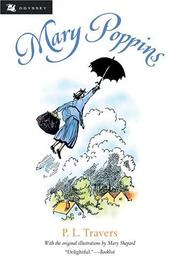
Mary Poppins
2,729-word summary 12 min read 206 pages in the book
- First published
- 1934
- Publisher
- Gerald Howe
- Pages
- 206
- ISBN
- 9780152017170
- Series
- Mary Poppins (#1)
Reading options
What's inside (7 sections)
I came to this one late because the film got there first. Like a lot of people my age I could hum the songs and picture the chalk drawings and the rooftop dance before I had read a single page. A friend kept telling me the books were odder and a bit sharper, so I finally picked up the first one. It was first published in 1934 by Gerald Howe in London, 206 pages in that first edition with drawings by Mary Shepard. The reading copy most people find now is the Harcourt paperback, 209 pages, ISBN 9780152017170. I read it across four nights, a chapter or two at a time, which turns out to suit it well.
What surprised me right away was how little it cares about explaining itself. There is no origin story for Mary. No prophecy. No lesson plan. She blows in, she does what she does, she leaves. Travers tells it plainly and lets the strange parts sit next to the washing and the shopping lists without apology. I liked that. I also found her harder to love than I expected, which I will get to.
This is the first book in the Mary Poppins series, so Jane and Michael are small, the twins John and Barbara are babies, and Cherry Tree Lane is still new to us. If you only know the musical, expect less singing and more snap.
The house on Cherry Tree Lane and the nanny who blows in
Number 17 Cherry Tree Lane is an ordinary London house with a garden and a lane full of neighbors who all know each other a little too well. Mr Banks works in the City. Mrs Banks is busy and tired and trying to keep a house with small children and too little help. Jane is older, sensible, eager to be good. Michael is younger, loud, quick to sulk. The twins are John and Barbara, still in the nursery stage. At the start their nanny, Katie Nanna, quits in a temper. Mrs Banks places an advertisement. Nobody answers it in any normal way.
Mary Poppins arrives on the East Wind. Travers makes a point of the wind. It bangs gates and rattles the house, and then there she is at the gate with a carpetbag and a parrot headed umbrella, coat buttoned, hat straight, boots neat. She measures the children with a tape measure. She sniffs at the house. She agrees to stay till the wind changes. That phrase comes back at the end, so remember it.
Her bag is the first magic. Jane and Michael watch her pull out an apron, boots, flannel, soap, and more, all from a bag that looked empty. She does not smile about it. She tells them to mind their manners. That mix never leaves. Mary is vain about her looks. She is cross when questioned. She denies doing anything magical the second after she does it. When Jane says something impossible happened, Mary says some version of, you should know better than to ask, or it was all in your head. As a reader I started to enjoy the denials as a running joke. As a parent reading it now, I can see how a child might find her thrilling and a little scary in the same afternoon.
The nursery routine matters more than I expected. Baths. Bedtime. Walks to the park. Shopping. Travers spends real pages on porridge and elbows off tables and please and thank you. The magic almost always starts inside an ordinary errand. A walk becomes a tea party on the ceiling. A shopping trip ends with stars. That is the engine of the book. You think you are reading about manners, and then the floor tilts.
Till the wind changes.
That is her contract, quoted here because everything turns on it. She does not promise a year or a term. She promises weather.
Days out, laughing gas, and the dogs next door
Mary gets a Thursday off, her day out, and her friend Bert comes into the story. In the books Bert is the Matchman when it rains and a pavement artist when it is fine, chalking pictures on the ground for pennies. He is chatty and kind in a way Mary is not. On their day out Mary and Bert step into one of his chalk pictures for tea, served as if by waiters, sitting on painted benches. Jane and Michael are not there for that one. We hear it secondhand, which annoyed me at first. I wanted to see it. Then I realized Travers does that on purpose. Mary has a life away from the children. She is not hired magic. She is a person who happens to be astonishing.
The Laughing Gas chapter was my favorite on this read. They go to visit Mr Wigg, or Uncle Albert Wigg, Mary's uncle. He is round and bald and jolly, and if his birthday falls on a Friday he fills with laughing gas and floats. Not a little hop. He bobs up to the ceiling with the furniture. The children laugh too and float up with him. They have tea in the air, passing cake and cups while trying not to tip. Mary stays mostly on the ground, disapproving, which makes it funnier. The way down is as simple as thinking sad thoughts. It is silly and physical and very well staged. You can see why the film kept a version of it.
Miss Lark's Andrew is quieter. Miss Lark lives next door and dotes on her pedigree dog Andrew, dressing him and fussing over him. There is also Willoughby, a mongrel from down the street. Jane and Michael assume Andrew is spoiled and Willoughby is rough. Mary translates what the dogs are actually saying, and the truth is nearly reversed. Andrew is miserable under all the coats and perfume and wants a plain dog life. Willoughby is generous. Without giving away every turn, the chapter ends with a swap that feels fair rather than preachy. I liked that Travers lets dogs speak in full sentences through Mary without making a big speech about kindness. She just shows two dogs asking for different things.
These three early episodes teach you how to read the rest. Something small goes wrong or someone wants something simple. Mary says little. The impossible arrives sideways. Then she denies it.
Bad Tuesday, the Red Cow, and the zoo at full moon
Bad Tuesday is the chapter people warn you about, rightly. Michael wakes in a foul mood. He kicks at everyone. He is rude to Ellen the maid and Mrs Brill the cook and Robertson Ay the houseboy, rude to Jane, rude to the twins. Mary does not scold him in the usual way. She takes out a compass and takes the children traveling. In the original 1934 text they visit far places and meet people described in ways that are now painful to read. Chinese, Inuit, African, and Native American figures were drawn as crude stereotypes in words and in Mary Shepard's first drawings.
Travers revised it twice, first in 1967 to remove slurs and mock speech, then in 1981 to replace the people with animals. A polar bear at the north, a macaw at the south, a panda at the east, a dolphin at the west. Most modern copies, including the Harcourt paperback cited here, use the animal version. I read the revised text. The plot still works. Michael's temper meets a world that does not bend to him, and the compass snaps him out of himself. But the history matters. If you read with kids, it is worth saying plainly that the first version was unfair and the author later changed it after complaints, including a period when some libraries pulled the book. That does not fix the original, but it explains what you hold in your hands.
The Dancing Cow slowed me down. Jane and Michael see a Red Cow walking down the lane looking for a star. Mary says she knew the cow through her mother. Then we get a story inside the story. The cow once caught a fallen star on her horn and could not stop dancing. She danced in fields and lanes until she was worn out. In desperation she jumped over the moon and shook the star loose. Now she misses the dancing and wants another star. It is sweet and strange, with nursery rhyme roots. It also stops the main plot cold for a fable. I admired parts of it and skimmed parts. Readers who love myths will like the detour. Readers who want the Banks plot to move may fidget.
Full Moon picks the pace back up. It is Mary's birthday, and her birthday falls on a full moon. That night the zoo holds a party for her. Jane and Michael sneak out and follow. The Hamadryad, a great cobra who calls himself a relative of Mary's, receives them. The cages hold people. The animals walk about free and stare in. Lions, tigers, bears, all polite and dressed for the occasion in their way. Mary is honored as an old friend. The children eat and watch and feel very small and very included at once. Travers writes crowds well here. You hear paws and voices and dishes. When the kids slip home, Mary the next morning says nothing happened. Of course.
Bird Woman, gingerbread stars, and Christmas shopping
The middle of the book settles into London details I loved. The Bird Woman sits on the steps of St Paul's Cathedral selling bags of crumbs for tuppence a bag. Jane and Michael go with Mary to feed the birds. There is no trick in this chapter, or only a small one. The point is attention. Travers slows down for pigeons landing on arms, for the old woman's hands, for coins counted. After so much floating and traveling, a quiet chapter about feeding birds feels earned. The phrase itself sticks.
Feed the birds, tuppence a bag.
Mrs Corry's shop is the opposite, loud with sugar. Mrs Corry is extremely old, maybe the oldest person in the world in the logic of the book, with huge daughters named Annie and Fannie who tower and giggle and help. Her fingers snap off as barley sugar and grow back. She sells gingerbread with gilt stars. Jane and Michael choose stars and eat paper and spice and wonder. On the way home they see lights going up in the sky. I will not spoil the link Travers draws between the shop and the night sky, but it is one of those images that stays after you close the book. A shop that sells stars is a lot to accept before lunch. Travers sells it by keeping Mrs Corry brisk and businesslike. No awe. Just trade.
Christmas Shopping brings Maia, one of the Pleiades, down to earth for gloves. Mary has new gloves she loves, soft and fine. Maia needs them for the cold among the stars. Mary gives them up after a pause that tells you how much it costs her. Vanity versus kindness is a real tension in Mary. She loves to look smart. She also looks after her star friend. Travers does not underline it. She lets Jane notice the pause. I thought about that pause for a day. It tells you more about Mary than any description.
There is also a twins chapter that many readers either love or skip. John and Barbara, still babies, understand the speech of starlings and sunlight and wind. They laugh with a starling on the windowsill. They know things adults have forgotten. Then, as they grow and learn words, they start to lose it. By the next birthday they are ordinary talkers. Travers is tender here about how fast that window closes. As a story it drifts. As a picture of how babies feel to watch, intent and far away, it rang true for me. My own kids had that look. Then school came.
West Wind and what to make of her
The last chapter is called West Wind. Spring comes. The wind shifts. Mary has said from the start that she stays till the wind changes, and now it has. She opens the umbrella and is lifted off, coat neat, bag in hand, unhurried. Jane and Michael run after her down the lane. The neighbors come out. Miss Lark. Admiral Boom in his ship shaped house. The Park Keeper. Even the sun seems to watch. Mary does not make a speech. She leaves a note for the children saying, in effect, that they will meet again. Then she is gone.
I felt the loss more than I expected. Not because Mary is warm. She is not. She is strict and often short. But she paid attention. She took Jane and Michael seriously enough to show them impossible things and then demand good manners right after. That combination is rare in children's books then and now. Most nannies in stories are either saints or jokes. Mary is neither. She is competent beyond reason and cross when crossed. Kids sense when an adult is acting. Mary never acts. She simply is.
That said, a fair reader should admit the drags. The book has almost no through plot. Twelve episodes start and stop. Characters like Mr Banks barely register. Mrs Banks is kind but thin on the page compared with the film version. Robertson Ay is lazy comic relief. Ellen sneezes. Mrs Brill scolds. If you need a villain or a quest, you will not find one. The tension is only whether the wind will change, and you know from page one that it will.
The sternness can also grate. Mary pinches, sniffs, and shuts down questions. Modern readers may flinch at a caregiver who is this cold, even in 1934 terms. I found myself reading her as a force rather than a model. Do not copy her tone. Copy her standards. Show up. Keep promises. Notice birds and cows and stars. Leave when it is time.
Who will like this now. Kids around seven to ten who enjoy short magical episodes and do not mind a sharp narrator often take to it. Read aloud, one chapter a night, it sings. The language is plain but old in spots, with farthings and prams and suet and references that need a quick gloss. Adults who love London books, nanny stories, or myth tucked into shopping trips will find plenty. Readers who want the film's warmth or a big arc may feel cool toward it. The film merged characters and softened edges. Bert in the film is a mix of the Matchman and the Sweep with songs and advice. In the book he is smaller, kinder, less central. Uncle Albert in the film is Mary's uncle too, but the book's tea on the ceiling belongs to Mr Wigg in the same spirit with less clowning. Miss Andrew, the Holy Terror from later books, is not in this one, so do not wait for her.
A note on text. Buy a modern copy and you get the revised Bad Tuesday with animals at the compass points. Some older secondhand copies still have the earlier wording and drawings. Libraries note this in records. If you care, check the copyright page for revised text. I prefer the revised version for reading with kids, with a short honest note about why it was changed.
I closed the book thinking about small magics more than big ones. Tea in the air. Crumbs for birds. Stars on gingerbread. Gloves given to a star. A cow looking for another dance. None of these save the world. All of them change how Jane and Michael see their street. That feels close to how childhood actually widens. Not by one great adventure, but by a dozen afternoons when an adult says, look properly, and then refuses to explain what you saw.
If you try it, try my method. One chapter a night. No skipping to the end. Let Mary be cross. Let the twins babble. Let the cow wander. When the West Wind comes, you will be a little annoyed at Travers for not giving you more goodbye. Then you will remember the note. She says they will meet again. There are more books, and the wind always turns.
FAQ
When was Mary Poppins published?
It was first published in 1934 by Gerald Howe in London. The first edition runs 206 pages and the Harcourt reading edition cited here runs 209 pages with ISBN 9780152017170.
Is Mary Poppins part of a series?
Yes. This is book 1 in the Mary Poppins series, followed by Mary Poppins Comes Back in 1935. Later books often revisit earlier visits rather than continuing in a straight line.
Is the book like the Disney film?
Partly. The film keeps the ceiling tea, the Bird Woman, and Cherry Tree Lane but softens Mary and merges Bert with the Sweep. The book is more episodic, and Mary is sterner and quick to deny her magic.
Similar books
More from Mary Poppins first, then related titles.
The Silver Chair
Eustace and Jill retold: four signs, a lost prince, Puddleglum the Marsh-wiggle, giants at Harfang, and the Lady below.
2,940-word summary · 13 min read
The Witches
A boy and his grandmother face the Grand High Witch's plan to turn England's children into mice.
2,738-word summary · 12 min read
The Wonderful Wizard of Oz
Dorothy is carried to Oz by a cyclone and walks the yellow brick road with Scarecrow, Tin Woodman, and Lion.
3,297-word summary · 15 min read
The Lion, the Witch and the Wardrobe
C. S. Lewis's Narnia opener retold: four Pevensies, the White Witch's winter, Aslan's sacrifice, and the crowning at Cair Paravel.
2,502-word summary · 11 min read

The Field Guide
Three siblings move into a creepy Maine estate, anger a brownie, and find a forbidden guide to the fairy world in the first Spiderwick book.
2,033-word summary · 9 min read
The Sword of Shannara
A young half-Elf and a company of companions set out to recover a magic sword before the Warlock Lord destroys the Four Lands.
2,474-word summary · 11 min read
The Borrowers
A family of tiny people live under the floorboards of an English house, borrowing what they need until a lonely boy and a suspicious housekeeper change…
2,164-word summary · 10 min read
The Stonekeeper
After their father's death, Emily and Navin chase a monster into a hidden world to save their mother, and Emily's great-grandfather's amulet offers power at a…
2,753-word summary · 12 min read
The Indian in the Cupboard
Omri learns a key turns plastic Little Bear into a live Iroquois man.
2,228-word summary · 10 min read
The Complete Fairy Tales
Mermaids, snow queens and tin soldiers in the full Andersen collection.
2,414-word summary · 11 min read
The Last Unicorn
A unicorn learns she may be the last of her kind and sets out to find the others, with a failed magician and a tired woman at her side.
2,245-word summary · 10 min read
Charlie and the Great Glass Elevator
Charlie and Wonka overshoot Earth in the glass elevator, meet alien Knids, then risk age pills and Minusland.
2,514-word summary · 11 min read
Magyk
A baby found in snow, a lost seventh son, and a run for the Marram Marshes as Marcia Overstrand shields two children from DomDaniel.
2,604-word summary · 12 min read
The Tombs of Atuan
Priestess Arha guards dark Tombs until wizard Ged comes to steal back ring.
2,043-word summary · 9 min read
Through the Looking-Glass
Alice steps through the mirror into a chessboard world of talking flowers, twins, Humpty Dumpty and quarrelsome queens.
2,610-word summary · 12 min read
The Neverending Story
Bastian steals a book about Fantastica dying and learns he must name and wish to save it.
1,941-word summary · 9 min read
Sabriel
A girl who grew up outside the magic kingdom must take up her father's bells and sword to stop the dead from rising.
2,021-word summary · 9 min read
A Gathering of Shadows
Kell and Lila reunite for magical games in Red London while a new power hunts Antari blood.
2,055-word summary · 9 min read
Tuck Everlasting
Winnie Foster meets the immortal Tuck family in the woods and must decide whether to drink from their spring.
2,750-word summary · 12 min read
The Phantom Tollbooth
A bored boy drives a toy car through a magic tollbooth into the Kingdom of Wisdom and learns to care about words, numbers and time.
2,765-word summary · 12 min read
The Last Battle
Lewis ends Narnia: Shift ape false Aslan, King Tirian last stand, Jill and Eustace at Stable Hill, and a morning beyond the world.
3,037-word summary · 13 min read
A Little Princess
Rich Sara Crewe loses her father and fortune at boarding school, survives the attic on stories and kindness, and is rescued from next door.
2,867-word summary · 13 min read
The Horse and His Boy
Shasta and Bree flee Calormen to Narnia with Aravis and Hwin.
2,594-word summary · 12 min read
Peter Pan
Wendy, John and Michael fly to Neverland with Peter, face Hook, and learn what growing up costs.
2,502-word summary · 11 min read
Howl's Moving Castle
Cursed old by the Witch of the Waste, hatmaker Sophie Hatter talks her way into wizard Howl's moving castle and bargains with fire demon Calcifer to break the…
2,363-word summary · 11 min read
A Darker Shade of Magic
Antari Kell Maresh, a blood magician who travels between Londons, meets thief Delilah Bard after she steals a stone of Black London magic that should have…
2,541-word summary · 11 min read
The Voyage of the Dawn Treader
Lewis sends Lucy, Edmund and Eustace aboard Caspian's Dawn Treader to find seven lost lords, past dragon gold, dark dreams and the world's edge.
2,330-word summary · 10 min read
The BFG
Orphan Sophie is taken by the Big Friendly Giant, who blows happy dreams and eats vile snozzcumbers, and helps her stop nine man eating giants.
2,812-word summary · 12 min read
Prince Caspian
The Pevensies return to ruins at Cair Paravel and help Caspian take back Narnia from Miraz.
2,304-word summary · 10 min read
James and the Giant Peach
Lonely James escapes two cruel aunts inside a giant peach with huge insect friends, rolling to the sea and floating on gulls to New York City.
2,384-word summary · 11 min read